

NEMT Entrepreneur provides expert insights, strategies, and resources to help non-emergency medical transportation professionals grow their businesses. Get industry-leading advice to succeed in NEMT.
Featured articles
Managing driver credentials manually is risky, time-consuming, and costly. Missed renewals can lead to fines up to $50,000, denied claims, and service interruptions. For NEMT providers, compliance is non-negotiable - drivers need valid licenses, medical cards, insurance, and certifications.
Manual systems like spreadsheets often fail, creating errors and communication gaps that disrupt operations. Automation solves this by sending timely reminders, centralizing records, and blocking non-compliant drivers from assignments. It reduces risks, saves time, and ensures revenue by preventing denied reimbursements.
Switching to automated tools isn’t just practical - it’s necessary to stay compliant and efficient in the NEMT industry.
The Risks of Manual Credential Tracking
The Cost of Manual Driver Credential Tracking in NEMT
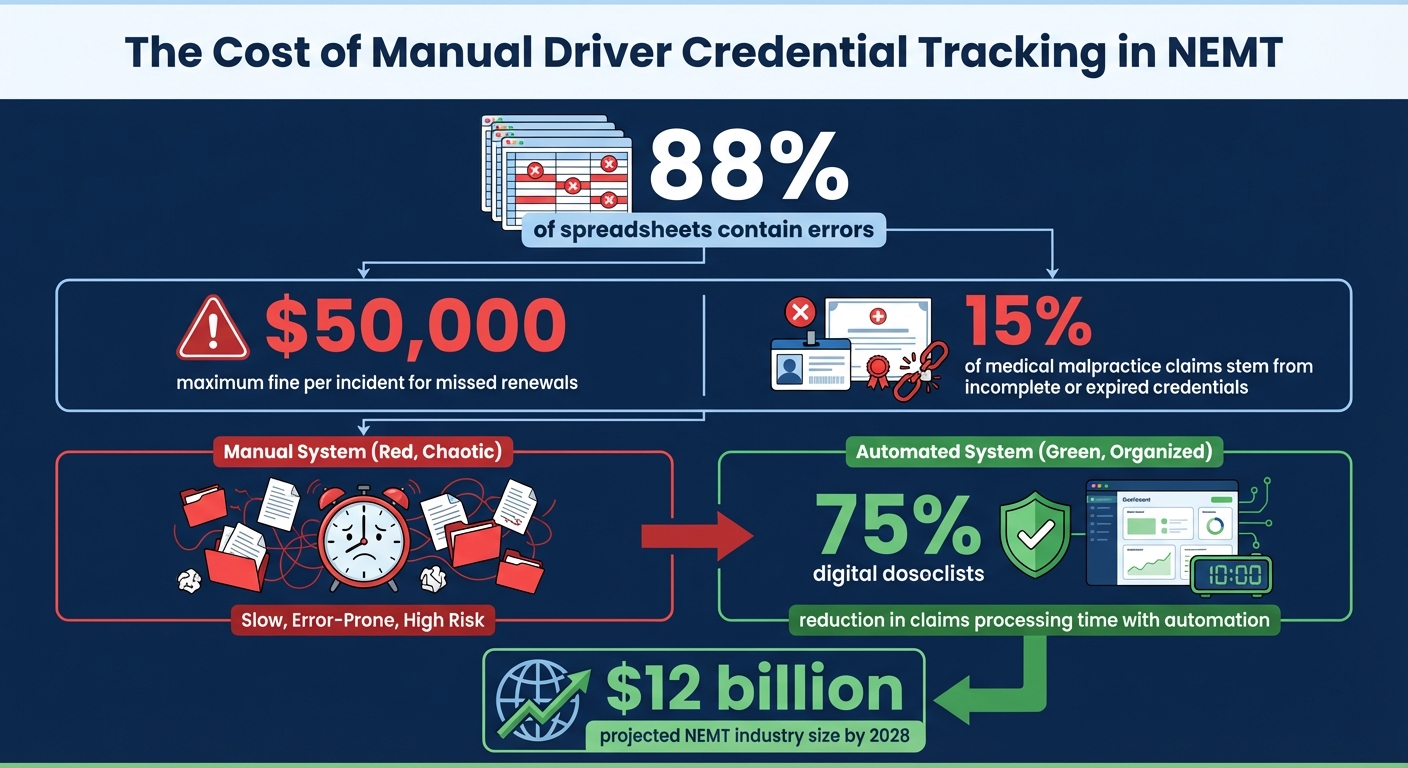
Relying on spreadsheets or paper files to keep track of driver credentials is a recipe for potential disaster. Studies reveal that 88% of spreadsheets contain errors. In the world of NEMT (Non-Emergency Medical Transportation), where drivers must maintain multiple credentials - like CDLs, DOT medical cards, drug test certifications, insurance documents, and CPR certificates - manual tracking quickly becomes a juggling act that’s prone to mistakes.
Even one missed credential renewal can have serious consequences. Manual systems don’t offer proactive alerts, making it easy for deadlines to slip through the cracks. The fallout? Fines can reach as high as $50,000 per incident. And it’s not just about the money - around 15% of medical malpractice claims stem from providers with incomplete or expired credentials.
Compliance Failures and Their Consequences
One of the biggest risks of missed renewals is compliance failure. State or federal audits can lead to more than just hefty fines if expired certifications are found. Your operational license could be suspended, bringing your services to a grinding halt until compliance is restored. On top of that, Medicaid and managed care organizations won’t reimburse trips conducted by non-compliant drivers, cutting into your revenue and disrupting cash flow.
The stakes get even higher when dealing with healthcare facilities and brokers. They often require immediate proof that your drivers meet all safety standards. If you can’t provide up-to-date documentation, you risk losing valuable contracts that took significant effort to secure. Daniela Oliveira, Head of Marketing at ExpirationReminder.com, emphasizes this point:
"A single missed renewal can halt services, trigger fines of up to $50,000 per incident and - most critically - put patient safety at risk."
Administrative Burdens of Manual Processes
Manual credential tracking doesn’t just increase risk - it’s also a massive drain on your team’s time and energy. Tasks that should take a few minutes can stretch into hours when staff have to sift through disorganized files, cross-check multiple spreadsheets, and send individual reminders to drivers. Johnny Mullins, Managing Partner at Ultralus, shares how automation transformed their operations:
"Tasks that used to take up time, like verifying medical providers or entering driver's license details and expiration dates, are now handled automatically."
Manual systems also create frustrating communication breakdowns between departments. For example, your dispatch team might assign a driver to a trip without realizing their medical card has expired because HR hasn’t updated the shared spreadsheet. These gaps lead to last-minute cancellations, unhappy patients, and strained relationships with healthcare partners. The constant firefighting leaves staff stuck in reactive mode, scrambling to fix problems instead of focusing on preventing them. It’s a cycle that highlights why automated solutions are no longer just a convenience - they’re a necessity.
How Automation Solves Credential Management Problems
Automation steps in to replace the headaches of manual credential tracking with smart systems that anticipate and address issues before they arise. Instead of relying on staff to remember renewal dates or comb through spreadsheets, automated platforms handle renewals and updates seamlessly. They send alerts, update statuses, and keep records organized. This shift from reactive problem-solving to proactive management is transforming how NEMT providers tackle compliance. Let’s explore how automated alerts, centralized storage, and real-time monitoring make this process smoother.
Automated Expiration Alerts and Notifications
Modern automation tools send reminders through both email and SMS at key intervals - usually 60, 30, and 7 days before a credential expires. These alerts are sent to both drivers and managers, ensuring no one is left in the dark. Jonathan Ripplinger, President of JR Transportation, highlights the difference automation has made:
"Avatar has been a game changer for JR Transportation. It automated our driver files and streamlined the hiring process. It keeps us on top of expiring files and easy to stay up to date and compliant."
Once a credential expires, these systems automatically update the driver’s status to "inactive". This prevents non-compliant drivers from being assigned trips, reducing the risk of denied reimbursements and protecting revenue.
Centralized Credential Storage and Tracking
Automation doesn’t stop at notifications - it also centralizes all credential data. Digital platforms create a single, searchable hub for driver and vehicle documentation, including licenses, medical certificates, drug test results, insurance policies, and training records. This eliminates the hassle of digging through filing cabinets or outdated spreadsheets.
Many advanced systems even use AI to extract data from uploaded documents automatically. This reduces manual entry errors and speeds up the compliance process. Lisa Johnson, Safety Director at Integrated Industries Corporation, shares her experience:
"We moved to Motive's Driver Qualification from JJ Keller because it was easier to use and way more reliable. It was very quick and simple to set up our documents, and getting insights into upcoming expirations takes just a few seconds."
Some platforms also include self-service portals, allowing drivers to log in, check their compliance status, and upload renewal documents directly. This gives drivers more responsibility while providing management with clear oversight.
Real-Time Compliance Monitoring
By integrating with scheduling and dispatch systems, automation ensures that only active, approved drivers are assigned to trips. The moment a credential expires, the system blocks that driver from the schedule, preventing compliance violations and potential revenue losses. This integration is essential for meeting funder contract requirements.
Dashboards provide a clear, real-time view of your entire fleet, showing which credentials are current, nearing expiration, or already expired. Compliance categories can be customized to meet state, federal, or funder-specific requirements. When auditors or brokers request documentation, everything is ready and accessible instantly, eliminating last-minute document scrambles. Adam Kinsler from Bellwether Transportation, Inc. sums it up perfectly:
"Automating the reminders for our driver record renewals freed up our team member to focus on driver retention."
The Financial and Efficiency Benefits of Automation
Automation simplifies compliance, saves time on administrative tasks, and secures revenue. Manual tracking often leads to compliance issues and service disruptions, but automation addresses these challenges while reducing costs. This impact is particularly evident in three key areas: minimizing service interruptions, cutting down on paperwork, and protecting revenue streams.
Reducing Compliance Risks and Service Interruptions
When credentials expire unexpectedly, the fallout can be severe - fines, legal troubles, and even license revocations can result from a single missed renewal. Operational downtime caused by expired credentials can pull drivers and vehicles out of service, disrupt schedules, and leave passengers stranded. Automated alerts eliminate these risks by ensuring that licenses, certifications, and the $1.5 million liability insurance required by most state Medicaid programs stay up to date. Additionally, when auditors or brokers request documentation, automated systems provide it instantly, showcasing your adherence to safety standards. This level of preparedness not only ensures compliance but also contributes to financial stability.
Improving Administrative Efficiency
Manual tracking is a time drain, pulling staff away from more impactful tasks like improving driver retention or enhancing service quality. Automation steps in to handle repetitive tasks, allowing teams to focus on activities that drive growth. Johnny Mullins, Managing Partner at Ultralus, highlights this advantage:
"Tasks that used to take up time, like verifying medical providers or entering driver's license details and expiration dates, are now handled automatically."
Cheryl Kastrenakes, Executive Director at Greater Mercer Transportation Management Association, echoes this sentiment:
"NovusMED's reporting capabilities provides us the data we need to accurately invoice. The report integrates with our invoicing program – this has saved us a huge amount of time."
Automation replaces cumbersome spreadsheets with real-time dashboards, enabling compliance reports to be generated in seconds. This shift not only saves time but also ensures greater accuracy and accessibility.
Protecting Revenue and Reimbursement
Automation does more than improve efficiency - it also safeguards your income. One of the fastest ways to lose revenue in the Non-Emergency Medical Transportation (NEMT) industry is through denied claims. For instance, if a driver with expired credentials completes a trip, the reimbursement for that trip is at risk. Automated systems prevent this by marking drivers as inactive the moment their credentials expire, ensuring only compliant drivers are dispatched. This approach is essential for maintaining accurate reimbursements and simplifying audits.
Automated billing further enhances revenue security by reducing claims processing time by up to 75%, which accelerates payments. In an industry expected to grow to $12 billion annually by 2028, protecting every dollar is crucial. Evan Anderson, COO at Anderson Coach & Travel, sums up the benefits:
"Avatar has reduced our administrative burden, improved our hiring efficiency, and ensured we never miss a compliance deadline."
sbb-itb-cef70f4
Implementing Automation: What NEMT Providers Should Consider
To truly capitalize on automation's potential, selecting the right platform is essential. The system you choose needs to align with your state's regulations and fit seamlessly into your current operations. The difference between a smooth transition and a costly misstep often lies in identifying tools that genuinely address your challenges instead of opting for features that don't add real value.
Prioritizing Prevention Over Remediation
Automation can eliminate manual errors, but it’s equally important to ensure the system aligns with both your operational and regulatory needs. A strong credential management system doesn’t just flag issues after they happen - it prevents them from occurring in the first place. For example, instead of notifying you only after a driver’s license or certification expires, look for platforms that send reminders well in advance. This allows drivers enough time to schedule physical exams or renew certifications without interrupting service. Ideally, your system should let you set custom lead times tailored to your specific requirements. For instance, if your state mandates a medical exam before renewal, configure alerts early enough to account for potential scheduling delays.
Evaluating Platform Features and Reliability
When choosing software, focus on features that enhance your automation strategy. Integration and customization are key. The system should work seamlessly with your scheduling software, ensuring non-compliant drivers are automatically blocked from being assigned trips. Advanced platforms often incorporate artificial intelligence - make sure these AI capabilities fit your documentation needs. For example, AI-driven tools can handle tasks like extracting and verifying data from medical records or tracking license expiration dates.
Johnny Mullins, Managing Partner at Ultralus, emphasizes the importance of such features:
"Avatar has revolutionized how we handle driver compliance. Their AI actually does the work for us. Tasks that used to take up time, like verifying medical providers or entering driver's license details and expiration dates, are now handled automatically."
The system should also generate detailed compliance reports and audit trails to simplify inspections by state regulators or brokers. Cloud-based platforms are particularly useful, as they update records in real time and ensure access during audits. For instance, in 2025, WellTrans adopted Momentm's NovusMED software suite and achieved full operational compliance within 90 days, scaling their operations statewide.
Finally, ensure the platform is adaptable. It should allow you to customize credential categories to meet state, federal, and funding-specific requirements. What works in one state might not meet the standards in another, so flexibility is crucial. Your automation tool should adapt to your regulatory landscape, not the other way around.
Conclusion
Trying to manually manage driver credentials is a gamble no NEMT provider can afford to take. The fallout - steep fines, denied claims, inactive drivers, and service disruptions - can hit both your finances and reputation hard. Automation takes the uncertainty and stress out of the equation by offering automated alerts, centralized data, and real-time tracking.
The stakes are high. These risks often lead to major operational and financial headaches. Automated systems, however, can cut billing time by 75% and free up administrative staff from the time-consuming burden of manual tracking. They also safeguard your revenue by ensuring that only compliant drivers are assigned trips, avoiding costly denied claims from brokers or managed care organizations.
But it’s not just about saving time. Automation brings peace of mind. It sends reminders 30, 60, or 90 days before credentials expire and automatically prevents non-compliant drivers from being assigned trips. When it’s time for an audit, all your records are ready and waiting - no scrambling required.
Switching from manual to automated credential management isn’t just about meeting regulations; it’s about creating a more efficient and reliable operation. By investing in the right platform, you’ll ensure smooth operations, boost administrative efficiency, and stay focused on your core goal: providing safe, dependable transportation. Automation isn’t just a tool - it’s a smarter way forward.
The real question isn’t whether automation is worth it - it’s whether you can afford to wait any longer to make the switch.
FAQs
How can automation help NEMT providers stay compliant with driver credential requirements?
Automation streamlines compliance for NEMT providers by taking the hassle out of managing driver and vehicle credentials. With automated systems, providers receive timely alerts before licenses, certifications, or inspections are set to expire. This allows them to address renewals proactively, avoiding penalties or disruptions in service. It also eliminates the need for manual tracking, which is often time-consuming and prone to mistakes.
On top of that, these tools centralize credential documentation, making it easily accessible during audits or inspections. By ensuring records are always current and that only authorized drivers and vehicles are on the road, providers can adhere to federal and state regulations more effectively. This not only simplifies compliance but also cuts down on administrative work, boosting overall efficiency.
How does automating driver credential tracking save money?
Automating the process of tracking driver credentials can lead to significant cost savings by cutting down on manual administrative tasks and reducing the time spent managing renewals. This efficiency helps prevent delays in credential verification, which can otherwise disrupt operations and result in expensive downtime.
On top of that, automation reduces the chances of non-compliance penalties by ensuring all credentials remain current. Staying compliant not only helps avoid fines but also ensures smoother reimbursement processes, keeping your business on track both financially and operationally.
How can automation help prevent disruptions caused by expired driver credentials in NEMT operations?
Automation plays a key role in keeping NEMT operations running smoothly by monitoring driver credential expiration dates and sending timely reminders. These notifications help providers stay on top of regulatory requirements, minimizing the chances of legal issues or operational hiccups.
With this process automated, NEMT providers can concentrate on delivering dependable services without the stress of tracking deadlines or scrambling to handle last-minute renewals. This method streamlines operations and lowers the risk of unexpected service disruptions.


