

NEMT Entrepreneur provides expert insights, strategies, and resources to help non-emergency medical transportation professionals grow their businesses. Get industry-leading advice to succeed in NEMT.
Featured articles
Running a Non-Emergency Medical Transportation (NEMT) business comes with risks. Missing trip details - like signatures or timestamps - can lead to denied claims, lost revenue, and even fraud accusations. Paper logs often fail to meet compliance standards, leaving providers vulnerable.
Digital trip logs solve this by automating records with GPS tracking, electronic signatures, and real-time data, creating tamper-proof evidence for audits and disputes. Providers using these systems report fewer denials, faster payments, and improved cash flow.
Key Takeaways:
- Common issues with paper logs: Missing timestamps, inflated mileage, and unsigned manifests lead to claim denials and fines.
- Digital benefits: GPS-verified routes, automated timestamps, and digital signatures prevent errors and ensure compliance.
- Proven results: Metro Medical Transport reduced claim denials from 23% to 6%, saving $150,000 monthly by adopting digital systems.
Switching to digital logs isn’t just about efficiency - it’s about protecting your business from legal and financial risks.
Why Trip Documentation Matters for Legal Protection
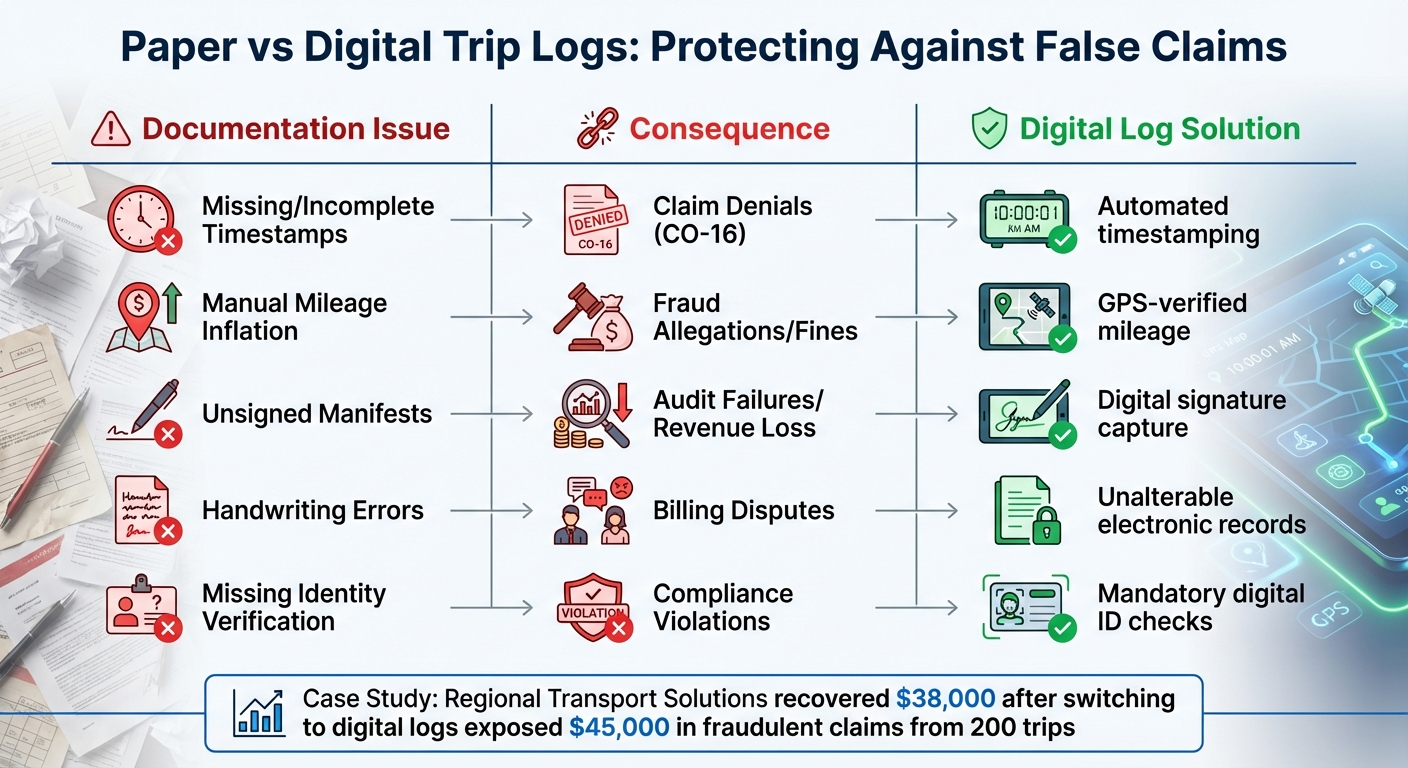
Paper vs Digital Trip Logs: Documentation Issues and Solutions for NEMT Providers
Trip records are your shield in disputes - they confirm services provided or reveal liability. When a payer questions whether a trip actually occurred, your documentation becomes the critical evidence standing between you and a denied claim - or, in extreme cases, accusations of fraud. This legal safeguard is the backbone of the entire documentation process.
Failing to maintain compliance or keeping incomplete records can lead to fines, criminal charges, and even exclusion from Medicare and Medicaid. Without solid proof, you could face allegations of billing for trips that never happened, inflating mileage, or submitting duplicate charges. Digital trip logs offer secure, unchangeable records with GPS data, digital signatures, and photographic evidence that can serve as undeniable proof during audits or legal challenges.
Common Documentation Problems and Their Consequences
Manual documentation is fraught with risks. Issues like missing timestamps, unsigned manifests, incomplete trip details, and illegible handwriting are common pitfalls that leave providers vulnerable to disputes over false claims. These errors can severely impact revenue.
Take the case of Regional Transport Solutions in 2024. The company discovered that two drivers had falsified mileage and documentation for about 200 trips over six months using manual logs. This fraud amounted to $45,000 in false claims. After switching to automated GPS tracking and digital signature capture, they managed to recover $38,000 through payer negotiations and corrected claims. The automated system exposed what manual processes had missed - systematic overbilling that had gone undetected for months.
Paper systems simply can't meet today's compliance demands. Handwritten logs are easy to alter, timestamps can be fabricated, and signatures can be forged. Auditors are looking for records that are consistent and verifiable. If a driver jots down a pickup time from memory hours after the trip, that's not evidence - it’s a liability.
| Documentation Issue | Consequence | Digital Log Solution |
|---|---|---|
| Missing/Incomplete Timestamps | Claim Denials (CO-16) | Automated timestamping |
| Manual Mileage Inflation | Fraud Allegations/Fines | GPS-verified mileage |
| Unsigned Manifests | Audit Failures/Revenue Loss | Digital signature capture |
| Handwriting Errors | Billing Disputes | Unalterable electronic records |
| Missing Identity Verification | Compliance Violations | Mandatory digital ID checks |
Digital logs eliminate these vulnerabilities by ensuring accuracy and accountability through automation.
How Digital Logs Protect You Legally
Beyond operational benefits, digital logs provide strong legal protection. These systems don't just verify trips - they create a detailed, automated record of every step. Timestamps for pickups, wait times, and deliveries are automatically recorded, eliminating human error. If a payer questions a trip, you can provide exact GPS coordinates showing your vehicle was at the right place at the right time.
Digital logs also establish permanent, tamper-proof audit trails that track every system access and modification. If someone attempts to alter a record, the system flags it. This transparency is vital when defending against fraud investigations or regulatory audits. Instead of relying on verbal assurances, you can present hard data that’s impossible to dispute.
State-specific regulations add another layer of complexity. In Colorado, for instance, trips over 25 miles require a "Verification Form for Transportation Services More Than 25 Miles", along with a justification from the treating provider. Digital systems can automatically prompt drivers to collect this documentation when the trip distance exceeds the threshold, ensuring you have the necessary evidence to support claims during disputes.
What Makes a Good Digital Trip Log System
To take full advantage of legal protections, a digital trip log system must meet specific criteria. It should capture critical data points, automate accuracy checks, and provide real-time verification to safeguard against liability. The right features differentiate systems that simply digitize paperwork from those that significantly reduce claim denials.
Here’s what to look for when evaluating digital trip log solutions.
Required Data Points in Digital Logs
A strong system ensures that every piece of required information is automatically recorded to confirm a trip occurred and justify billing. For starters, member identification must include the full name and a unique identifier, such as a Health First Colorado ID. Additionally, it should verify that the driver confirmed the member's identity before transport. This step helps prevent fraudulent billing for the wrong person.
Location data must go beyond listing addresses. The system should log complete pickup and destination addresses along with GPS coordinates for both points. Timestamps should reflect actual pickup and drop-off times, wait periods, and total transport duration - no room for estimates entered later. These details are crucial for justifying wait time charges and validating service duration in case of disputes.
For personnel verification, the system needs to document the vehicle ID or license plate and the driver's name for each trip. Service verification is equally important, requiring digital signatures from the member, escort, or medical facility staff to provide undeniable proof that the trip occurred. Lastly, the system must capture the trip purpose and medical necessity rationale, as well as any required prior authorization numbers, to meet the "medically necessary" requirement for reimbursement.
| Data Category | Essential Data Points | Purpose for Liability Protection |
|---|---|---|
| Member | Name, ID, Identity Verification | Prevents billing for the wrong individual. |
| Location | Pickup/Drop-off Addresses & GPS Coordinates | Confirms the trip occurred at the correct locations. |
| Time | Actual Pickup/Drop-off Timestamps | Justifies wait time charges and service duration. |
| Personnel | Driver Name & Vehicle ID | Ensures only approved drivers and vehicles are used. |
| Verification | Digital Signatures (Member/Facility) | Provides undeniable proof of service delivery. |
| Compliance | Trip Purpose & Medical Necessity Rationale | Supports reimbursement under "medically necessary" rules. |
By capturing detailed and accurate location data, the system reduces the likelihood of documentation disputes.
GPS and Real-Time Tracking for Accurate Records
GPS technology transforms trip logs into reliable legal records. Real-time tracking allows the system to recreate the actual route taken and calculate precise mileage - essential for Medicaid and insurance reimbursements. This functionality eliminates issues like manual mileage inflation, which cost Regional Transport Solutions $45,000 in fraudulent claims over 200 trips.
"GPS tracking data automatically validates trip details, including pickup and delivery locations, route efficiency, and service times... [and] prevents unauthorized route deviations or mileage inflation." – NEMT Platform
The system should analyze actual route data against pre-approved routes, flagging discrepancies and alerting management to unauthorized stops or deviations that could signal fraud or safety concerns. By syncing GPS data with dispatch and billing modules in real time, the system ensures all records remain consistent and up-to-date. Electronic timestamps paired with GPS coordinates create a detailed and accurate trip record. When combined with digital signatures, this data provides the legal proof needed to counter challenges about whether a trip occurred.
Automated Error Detection and Alerts
Preventing errors before claims are submitted is the most effective way to avoid denials. Automated systems validate trip data immediately after completion, identifying missing documentation or incorrect coding. This proactive approach helps avoid the costly cycle of resubmitting claims.
For instance, the system can flag incomplete data - like unsigned manifests or incorrect vehicle IDs - so staff can address issues promptly instead of discovering them weeks later after a claim is denied. Advanced billing software also checks reference codes, such as HCPCS codes, to ensure they align with the service provided - whether it’s for ambulatory or wheelchair transportation. This is especially critical as new coding policies, effective July 1, 2025, require HCPCS S0215 for billing ambulatory/mobility vehicle mileage. Additionally, submission reminders ensure staff meet strict filing deadlines, reducing the risk of denials for late submissions.
Automated monitoring also detects unusual patterns, such as extended trip durations, unexpected routes, or mileage inconsistencies, and notifies management for immediate review. For example, this feature helped Regional Transport Solutions uncover systematic overbilling that manual reviews missed for months. Correcting these errors allowed the company to recover $38,000 through revised claims. These tools not only streamline operations but also help maintain compliance.
"Any missing or inaccurate trip data can lead to claims rejections, delayed payments, or even penalties for non-compliance." – NextBillion.ai
How Digital Trip Logs Prevent Common Claim Denials
Claim denials can be a major headache, draining revenue and piling on administrative work. Digital trip logs tackle these issues head-on by addressing the root causes of common denials. Here's a closer look at how they resolve three frequent rejection triggers, each tied to a specific denial code, ensuring claims are accurate and complete.
Fixing CO-16: Missing or Incomplete Information
CO-16 denials usually happen when claims lack essential details, like member IDs, diagnosis codes, or proof of service. Digital trip logs solve this by making sure every required field is completed at the point of service. Mobile apps guide drivers step-by-step, ensuring they capture crucial details like pickup times, wait periods, and signatures. The system won’t allow a trip to close out until all fields are filled. It also logs GPS coordinates and timestamps automatically, while real-time checks verify member eligibility and link prior authorization numbers to the trip record.
These measures significantly improve claim acceptance rates by eliminating gaps in documentation.
Preventing CO-18: Duplicate Claims
Duplicate claims are another common issue, often caused by billing the same trip twice. Digital systems prevent this by assigning a unique trip identifier to every authorized service. They also apply correct modifiers to same-day trips, ensuring each one is tracked separately. Real-time validation scans for identical member IDs, dates, and service codes before submission, and GPS data confirms trips occurred at different times and places.
This process eliminates confusion and ensures claims are submitted correctly the first time.
Solving CO-29: Timely Filing Issues
Filing delays can lead to permanent revenue losses, with about 65% of denied claims never being resubmitted. Digital trip logs address this by capturing trip data at the point of service and processing claims immediately upon trip completion.
"Automated claim submission systems process billing information immediately after trip completion, accelerating reimbursement cycles and improving cash flow." – NEMT Platform
Automated reminders help keep payer deadlines on track, while real-time error checks catch missing details before submission, avoiding the back-and-forth of corrections and resubmissions. Even if the system goes offline, mobile apps store data locally and upload it as soon as connectivity is restored.
sbb-itb-cef70f4
Benefits of Using Digital Trip Logs
Switching from paper to digital trip logs has brought measurable improvements to Non-Emergency Medical Transportation (NEMT) operations. Organizations that have embraced this shift report fewer claim denials and noticeable boosts in monthly revenue.
Fewer Claim Denials and Lower Liability Risks
Digital trip logs help minimize claim denials by automatically detecting missing authorizations or coding errors, ensuring claims are accurate before submission. This automation leads to higher clean claim rates, reducing the chances of rejection. Features like GPS tracking, digital signatures, and photo evidence provide undeniable proof of service, protecting against fraud and false claims.
Better Audit and Compliance Results
Digital systems make audits and compliance checks far smoother. With tamper-proof records, you can quickly retrieve complete documentation for state or federal inspections. Real-time eligibility checks prevent non-reimbursable services from being provided. Additionally, advanced security measures - such as two-factor authentication and encrypted data transmission - ensure compliance with updated HIPAA requirements.
Efficiency Gains and Cost Savings
Automation cuts down on tedious manual tasks, freeing up staff time for more critical duties. For example, Metro Medical Transport saw an 18% drop in administrative costs after adopting digital systems, while Regional Transport Solutions reduced processing times by 30%. These improvements also helped lower staff turnover from 40% to 15% by streamlining workflows. Mobile apps guide drivers through required documentation on-site, reducing errors often caused by repetitive manual entries.
"The real value shows up in your cash flow. Instead of waiting weeks to submit paper claims, you're getting money in the door faster." – Pi Tech
Digital tools like electronic claim submission and real-time status tracking further speed up payment processing, bringing in revenue faster than traditional paper-based methods. These advantages highlight how digital trip logs can play a vital role in improving operational efficiency and financial health.
Conclusion
Disputes over false claims can lead to financial setbacks and tarnish your reputation. However, digital records offer the solid proof needed to protect your business. Tools like GPS tracking and digital signatures establish a reliable audit trail that stands up against fraud. When faced with a challenge, these systems provide GPS-verified, timestamped evidence to confirm your services.
Beyond legal protection, these tools bring tangible operational benefits. Providers see fewer claim denials, quicker payments, and reduced costs. They also shield themselves from the risks tied to incomplete or inaccurate records. Consider this: a single HIPAA violation can lead to fines up to $50,000, with annual penalties hitting $1.5 million. Digital systems equipped with encryption and role-based access controls help you avoid such costly mistakes.
"The tracking system monitors the trip from beginning to end... It prevents unauthorized rides and scams between drivers and passengers." – Yurii Martynov, Marketing Director, RouteGenie
Embracing digital transformation strengthens your business. Digital logs ensure you're always audit-ready and promote operational transparency. This level of integrity not only provides legal protection but also boosts your bottom line.
Automated documentation doesn't just reduce liability - it simplifies your workflow. The technology is already here to automate records, prevent fraud, and ensure compliance with state regulations. By adopting digital logs today, you can safeguard your business against future audits and disputes.
FAQs
How do digital trip logs help NEMT providers stay compliant and reduce liability?
Digital trip logs play a crucial role in helping NEMT providers maintain compliance by recording precise, timestamped details for every trip. These logs include vital information such as pick-up and drop-off times, locations, driver activities, and vehicle specifics. This ensures trips align with regulatory and billing standards while reducing the chances of errors or missing information - key factors in avoiding claim rejections and potential legal issues.
Another advantage of digital trip logs is their ability to provide reliable proof of service. This is essential for audits, resolving disputes, and showing compliance with federal and state regulations. They also strengthen record-keeping processes, making it easier to detect and prevent fraud while addressing legal or insurance matters efficiently. By integrating digital trip logs, NEMT providers can boost accountability, promote transparency, and lower liability risks.
What features should I prioritize in a digital trip log system to protect against false claims?
When selecting a digital trip log system for your NEMT operations, it's crucial to prioritize features that boost accuracy, compliance, and liability protection. A robust system should capture precise timestamps for pick-up and drop-off times, along with exact addresses and odometer readings. This ensures your trip documentation is detailed and easy to verify.
Key features to consider include real-time GPS tracking and optional live video monitoring. These tools not only enhance driver accountability but also provide valuable evidence in case of disputes. Additionally, secure data storage with encryption and role-based access is essential for complying with HIPAA regulations and protecting sensitive trip data.
The right system should also simplify documentation by recording critical details like vehicle information, passenger verification, and trip type. By minimizing errors, streamlining billing, and reducing liability risks, such a system helps safeguard your business while maintaining efficient operations.
How can digital trip logs protect NEMT providers from false claims?
Digital trip logs offer NEMT providers a reliable way to document trips with precise, timestamped records. These logs include critical information such as pickup and drop-off times, addresses, vehicle details, and odometer readings. This thorough record-keeping makes it nearly impossible to alter or dispute trip data, giving providers a solid foundation to handle audits or resolve disputes with confidence.
Many of these systems also feature GPS tracking and real-time data collection, adding another layer of verification. This ensures that routes and trips are legitimate, discouraging fraudulent practices like billing for trips that didn’t occur. Additionally, the tamper-proof nature of these records provides legal protection. By adopting digital trip logs, providers can minimize liability risks, meet regulatory requirements, and secure their operations against potential challenges.


