The operator's publication for non-emergency medical transportation. State licensing guides, broker intel, a 2,000+ provider directory and The Dispatch, our weekly newsletter.
California does not issue an NEMT business license. What it has instead is a Medi-Cal provider enrollment with detailed vehicle and driver rules written into state regulation, managed care plans that control most of the trip volume, and a charter-party carrier law that exempts medical transportation only when a vehicle is used for nothing else. Get the order right and you avoid paying for a permit you may not need while your enrollment sits in a queue. This guide covers what a wheelchair van or litter van operator actually needs in 2027, with the primary source for each requirement.
Rules and forms change. Confirm current requirements with the Department of Health Care Services (DHCS) and with each plan before you spend money.
The short answer: what you need, in order
- Decide what you will run. Wheelchair van or litter van service is NEMT in Medi-Cal. Ambulatory rides in a car or minivan are NMT. The vehicle, driver and paperwork rules differ.
- Form the business. Register with the Secretary of State, get an EIN, and get your local business license or permit.
- Get an NPI. Business entities use a Type 2 NPI.
- Buy and equip vehicles to Title 22 standards, register them commercially with the DMV, and get each van a Vehicle Safety Systems Inspection (VSSI) certificate from a Bureau of Automotive Repair licensed station.
- Bind insurance: commercial liability, commercial vehicle insurance, and workers' compensation once you have employees.
- Qualify your drivers: license, first aid, CPR, federal medical exam forms, and pre-employment drug and alcohol tests.
- Apply to DHCS through PAVE as a medical transportation provider.
- Credential with the managed care plans (and their transportation brokers) in your counties. A plan can use you for up to 120 days while your Medi-Cal enrollment is pending.
- Answer the CPUC question vehicle by vehicle. A van used exclusively for medical transportation is exempt from the charter-party permit. A van that also does non-medical for-hire work may not be.
NEMT vs. NMT in Medi-Cal
Most operators who get the California rules wrong start by treating every medical ride the same. Medi-Cal splits them into two benefits, and DHCS defines them on its transportation services page:
- Non-emergency medical transportation (NEMT) is transportation by ambulance, wheelchair van or litter van for members who cannot use public or private transportation. It requires a prescription. Under 22 CCR 51323, litter van and wheelchair van service is covered when ordinary public or private conveyance is medically contraindicated, and fee-for-service NEMT needs a physician's, dentist's or podiatrist's prescription plus prior authorization. In managed care, the member needs an approved Physician Certification Statement (PCS) form, per DHCS All Plan Letter 22-008.
- Non-medical transportation (NMT) is transportation by private or public vehicle for members who have no other way to get to a covered appointment. APL 22-008 covers passenger car, taxicab and other public or private conveyance, plus mileage reimbursement when a member uses a private vehicle.
The practical difference: an NMT business can start with sedans and minivans. An NEMT business needs wheelchair-accessible vehicles or gurney-capable vans built to the equipment lists below. If you are new to litter van work, our explainer on what a gurney is and how it is used in NEMT covers the basics. DHCS lets an enrolled NEMT provider add NMT through a supplemental change in PAVE, and new companies can also enroll for NMT only, according to its NMT provider page.
Who pays for the trips in 2026 and 2027
Most Medi-Cal members are in managed care, and their plan arranges both NEMT and NMT. DHCS tells members in plans such as Kaiser Permanente, Anthem Blue Cross and CenCal Health to call their plan's member services line to book rides. Members still in fee-for-service request transportation through DHCS directly.
Plans may hand trip management to a transportation broker under a written subcontract, but APL 22-008 says the plan cannot delegate its responsibility for monitoring and oversight of its network providers. The broker that arranges rides differs by plan and changes when contracts are rebid, so this guide does not name one. Look up the current broker in each plan's provider manual or member handbook. There is no county-by-county broker system to apply through, and your county Medi-Cal eligibility office is not the place to ask.
The credential stack, in order
1. Business entity, EIN and local license
Register your corporation or LLC through the Secretary of State business portal and get an EIN from the IRS. The DHCS application checklist asks for your local business license, tax certificate or permit, IRS documentation of your FEIN, your articles of incorporation or partnership agreement, and your lease if you do not own your premises. Get the city or county license before you apply, because it is on the list.
2. NPI
Apply for a National Provider Identifier through NPPES. DHCS guidance for transportation providers says corporations, LLCs and partnerships must use a Type 2 NPI; a sole proprietor uses a Type 1. Our NPI guide for NEMT companies walks through the NPPES application and the transportation taxonomy codes.
3. Vehicles that meet Title 22
California's equipment rules are specific, and they are what the old version of this article got most wrong. A minivan does not qualify as a wheelchair van.
Wheelchair vans (22 CCR 51231.2) must carry, among other items:
- One standard-size wheelchair, and seating for at least two patients in standard wheelchairs
- A loading entrance for a seated wheelchair user and a separate emergency exit that fits a standard wheelchair
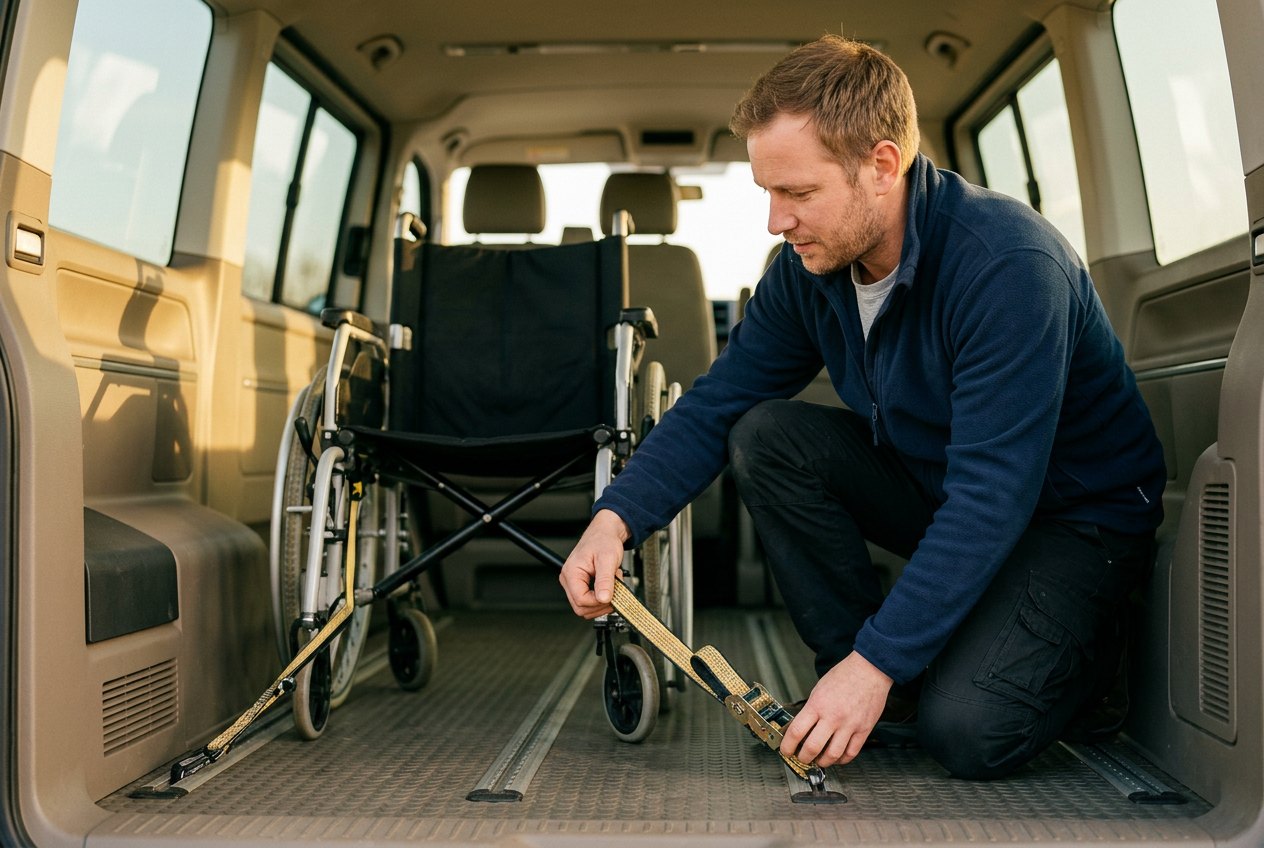
- A lift or ramp with a load capacity of at least 450 pounds, secured to the vehicle
- Wheelchair fasteners strong enough to keep chairs from rotating or lifting and to hold them if the van overturns
- Approved seat belts for the driver and front passengers, a foot stool or extra step, interior light, portable battery light, heating and air conditioning in the patient compartment, and washable vinyl seats
- A 4-B:C dry powder or CO2 fire extinguisher, spare wheel and tools, current street maps, and your business name on both sides and the rear in letters at least four inches tall
Litter vans (22 CCR 51231.1) need a loading entrance and separate emergency exit that fit a standard gurney, a two-person gurney with mattress and restraining straps, a cot fastener, gurney fasteners rated to hold in a rollover, and an attendant seat in the patient compartment. A litter van must run with a certified driver and an attendant, and it may not display identification as an ambulance. It can double as a wheelchair van only if it also meets every wheelchair van requirement.
Register each vehicle as a commercial vehicle with the DMV; DHCS asks for the commercial registration. Then get a Vehicle Safety Systems Inspection (VSSI) certificate. Title 22 still refers to a "standard brake and light certificate," but that program ended, and DHCS states that applications received on or after March 27, 2025 must include a valid VSSI certificate issued by the Bureau of Automotive Repair (DHCS provider requirements notice). This is a BAR station inspection, not a DMV inspection.
Watch seating capacity when you buy. Under Vehicle Code 233, a vehicle designed for more than 10 people including the driver, used to carry passengers for compensation, is legally a bus, which brings bus licensing and inspection rules with it. A typical wheelchair van stays under that line, but a converted 12- or 15-passenger van may not. For what a compliant van costs, see our medical transport van cost breakdown.
4. CHP: when it applies
For a private wheelchair or litter van operator, the California Highway Patrol is usually not a licensing step. DHCS asks for CHP certificates only from ambulance providers. The CHP's annual inspection of general public paratransit vehicles does not reach most NEMT vans, because Vehicle Code 336 limits that category to vehicles run under a publicly owned transit system and excludes vehicles used exclusively to transport disabled persons. Two exceptions to check: a vehicle that meets the bus definition above, and any van you run under a contract with a public transit agency.
5. Insurance
The DHCS transportation provider application page lists three insurance items:
- Commercial liability insurance of not less than $100,000 per claim and a minimum annual aggregate of $300,000
- Proof of commercial vehicle insurance
- Workers' compensation, required by California law once you have one or more employees
Those are the enrollment floor. Plans and brokers write their own minimums into network contracts, and they can be higher, so get each plan's credentialing packet before you bind a policy. The $750,000 figure that circulates for California comes from the CPUC's charter-party carrier rules: General Order 115-G sets $750,000 for vehicles seating 8 or fewer. It applies to permitted carriers, not to exempt medical vehicles. Premiums vary too much by driver history, territory and fleet size for a single per-vehicle number to be useful; get quotes.
6. Drivers
Title 22 requires wheelchair van and litter van drivers and attendants to be at least 18, hold a current California driver license (or ambulance driver certificate), hold current first aid certification, and have passed a physical exam within the past two years. It also bars anyone required to register as a sex offender for offenses involving force, anyone with a drug- or alcohol-related felony conviction in the past seven years, and anyone who habitually misuses drugs or alcohol from driving or attending.
The current DHCS application checklist goes further. For each driver it asks for a California driver license, first aid and CPR certificates, a pre-employment drug test listing the drugs tested, alcohol test lab results, and the federal medical exam forms MCSA-5875 and MCSA-5876. The NMT enrollment page also asks for each driver's DMV driving history printout. Plans and brokers can add requirements of their own during credentialing.
7. DHCS enrollment through PAVE
Wheelchair van, litter van and ambulance companies apply as medical transportation providers in the PAVE portal. Only providers approved by DHCS can bill Medi-Cal for NEMT or NMT. An application fee is due when you submit; the amount changes from year to year, and DHCS has accepted hardship waiver requests with supporting documentation. Check the current fee in PAVE rather than relying on an old number.
On timing, Welfare and Institutions Code 14043.26 gives DHCS up to 180 days after receiving an application package to act on it, and an incomplete package adds time while you fix and resubmit it. Plan for months, not weeks.
8. Plan and broker credentialing
Managed care plans must use Medi-Cal-enrolled transportation providers, but APL 22-008 lets a plan bring an NEMT or NMT provider into its network for up to 120 days while enrollment is pending. If DHCS denies the enrollment, the plan has to end the arrangement. In practice this means you can submit to DHCS and start plan or broker credentialing in parallel, which shortens the wait before your first trip.
Plan contracts also carry service standards. APL 22-008, for example, requires a plan to authorize urgent NEMT when a scheduled NEMT provider is late or does not show. Late pickups follow you into credentialing reviews.
9. The CPUC question, answered precisely
Charter-party carriers in California need a CPUC permit. Public Utilities Code 5353(i) exempts vehicles used exclusively to provide medical transportation. The CPUC's Medical Transportation Exemption page adds the details that matter:
- Covered trips include doctor, dentist, hospital and clinic visits, and transport of people in wheelchairs or on gurneys even when the individual trip has no direct medical purpose. Caregivers and family members riding along are covered.
- The exemption is vehicle-specific and use-specific. It does not apply to your company as a whole.
- A vehicle that carries both medical and non-medical for-hire passengers may lose the exemption entirely, including for its medical trips.
- Safety inspection, insurance and DMV rules still apply to exempt vehicles.
If you plan to run airport, event or other private-pay non-medical trips, either keep those on separate vehicles under a CPUC permit or get a formal opinion from CPUC Transportation Licensing staff first. The CPUC's charter-party licensing page lists the current application fees ($1,000 for a permit, $1,500 for a class A certificate).
What it costs
The fixed, sourced costs are small: the PAVE application fee, your local business license, VSSI certificates, and training and testing for each driver. The money is in vehicles, insurance and payroll, and those depend on your market and mix of trips.
Medi-Cal fee-for-service rates are set by DHCS, and plan or broker rates are negotiated in each contract. Per-trip figures you see quoted online for California rarely say which plan, which mode or which year they came from, so do not build a budget on them. Ask each plan or broker for its rate schedule during credentialing, then run your own numbers with the NEMT cost per trip calculator and the vehicle break-even calculator. Our general startup costs and licensing guide covers the categories most operators underestimate.
Common mistakes
- Buying a minivan for wheelchair work. Title 22 sets the equipment list. A van without a 450-pound lift or ramp, two wheelchair positions and a separate emergency exit will not pass enrollment as a wheelchair van.
- Getting a CPUC permit you do not need, or skipping one you do. Exempt vans used only for medical trips do not need it. A van that also runs non-medical for-hire trips can lose the exemption.
- Calling the county to find a broker. Trip volume comes from managed care plans and the brokers they contract with.
- Sending a brake and lamp certificate. DHCS stopped accepting those for applications received on or after March 27, 2025. You need the VSSI certificate.
- Waiting on DHCS before talking to plans. The 120-day pending-enrollment allowance exists so you can credential in parallel.
- Buying a 12- or 15-passenger van without checking the bus definition. More than 10 seats including the driver, used for compensation, makes it a bus.
Operating in more than one state, or still choosing where to launch? Our NEMT licensing and certification by state guide compares each state's NEMT credential, licensing agency and broker setup in one table.
FAQ
Do I need a CPUC TCP permit to run NEMT in California?
Not for a vehicle used exclusively for medical transportation. Public Utilities Code 5353(i) exempts those vehicles, and the CPUC applies the exemption vehicle by vehicle. If a van also carries non-medical for-hire passengers, it may lose the exemption, so either separate your fleets or ask CPUC licensing staff for an opinion.
How long does Medi-Cal enrollment take?
State law gives DHCS up to 180 days after it receives an application package to act, and an incomplete package adds time. Managed care plans can use a provider for up to 120 days while enrollment is pending, so start plan credentialing alongside your PAVE application.
What inspection does a California wheelchair van need?
For Medi-Cal enrollment, each van needs a valid Vehicle Safety Systems Inspection certificate from a Bureau of Automotive Repair licensed station, which replaced the old brake and light certificate. It must also meet the Title 22 equipment list.
Can I start with sedans and minivans?
Yes, for NMT (ambulatory) trips. DHCS enrolls NMT-only providers, and they need commercial registration, commercial vehicle insurance and qualified drivers. Wheelchair and gurney trips require vans that meet Title 22.
How much insurance do I need?
DHCS requires commercial liability of at least $100,000 per claim and $300,000 aggregate, commercial vehicle insurance, and workers' compensation if you have employees. Plans and brokers can set higher minimums in their contracts, so check those before you buy a policy.
Next steps
Looking at the competition in your area? Browse California NEMT providers in the directory, or start with the Los Angeles, Sacramento and Riverside and San Bernardino metro pages. Already operating? Add your company to the directory. For rule changes and broker news as they happen, subscribe to the newsletter.