Managing a Mixed NEMT Fleet: Ambulatory, Wheelchair and Stretcher Vehicles


The operator's publication for non-emergency medical transportation. State licensing guides, broker intel, a 2,000+ provider directory and The Dispatch, our weekly newsletter.
A mixed NEMT fleet runs ambulatory, wheelchair and sometimes stretcher service out of one dispatch office. The work is matching each trip to the lowest level of service that safely fits the rider, keeping enough wheelchair capacity for the hours when it is scarce, and training drivers so one sick call does not take a vehicle off the road. Regulatory points below cite the federal ADA transportation rules (49 CFR Parts 37 and 38) and, as a state example, Colorado's Medicaid NEMT rules.
The three levels of service at a glance
Each level of service carries different equipment, crew and licensing. The rule that drives fleet planning: a vehicle can serve down a level but not up. A wheelchair van can carry an ambulatory rider. A sedan cannot carry a rider who stays in a wheelchair, and a wheelchair van is not a stretcher van.
| Level of service | Who rides | Typical vehicle | Crew | Rules to check |
|---|---|---|---|---|
| Ambulatory | Riders who can walk to and enter the vehicle, with or without a cane or walker | Sedan, SUV or minivan | Driver | Business and for-hire authority, broker credentialing, insurance |
| Wheelchair | Riders who stay seated in a manual or power wheelchair or scooter | Ramp minivan or lift-equipped full-size van | Driver trained on lift, ramp and securement | All of the above, plus 49 CFR Part 37 service rules and the Part 38 vehicle specs for accessible vehicles, plus state vehicle inspection |
| Stretcher | Riders who must lie flat and need no medical care en route | Mid- or high-roof van with a cot and floor fastener | Driver plus attendant; required in Illinois and California | Varies by state: a stretcher van license, a Medicaid category, an ambulance license, or a prohibition |
Stretcher service is the line where planning mistakes become licensing problems. Some states license stretcher vans directly, some regulate them only through Medicaid, some require ambulance-type licensing, and a few do not allow them at all. Colorado's NEMT billing manual, for example, defines a stretcher van as "a vehicle that can legally transport a client in a prone or supine position when the client does not require medical attention en route" (HCPF NEMT Billing Manual). Our stretcher and gurney guide walks through the state regimes, crew rules and equipment costs. Get your state's classification in writing before you buy a cot.
Planning the vehicle mix
Plan the fleet from trip demand by level of service. Pull a few months of trip requests, including the ones you turned down, and sort them by level of service and hour of day. Daily totals hide the real constraint. Wheelchair demand can bunch around fixed appointment blocks such as dialysis chair times, and that peak is what sets how many wheelchair vehicles you need.
Worked example: a 6-van fleet with 2 wheelchair vans
Example only. The figures below are hypothetical and chosen to show the method, not to describe a typical market.
A company runs 4 ambulatory minivans and 2 ramp wheelchair minivans. On a typical weekday its intake log shows 52 one-way trip legs: 36 ambulatory, 14 wheelchair and 2 stretcher requests that it turns away. In this market a vehicle completes about 10 legs in a 10-hour shift.
- Ambulatory: 4 vans at about 10 legs each gives about 40 legs of capacity against 36 legs of demand. Tight but workable.
- Wheelchair, daily view: 2 vans at about 10 legs each gives about 20 legs of capacity against 14 legs of demand. On paper there is room.
- Wheelchair, peak view: 6 of the 14 wheelchair legs are pickups for dialysis chair times between 5:30 and 7:00 a.m. Each wheelchair van can do 2 of those in the window. That is 4 covered and 2 short, every morning.
- Stretcher: 2 requests a day is below the volume our gurney guide suggests a stretcher unit needs (a reliable three or more trips a day from facility relationships) to carry its second crew member.
The options for the wheelchair gap, from cheapest to most expensive:
- Ask the dialysis centers to stagger chair times by 30 minutes. One conversation can close the gap.
- Run the wheelchair vans in the morning peak only for wheelchair riders, and give them ambulatory legs midday, when wheelchair demand is lower. Serving down a level is allowed; serving up is not.
- Replace one ambulatory minivan with a ramp minivan at its next replacement date. The fleet stays at 6 vehicles, with 3 able to carry wheelchairs.
- Add a seventh vehicle. Run the numbers in the NEMT vehicle break-even calculator first, using your own rates and costs.
Stretcher requests go to a referral partner until volume supports a unit. Log them anyway: declined trips by level of service show which vehicle to add next.
Buying the right wheelchair vehicle
A ramp minivan is easier to park and suits single-chair trips. A full-size lift van carries larger power chairs and more than one chair. Our medical transport van cost guide breaks down chassis, conversion and outfitting costs by vehicle class.
If a vehicle is meant to be accessible, the federal spec is 49 CFR Part 38 (49 CFR 37.7). Under 49 CFR 38.23, lifts need a design load of at least 600 pounds and a platform at least 30 inches wide and 48 inches long (measured from 2 inches above the platform surface), ramps 30 inches or longer must hold 600 pounds, and each securement location needs a 30 by 48 inch clear floor area. For vehicles 22 feet long or less, the door opening must leave at least 56 inches of clearance above the raised lift platform or ramp (49 CFR 38.25). Check those numbers on any used van before you buy.
Whether a purchase must be accessible at all depends on your business. A private company primarily engaged in transporting people that buys a new van for demand-responsive service must make it accessible unless its service as a whole meets the equivalent service standard (49 CFR 37.103 and 37.105). Service under contract with a public entity carries that entity's obligations (49 CFR 37.23). If unsure, ask before the purchase, not after.
Scheduling by level of service
Most mismatches start at intake. A rider booked as ambulatory who arrives in a power chair costs you the trip, the deadhead miles and often the next pickup.
Intake questions that set the level of service
- Can the rider walk to the vehicle and get in, with or without a cane or walker?
- Does the rider stay in a wheelchair or scooter? Manual or power? Approximate width, length and combined weight of rider and chair?
- Does the rider need to lie flat for the whole trip?
- Does the rider need any monitoring or care during the ride, such as IV fluids or oxygen they cannot manage themselves? If yes, this is an ambulance trip, not NEMT.
- Are there stairs at pickup or drop-off? Curb-to-curb or door-to-door?
- Will an escort or attendant ride along?
Save the answers in the rider profile and flag any change for a dispatcher.
On Medicaid work, the level of service is usually set by the state or broker, not chosen by you, and payment follows the least costly mode that fits the rider. Colorado's manual states it plainly: "Payment will only be made for the least expensive mode suitable to the member's condition" (HCPF NEMT Billing Manual). Sending a wheelchair van on an ambulatory trip is fine operationally, but expect to be paid the ambulatory rate.
Larger power chairs
Under 49 CFR 37.165, which applies to public and private entities, you must carry a wheelchair and rider who are larger or heavier than the Part 38 design figures if the lift and vehicle can physically accommodate them. You may decline only if the combined weight exceeds the lift's rating or carrying the chair is shown to be inconsistent with legitimate safety requirements. You also may not deny a ride because the chair cannot be secured to your satisfaction, and you may recommend but not require that a rider transfer to a vehicle seat. In practice, that means recording chair dimensions and combined weight at intake and dispatching only vehicles whose lift rating and door clearance fit.
Time blocks and multi-loading
Wheelchair and stretcher legs take longer at each stop than ambulatory legs. Measure your own average load and unload time by level of service and build it into the schedule, rather than using one standard stop time for every trip. A schedule that ignores dwell time looks efficient at 6 a.m. and is late by 9.
Example: if your logs show wheelchair stops averaging 8 minutes longer than ambulatory stops, a van with 5 wheelchair pickups before 9 a.m. needs about 40 extra minutes in the plan.
Multi-loading (carrying more than one rider at once) is where mixed vehicles earn their keep. Part 38 allows fold-down seats in a securement area as long as they do not block the required clear floor space when folded up (49 CFR 38.23(d)(2)), so a wheelchair van can carry ambulatory riders when no chair is aboard. Check your broker contract before you multi-load, since a contract can set maximum ride times or conditions on shared rides.
What to require from dispatch software
For a mixed fleet, the features that matter are capability tags on each vehicle and driver (ramp, lift, number of securement positions, cot, wheelchair-trained, stretcher-trained), rider profiles that store level of service and chair details, and a scheduler that will not assign a trip to a vehicle or driver without the right tags. Our NEMT software comparison lists vendors and published pricing.
Driver training and cross-training
Federal rules require each public or private entity operating a demand-responsive system to train personnel "to proficiency, as appropriate to their duties," so they operate vehicles and equipment safely and treat riders with disabilities respectfully (49 CFR 37.173). Your broker contract and state program will usually add specific courses on top.
Wheelchair securement and lift operation
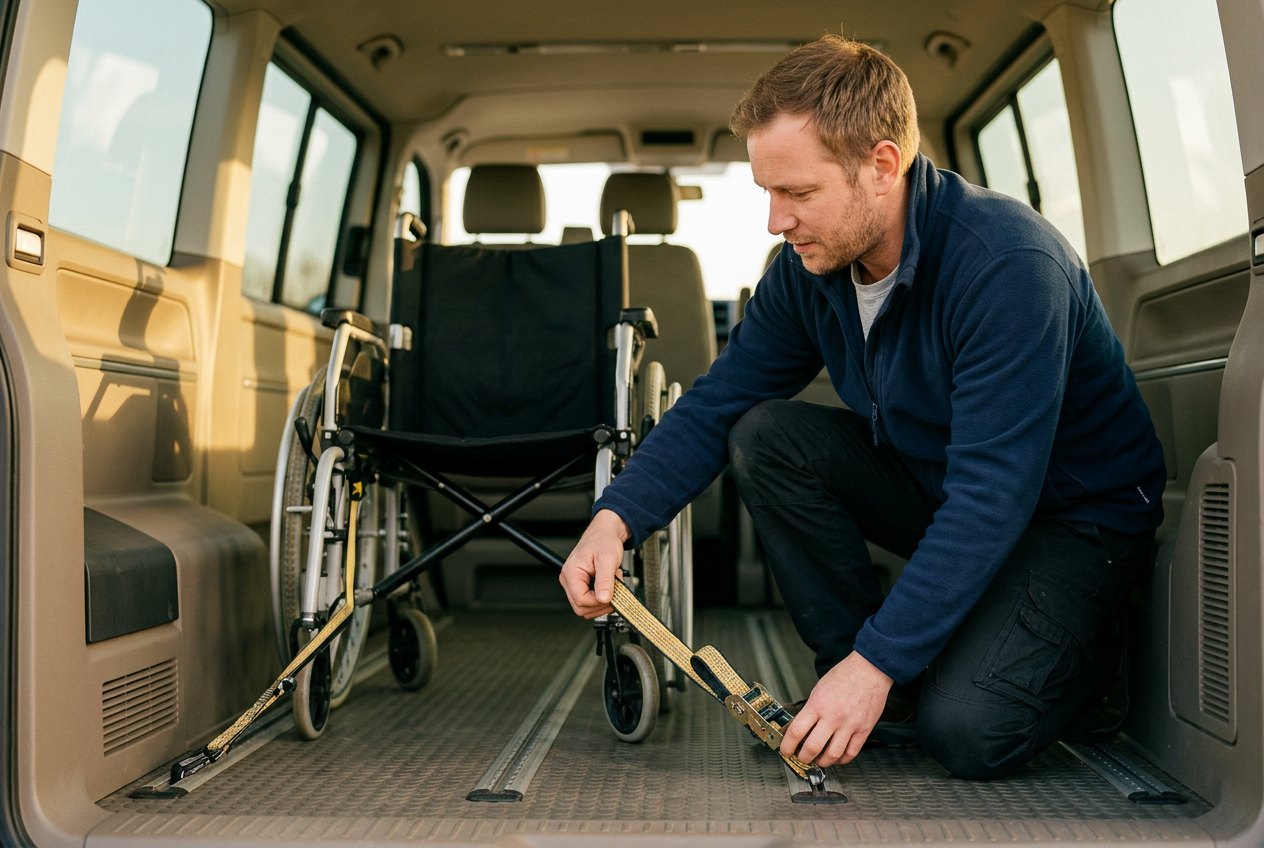
- Two systems, not one. Part 38 requires a securement system for the chair and, for each securement location, a lap belt and shoulder harness for the rider. The belt and harness may not be used in place of securing the chair (49 CFR 38.23(d)(7)).
- What you can and cannot require. You may require that the chair be secured. You may not refuse the ride because the chair is hard to secure, and drivers must assist with lifts, ramps and securement when needed or asked, including leaving the driver's seat to do it (49 CFR 37.165). Whether the rider must wear the belt and harness is set by your state law and broker contract, so put your policy in writing.
- Lift failure. Part 38 lifts must have an emergency way to lower an occupied platform to the ground and stow the empty lift if power fails (49 CFR 38.23(b)(3)). Every wheelchair-trained driver should practice that procedure on the actual lift model they drive.
- Chairs and tiedowns. Some wheelchairs are built and crash-tested for use as a seat in a vehicle (the industry standard known as WC19), and tiedown systems have their own crash-test standard (WC18). These are industry standards, not federal rules, but drivers should know how to find the marked securement points on a WC19 chair (UMTRI wheelchair transportation safety FAQs).
Our wheelchair securement training guide covers the hands-on sequence.
Stretcher crews
Stretcher training is about lifting, loading and knowing where the service ends. Illinois and California require two-person stretcher crews. Train crews on the cot, fastener and stair chair you actually use, on team lifts and slide transfers, and on when to call an ambulance instead. State stretcher rules draw the same line: no medical care or monitoring en route. A crew that starts assessing or treating a rider has left NEMT. The gurney guide quotes the Illinois, Arizona and California rules.
A cross-training matrix
Cross-training keeps a mixed fleet running on short-staffed days. Keep a matrix of who is cleared for what, and schedule against it.
| Tier | Cleared for | Adds |
|---|---|---|
| 1 | Ambulatory trips | Base onboarding, passenger assistance, your broker's required courses |
| 2 | Ambulatory and wheelchair trips | Lift and ramp operation, emergency lift procedure, securement on each van model in the fleet |
| 3 | Stretcher crew | Cot, fastener and stair chair training, team lifting, any certifications your state's stretcher rules require |
Example: in the 6-van fleet above, if only 2 of 7 drivers are wheelchair-trained, one sick call parks a wheelchair van during the morning dialysis peak. Getting 4 of 7 drivers to Tier 2 means a sick call costs you an ambulatory route instead, which an ambulatory-only driver can absorb.
Maintenance by vehicle type
Accessibility equipment is not optional upkeep. Under 49 CFR 37.161, public and private transportation providers must keep lifts, securement devices and other accessibility features in operative condition, repair them promptly, and take reasonable steps to accommodate riders while a feature is out of order. The specific out-of-service timelines for broken lifts in 49 CFR 37.163 apply only to public entities, but your broker contract may set its own.
Daily checks by vehicle type
| Vehicle | Add to the standard pre-trip check |
|---|---|
| Ambulatory | Tires, lights, brakes, fluids, seat belts, step or running board, interior cleanliness |
| Wheelchair | Full lift or ramp cycle; interlock that keeps the vehicle from moving with the lift deployed; platform barriers; complete set of tiedowns and belts for every securement position, with no frayed webbing; slip-resistant floor; doorway lighting working (Part 38 calls for at least 2 foot-candles on a deployed lift or ramp, 49 CFR 38.31) |
| Stretcher | Cot locks and wheels, cot straps, floor fastener and its mounting, loading method (lift, winch or ramp), stair chair, attendant seat belt |
Scheduled service
Service the chassis on the vehicle maker's schedule and the lift or ramp on the mobility equipment maker's schedule. They are separate manuals. Some lift makers set service intervals by cycle count rather than mileage, so log lift cycles if your lift's manual does. Check open recalls by VIN through NHTSA's recall lookup, and register your conversion equipment with its manufacturer so you get its service bulletins.
If any of your vehicles are commercial motor vehicles under federal rules, Part 396 adds annual inspections, driver vehicle inspection reports and recordkeeping. Many minivan fleets fall outside it. Our FMCSA Part 396 summary explains how to tell.
Plan for the expensive outage
A wheelchair van in the shop costs more than an ambulatory van in the shop, because ambulatory vehicles cannot cover its trips. Service wheelchair vans outside peak wheelchair hours, never two at once, and know which trips go to a partner if a lift fails mid-week.
Utilization metrics by level of service
Track each metric by level of service. A fleet average hides a wheelchair van turning trips away while an ambulatory van sits idle.
| Metric | How to calculate it | What it tells you |
|---|---|---|
| Legs per vehicle service hour | Completed one-way legs divided by hours the vehicle was in service | Productivity, compared within the same level of service |
| Revenue per vehicle service hour | Paid revenue divided by service hours | Whether a level of service covers its higher cost |
| Deadhead share | Unpaid miles divided by total miles | Routing and service area fit |
| On-time pickup rate | Pickups inside the window your broker contract defines, divided by all pickups | Schedule realism, especially dwell time |
| Average stop dwell time | Arrival to departure at pickup and drop-off | The time blocks to build into scheduling |
| Trips declined, by level of service and hour | Requests you could not accept | Which vehicle to add or convert next |
| Out-of-service days | Days each vehicle was unavailable, by cause | Maintenance planning and spare needs |
To turn these into money, plug your actual costs into the NEMT cost per trip calculator for each level of service. A wheelchair leg that pays more than an ambulatory leg can still earn less per hour once longer dwell time and lower multi-loading are counted.
State rules change: Colorado as an example
State programs change credentialing systems and brokers often. Colorado shows how fast:
- Credentialing: Health First Colorado required NEMT providers to credential all drivers and vehicles through the ProCredEx platform, with a completion deadline of March 15, 2024. At the time, Transdev Health Solutions (formerly IntelliRide) managed driver and vehicle credentialing (HCPF credentialing notice).
- Broker change: MediDrive became the NEMT broker for the nine-county Denver metro area previously served by Transdev on July 1, 2026 (HCPF Provider News, July 16, 2026). HCPF's timeline sets statewide implementation of the MediDrive broker model for January 1, 2027, and requires provider, driver, vehicle and credentialing information to stay current in ProCredEx (HCPF NEMT page).
Every vehicle you add, convert or retire has to be updated in the credentialing system before it takes trips, so build that into vehicle onboarding and read your broker's provider notices monthly. Our NEMT broker report card tracks broker changes by state.
Frequently asked questions
Can a wheelchair van take ambulatory trips?
Yes. A vehicle can serve down a level. On Medicaid trips, expect payment at the rider's authorized level of service, not for the vehicle you sent.
Can we refuse a power wheelchair that is too big for our lift?
Only if the combined weight of chair and rider exceeds the lift's rating, or carrying it is shown to conflict with legitimate safety requirements (49 CFR 37.165(b)). Otherwise, if the lift and vehicle fit it, you carry it.
When does a mixed fleet need a stretcher van?
Only after you confirm your state allows stretcher vans under a license you can get, and when you have steady facility volume. Our gurney guide suggests at least three reliable stretcher trips a day before a unit carries its second crew member. Until then, refer stretcher requests to a partner and log them.
For new guides on fleet operations, broker changes and state rules, subscribe to The NEMTrepreneur Dispatch.