

NEMT Entrepreneur provides expert insights, strategies, and resources to help non-emergency medical transportation professionals grow their businesses. Get industry-leading advice to succeed in NEMT.
Featured articles
If you run NEMT for Medicaid, you need to check both the federal OIG LEIE and each state Medicaid exclusion list. A clean federal result does not mean a worker or vendor is clear at the state level.
Here’s the short version:
- Use both checks before hire or contract start
- Repeat both checks every month
- Screen more than drivers: include dispatchers, billers, office staff, contractors, vendors, mechanics, and owners over 5%
- Keep proof of every search, including negative results
- State lists can show names missing from LEIE; one source cited 64.4% of state-excluded, NPI-identified providers had no LEIE record
- State updates vary: weekly, monthly, quarterly, or unevenly
- LEIE is monthly
- Match review is different: LEIE often uses name first, then SSN/EIN; state lists often need DOB, license number, and address checks
- A one-day gap can create billing trouble if excluded work ties to Medicaid claims
This comes down to one rule: federal screening is the floor, not the whole job. If you only run LEIE, you can miss state actions, miss audit proof, and leave your NEMT business open to repayment and penalty risk.
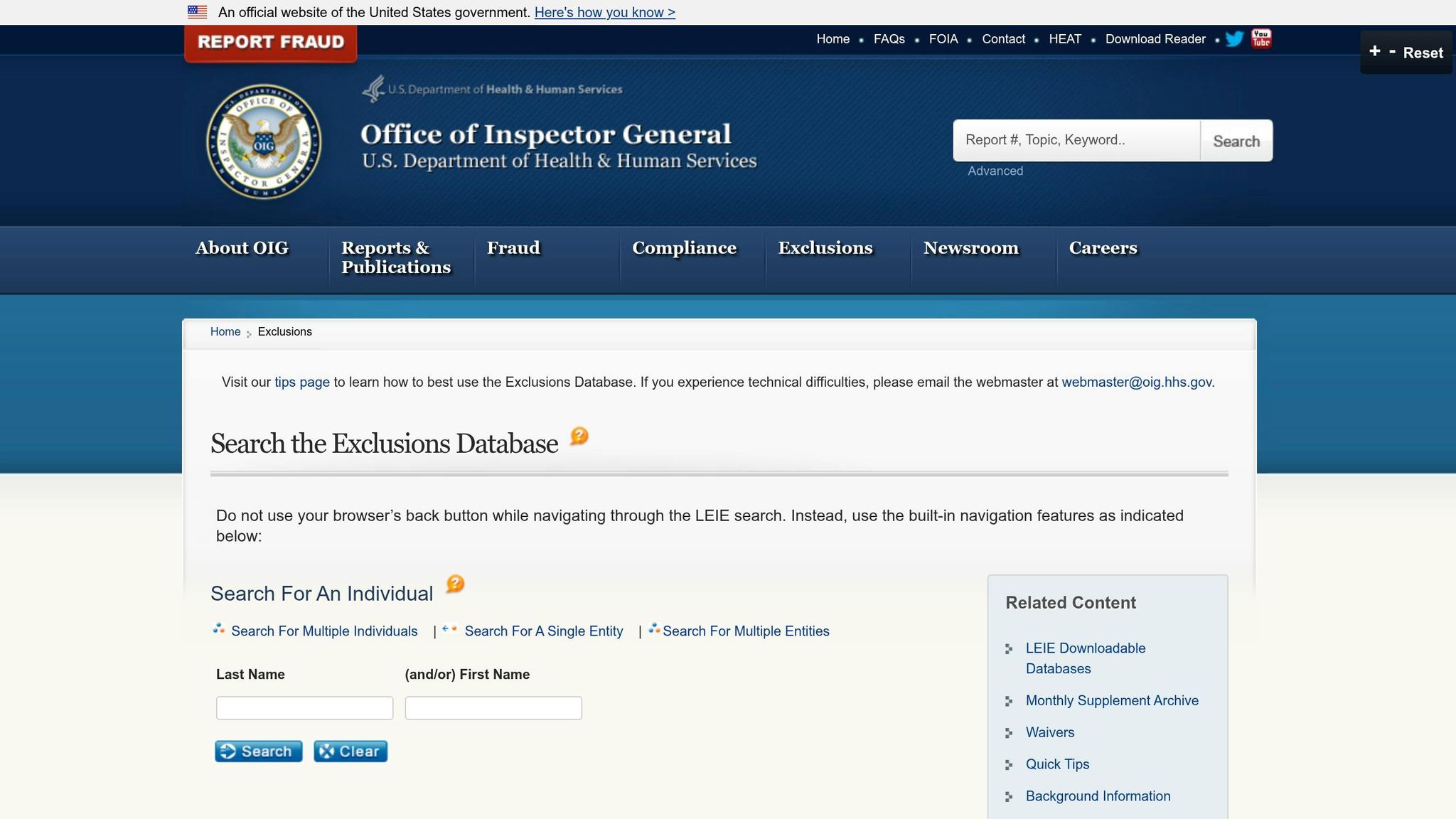
Using the OIG's Exclusions Database
sbb-itb-cef70f4
Quick Comparison
| Point | OIG LEIE | State Medicaid Lists |
|---|---|---|
| Who runs it | HHS OIG | Each state Medicaid agency |
| Scope | Federal healthcare programs | One state’s Medicaid program |
| Update cycle | Monthly | Varies by state |
| Match review | Name, then SSN/EIN | Often manual review with DOB, license, address |
| Can it miss state action? | Yes | Less likely for that state |
| When to use it | Before hire and monthly after | Before hire and monthly after |
If I were building an NEMT screening process, I’d treat both searches, monthly timing, and audit-ready records as the minimum standard.
OIG LEIE vs. State Medicaid Lists: Key Differences

OIG LEIE vs State Medicaid Lists: NEMT Screening Comparison
For NEMT employers, the day-to-day difference is pretty straightforward: the LEIE is the federal starting point, while state lists catch exclusions that can show up sooner or only at the state level.
OIG LEIE: The Federal Baseline Screen
The HHS OIG LEIE is the federal baseline for excluded people and entities across all federally funded healthcare programs.
It includes both mandatory and permissive exclusions. Mandatory exclusions cover cases like Medicare or Medicaid fraud and patient abuse convictions. Permissive exclusions can include license revocations or suspensions, along with defaulted education loans.
One issue matters a lot in practice: the LEIE can trail state action. State agencies move on their own authority and schedules, and OIG may not reflect those actions for months or even up to a year.
State Medicaid Lists: State-Level Sanctions and Terminations
Forty-four states and the District of Columbia keep separate Medicaid exclusion lists. Seven states rely only on the federal LEIE.
These lists are run by individual state Medicaid agencies and apply only to that state’s Medicaid program. Their update schedules vary by state. And this is where things get serious for screening: a person can land on a state list before that action ever shows up on the federal LEIE.
Fonteum’s research found that 64.4% of NPI-identified providers excluded by state Medicaid programs have no record on the federal OIG LEIE. So if you run only a federal search, you can miss a large share of providers barred at the state level.
Section 6501 of the Affordable Care Act adds another layer. If one state Medicaid program excludes a provider for cause, that can trigger exclusion from other state Medicaid programs too. In plain English, state-level checks aren’t optional. They need to be part of your screening workflow.
Here’s how the two lists stack up on the points that matter most for NEMT employers:
| Feature | OIG LEIE | State Medicaid Lists |
|---|---|---|
| Source Owner | HHS Office of Inspector General (OIG) | Individual State Medicaid Agencies |
| Scope of Exclusion | All federal healthcare programs | Specific state Medicaid program |
| Match Method | SSN/EIN search | Manual cross-check using license number, DOB, and address |
| Update Timing | Monthly | Varies: weekly, monthly, quarterly, or irregular |
| Jurisdiction | Federal (national) | State-specific |
Those differences affect search order, match review, and check frequency. A federal screen gives you the baseline, but state lists often tell you what’s happening on the ground first.
How to Run and Review Both Checks in Practice
Knowing these two lists exist is one thing. Using them the right way, every single time, for every person, is what turns policy into compliance.
Match Inputs and False-Positive Review
The OIG LEIE search starts with a legal name. If that name brings back a possible hit, confirm it with an SSN for individuals or an EIN for entities. State lists usually take more hands-on review. In many cases, you’ll need backup identifiers like professional license numbers, date of birth, and past addresses.
Don’t use NPI as your main match point. A lot of federal and state records don’t include it.
Name-only matching can lead to a lot of false positives, which is why better matching steps matter. If you get a match, pause Medicaid-funded work, check the record with secondary identifiers, and clear or confirm the hit before work starts again. Then document why you made that call either way.
And this part trips people up all the time: don’t screen only drivers. Screen everyone tied to Medicaid revenue. For NEMT, that includes:
- Drivers
- Dispatchers
- Billers
- Mechanics
- Office staff
- Contractors
- Medicaid-paid vendors
- Owners with more than 5% interest
How Often to Check Each List
Once you’ve matched names and cleared any hits, timing becomes the next control point.
The LEIE updates monthly. That means you should screen before engagement and then monthly after that. The Joint Commission's 2025 requirements also back monthly exclusion screening as part of accreditation compliance. If the review isn’t tied to a fixed schedule, it’s easy for gaps to creep in.
State Medicaid update schedules are less predictable. Some states post updates weekly, while others do it monthly, quarterly, or on no clear pattern. The safest move is to screen each state list at least monthly in every state where you operate or where staff hold a license.
Recordkeeping and Where Each Check Fits in Credentialing
What to Document for Every Search
Once your search rules are in place, the next issue is simple: proof matters.
After a hit is cleared or confirmed, the audit trail carries as much weight as the result itself. If your screening log only shows confirmed hits, that won't pass a Medicaid audit. Negative results matter too. Auditors want proof that the searches happened even when no match turned up, so keep a time-stamped screenshot or PDF for every negative result.
For each search, document:
- Search date
- List version or export used
- Reviewer's name
- Subject screened
- Identifiers used, such as DOB, license number, or SSN/EIN
- Result
- Resolution notes for any possible match
For OIG LEIE searches, resolution turns on SSN or EIN verification. For state Medicaid list searches, document secondary identifiers like license number or past address to show why a name match was cleared or confirmed.
Retain all screening records for at least 10 years.
Where These Checks Belong in the Credentialing Process
Run the OIG LEIE first, then each state Medicaid list that applies to every state tied to your operation. Clear both before hiring, contracting, or assigning Medicaid-reimbursable work. Keep each monthly clearance in the credentialing file.
That timing isn't just a box to check. Even a one-day lapse can create overpayment liability for claims billed during that period.
Comparison Table: Recordkeeping and Workflow Placement
Use the table below to separate documentation needs from workflow placement.
| Feature | OIG LEIE Check | State Medicaid List Check |
|---|---|---|
| Documentation needs | Time-stamped screenshot/PDF of the result, plus search date, list version/export, reviewer name, and SSN/EIN verification | Same as OIG, plus resolution notes for name-only matches using license number, DOB, or past address |
| Audit value | Shows the federal baseline was checked | Shows compliance with state-specific Medicaid program integrity rules |
| Pre-hire timing | Before any service is furnished or billed | Before any service is furnished or billed |
| Contractor screening | Yes, for 1099 drivers and vendors | Yes, for vendors and other paid entities tied to Medicaid work |
| Recurring review | Monthly | Monthly |
| Multistate impact | National federal baseline | Check every state tied to your operation |
Conclusion: A Clear Screening Standard for NEMT Employers
The LEIE is the federal baseline. But by itself, it doesn't go far enough.
State Medicaid lists fill that hole by flagging state-level exclusions and terminations that the LEIE can miss. For NEMT employers, that means state checks are not optional.
The standard is pretty simple:
- Run both checks before hire
- Run both checks every month after hire
That cadence matters. One excluded driver can create severe penalty exposure, and even a one-day lapse in screening can trigger overpayment liability for claims billed during that window.
Just as important, document every search like it may need to stand up in an audit later. Keep:
- dated screenshots
- negative results
- reviewer names
- match-resolution notes
Retain all screening records for 10 years.
FAQs
Why isn’t the OIG LEIE check enough by itself?
Using only the OIG LEIE creates a compliance gap. Plain and simple, it doesn’t include every barred provider.
State Medicaid agencies can exclude people under their own rules, on their own timelines, and for state-specific reasons. Those actions may never show up on the federal list at all. In some cases, they appear later.
That’s where trouble starts for NEMT employers. If you rely on an LEIE-only check, you can miss people who are barred at the state level. And that can leave your business exposed to civil monetary penalties and False Claims Act liability.
Which workers and vendors should I screen monthly?
Screen every person or company that could affect your participation in federal healthcare programs, including NEMT. That means all W-2 employees, 1099 contractors, volunteers, clinical staff, executive leaders, board members, and owners with 5% or more interest.
You should also screen vendors and delegated entities that provide billable items or admin services. This includes vehicle suppliers, IT, legal, accounting, and marketing firms. Run these checks before onboarding and at least monthly after that.
What proof should I keep for each exclusion search?
Keep an audit-ready record of every search. That means logging the date and time, the databases checked, the search terms used, and the final results.
You should also save proof of no results for every employee, contractor, and owner. Screenshots or data extracts work well here. The point is simple: if an auditor asks, you need to show that the search happened and what it returned.
If a search shows a potential match, keep a bit more detail on file, including:
- Identity verification notes
- The reason for the decision
- Any compliance officer approval
Hold these records for 7 to 10 years.


