

NEMT Entrepreneur provides expert insights, strategies, and resources to help non-emergency medical transportation professionals grow their businesses. Get industry-leading advice to succeed in NEMT.
Featured articles
Preventive maintenance saves money and ensures reliability, while reactive repairs can lead to costly disruptions. For Non-Emergency Medical Transportation (NEMT) providers, keeping vehicles in top condition is key to avoiding missed medical appointments, regulatory risks, and financial losses. Here's what you need to know:
- Preventive Maintenance: Involves regular servicing (oil changes, brake checks, etc.) to prevent breakdowns. It reduces downtime by 47%, extends vehicle lifespan by 17%, and lowers repair costs by 12–18%.
- Reactive Repairs: Fixes issues after they occur. While seemingly cheaper upfront, it can cost 2–5x more due to emergency fees, downtime, and reputational damage.
Quick Comparison:
| Aspect | Preventive Maintenance | Reactive Repairs |
|---|---|---|
| Cost | Predictable, planned expenses | High, unpredictable emergency costs |
| Downtime | Minimal, scheduled during off-peak hours | Unplanned, disruptive |
| Safety | Low risk, issues addressed early | High risk, potential mid-trip failures |
| Vehicle Lifespan | Extended through routine care | Shortened due to cumulative damage |
| Compliance | Supports regulatory requirements | Higher risk of penalties |
Preventive strategies not only reduce costs but also improve reliability, ensuring patients reach their appointments without delays. Reactive repairs, on the other hand, often result in chaos and higher expenses. A balanced approach, with a focus on prevention, is the smartest choice for NEMT fleets.
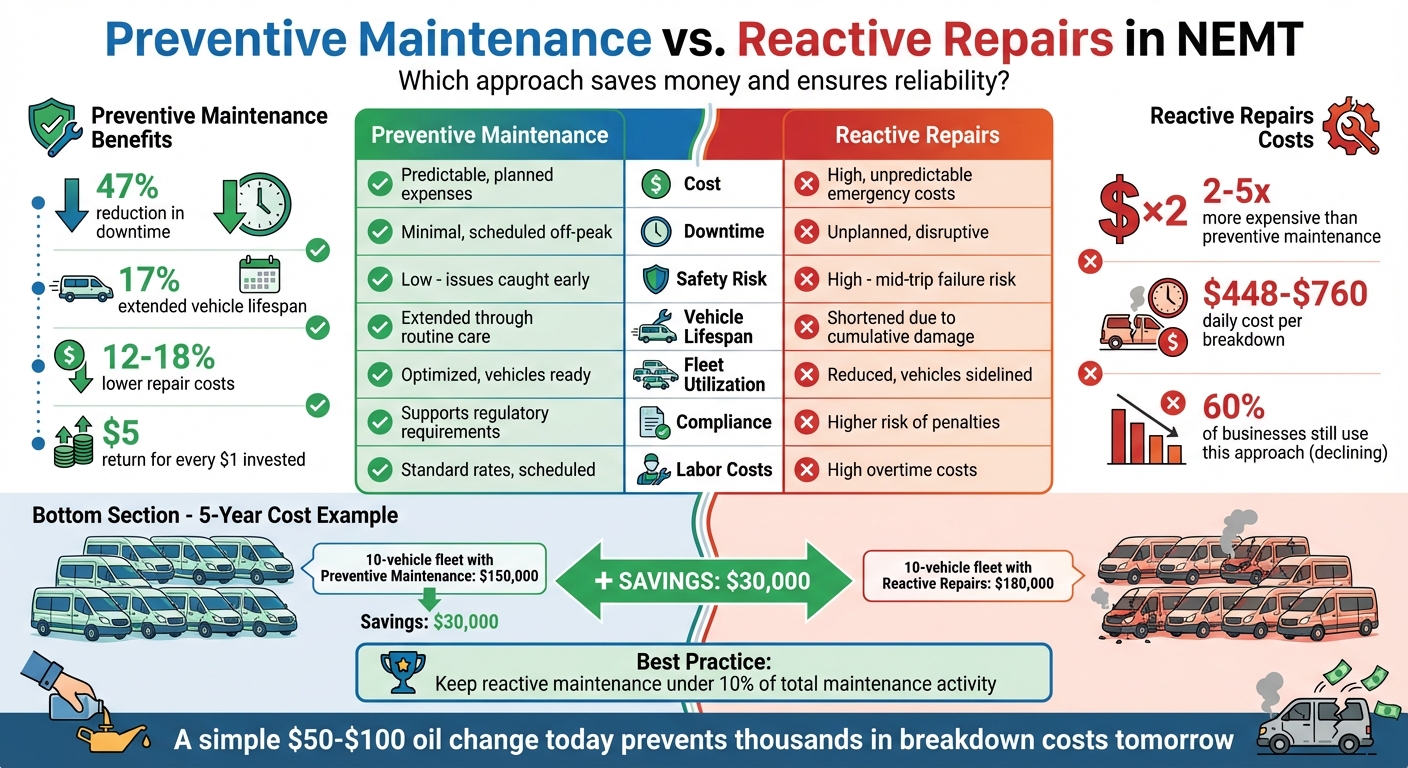
Preventive Maintenance vs Reactive Repairs: Cost and Performance Comparison for NEMT Fleets
Preventive Maintenance: Scheduled Care for NEMT Fleets
What Is Preventive Maintenance?
Preventive maintenance is a proactive approach aimed at keeping vehicles in top condition through regular inspections, servicing, and repairs - before any issues arise. For Non-Emergency Medical Transportation (NEMT) fleets, this involves routine tasks like oil changes, brake inspections, tire rotations, and maintaining specialized equipment such as ADA-compliant wheelchair lifts and ramps.
This type of maintenance typically follows three main schedules:
- Time-based: Performed at regular intervals, such as weekly, monthly, or semi-annually.
- Mileage-based: Triggered by specific distances, like oil changes every 5,000–6,000 miles.
- Predictive: Relies on sensors and software to monitor vehicle health and predict potential component failures.
NEMT fleets often face unique challenges due to their high-stress, short-distance operations. With 90% of trips being under 20 miles and 75% under 10 miles, vehicles require more frequent attention than what standard owner’s manuals typically suggest. By sticking to a structured maintenance plan, fleet managers can ensure not only optimal vehicle performance but also unlock a range of operational benefits.
Benefits of Preventive Maintenance for NEMT
Preventive maintenance offers both financial and operational perks. Studies show it can reduce downtime by 47% and extend a vehicle's lifespan by 17%. Regular inspections also enhance safety and compliance by catching issues early. As highlighted by Government Fleet:
If your operation fails to practice preventive maintenance... you could be prosecuted for a negligent act, which you failed to prevent.
In cases where vehicle malfunctions lead to accidents, authorities may review maintenance records and hold operators accountable for negligence.
Operationally, fewer breakdowns mean better on-time performance for scheduled pickups, which helps build trust with healthcare providers and patients. Plus, well-maintained vehicles tend to deliver better fuel efficiency and retain more value when it’s time to sell.
Requirements for Preventive Maintenance
Creating an effective preventive maintenance program begins with a detailed checklist. This should cover essentials like engine oil and filters, brakes, steering and suspension systems, tires, lights, and NEMT-specific equipment such as wheelchair lifts, ramps, and securement points.
Drivers play a crucial role here. As Patrick M. Bartole of New Jersey City University puts it:
The vehicle operator is the first line of defense against unexpected breakdowns and repairs.
Training drivers to perform daily pre- and post-trip inspections - checking safety items like wipers, horns, and brakes - and ensuring they promptly report any issues is key to minimizing unexpected repairs.
To manage maintenance effectively, operators can either handle it in-house or outsource to specialized local vendors. Using fleet management software is also highly recommended. These tools simplify record-keeping, scheduling, and cost tracking, outperforming manual spreadsheets. They can also help identify vehicles that are becoming too costly to maintain. With the average repair and maintenance cost for NEMT vehicles at approximately $0.12 per mile, closely monitoring these expenses helps make smarter decisions about vehicle replacements. By following these steps, fleet managers can establish a preventive maintenance strategy that ensures reliability and operational efficiency.
Reactive Repairs: Fixing Problems After They Happen
What Are Reactive Repairs?
Reactive repairs, often called "run-to-failure" maintenance, involve fixing vehicles only after they break down. Unlike preventive strategies that address issues during scheduled inspections, this approach waits until a failure occurs. When a vehicle breaks down, it’s immediately pulled from service, leaving fleet managers scrambling to reassign trips. Surprisingly, over 60% of businesses still rely on reactive maintenance, though only about 25% use it as their primary strategy - and that number is steadily dropping. The reason? This approach often uncovers costly operational pitfalls.
Hidden Costs and Risks of Reactive Repairs
Reactive maintenance can be shockingly expensive - studies indicate it costs 2 to 5 times more than preventive maintenance. DwyerOmega puts it bluntly:
You'll pay 2-5 times as much as you would have if you'd performed proactive maintenance. - DwyerOmega
These higher costs come from emergency repair fees, overtime for technicians, and expedited shipping for parts. For Non-Emergency Medical Transportation (NEMT) providers, the stakes are even higher. Missed or delayed medical appointments can harm reputations, lead to lost clients, and even result in fines for failing to meet regulatory standards. A single breakdown can throw an entire fleet’s schedule into chaos, forcing dispatchers to make last-minute adjustments. Other vehicles may have to cover longer routes, increasing wear and tear - and the risk of more breakdowns. The financial strain from these disruptions often snowballs into larger operational challenges.
Challenges in Reactive Maintenance
Reactive repairs often arise from unscheduled maintenance. Other factors include drivers neglecting to inspect vehicles or report minor issues, as well as the tough demands of NEMT operations - constant idling and stop-and-go urban driving take a toll. J. J. Keller & Associates highlights the core issue:
The problem with reactionary maintenance programs is that they are based on failure... This type of maintenance program is destined to lead to down-time and the resulting costs of idle equipment. - J. J. Keller & Associates
When vehicles are sidelined, fleets must rely on expensive spare vehicles. The unpredictability of reactive maintenance makes it nearly impossible to plan budgets or staffing effectively. What starts as a small issue - like an oil leak - can quickly spiral into major problems, such as engine failure. For NEMT fleets, this unreliability creates a vicious cycle of costly crisis management.
Comparing Preventive Maintenance and Reactive Repairs
Comparison Table: Key Metrics
When it comes to Non-Emergency Medical Transportation (NEMT) operations, the distinction between preventive maintenance and reactive repairs becomes evident in their influence on key performance metrics. Here's a side-by-side look at how these approaches measure up:
| Metric | Preventive Maintenance (PM) | Reactive Repairs (Run-to-Failure) |
|---|---|---|
| Primary Cost | Predictable, budgeted intervals | High, unpredictable emergency costs |
| Downtime | Planned, minimal, and off-peak | Unplanned, prolonged, and disruptive |
| Fleet Utilization | Optimized; vehicles ready for trips | Reduced; vehicles sidelined unexpectedly |
| Safety Risk | Low; issues caught early | High; risk of mid-trip breakdowns |
| Vehicle Lifespan | Maximized through routine care | Shortened due to cumulative wear |
| Compliance | Supports safety audits and regulations | Risk of penalties for non-compliance |
| Labor Costs | Standard rates; scheduled shifts | High; often requires overtime labor |
These metrics highlight the real-world impact on NEMT operations. Preventive maintenance isn’t just about keeping vehicles running smoothly - it’s about saving money and avoiding disruptions. In fact, preventive strategies can cut repair costs by 12%–18% and deliver an average return of $5 for every $1 invested. For NEMT providers working within tight budgets, these savings can directly enhance profitability.
Impact on Fleet Utilization and Reliability
Fleet availability is the backbone of meeting patient transport commitments. Preventive maintenance ensures vehicles are serviced during off-peak hours - like late nights or weekends - so they’re ready to roll during high-demand periods. This approach allows dispatchers to plan maintenance without interfering with patient schedules, keeping operations smooth and predictable.
On the flip side, reactive repairs throw this predictability out the window. A breakdown mid-route doesn’t just take the vehicle out of service - it disrupts patient appointments and creates logistical headaches. Beyond the immediate inconvenience, these disruptions can harm your reputation with both patients and healthcare partners.
To maintain reliability, top-performing NEMT providers limit reactive maintenance to under 10% of their total activity. The other 90% follows carefully planned schedules, ensuring vehicles are consistently ready when needed.
Risk Management and Compliance
Preventive maintenance also plays a critical role in managing risk and meeting regulatory requirements. State regulations often mandate safety inspections, and a well-documented maintenance schedule can serve as proof of compliance during audits. Digital logs make it easier to track and demonstrate this due diligence.
Reactive maintenance, however, exposes providers to greater risks. Mechanical failures can lead to accidents, and without proper maintenance records, providers may face "negligent entrustment" liability claims. George Campbell, Director of Technical Services for a major city, sums it up perfectly:
"If you spend the time today to prevent the time you'll spend tomorrow when equipment breaks down unexpectedly, you'll actually end up saving more time, and of course, money." - George Campbell
Beyond legal and financial risks, preventive maintenance also reduces workplace injuries by addressing hazards like worn brakes, faulty tires, and steering problems before they escalate. For NEMT providers, this is more than just a best practice - it’s a legal obligation. Under the Consolidated Appropriations Act, 2021, NEMT services are a statutory requirement for Medicaid, meaning fleet reliability is critical for compliance. With 3 million to 4 million Medicaid beneficiaries relying on NEMT annually, ensuring vehicles are dependable isn’t optional - it’s essential.
sbb-itb-cef70f4
Building a Preventive Maintenance Strategy for NEMT
Steps to Transition from Reactive to Preventive Maintenance
Making the leap from reactive fixes to a preventive maintenance plan starts with gathering the basics: document each vehicle's mileage and service history, then set up maintenance intervals based on manufacturer guidelines. This initial step helps pinpoint which vehicles need immediate care and which can follow a regular maintenance schedule.
To ease the financial burden, roll out the plan in phases. Start by inspecting all vehicles and addressing critical safety components like brakes, tires, and steering systems. Spread out deferred maintenance tasks over several months instead of tackling everything at once. For tracking, smaller fleets can rely on spreadsheets, while larger operations might need fleet management software. These tools can automatically generate service alerts and help avoid missed appointments. This method keeps your fleet running smoothly while minimizing disruptions.
Another key piece of the puzzle is driver training. Daily inspections by drivers can catch minor issues early, preventing them from snowballing into major problems.
Using Technology and Data for Maintenance Management
Once your maintenance schedules and driver roles are in place, technology can take your strategy to the next level. Modern NEMT software can track vehicle usage and send real-time maintenance alerts. Features like route optimization help reduce unnecessary mileage, which means less wear and tear on your fleet and fewer routine services like oil changes and tire rotations.
Automated systems also make it easier to schedule maintenance during off-peak times, ensuring patient transport services remain uninterrupted. If your fleet includes a mix of vehicle types, such as wheelchair vans and sedans, specialized software can tailor maintenance schedules to meet the unique needs of each vehicle. By using real-time data, you can fine-tune your preventive maintenance approach and ensure your fleet stays in top condition.
Balancing Preventive and Reactive Repairs
Even with a strong preventive maintenance plan, unexpected repairs are inevitable. That’s why it’s smart to have contingency plans in place. Set aside emergency funds and establish after-hours repair options to handle urgent situations. A hybrid approach works best - stick to your preventive schedule but remain flexible enough to address sudden issues. Telematics can help by providing data to adjust service intervals based on actual vehicle performance rather than assumptions.
Over time, this strategy pays off. For instance, a 10-vehicle fleet running on a preventive maintenance plan might spend about $150,000 over five years, compared to $180,000 with a reactive approach. Balancing prevention and quick responses not only saves money but also lays the groundwork for smoother fleet management down the road.
5 Steps to Improve Your Fleet's Preventive Maintenance Program | Fleet Management Tips
Conclusion: Choosing the Best Approach for Your Fleet
For NEMT operators, staying ahead with proactive maintenance isn't just a good idea - it's essential for protecting profits and ensuring patients reach their destinations without delays. Preventive maintenance keeps costs in check by slashing emergency repair bills and avoiding the hefty $448–$760 daily cost of unexpected vehicle breakdowns. Add the benefits of extending vehicle lifespan and reducing emergency disruptions, and the financial upside becomes crystal clear.
But it’s not just about the money. Preventive maintenance plays a crucial role in maintaining safety and meeting compliance standards. Regular checkups can identify problems like worn-out brake pads or underinflated tires before they escalate into dangerous roadside incidents. This approach safeguards the drivers and the vulnerable passengers who depend on reliable transportation. It also ensures your fleet meets regulatory requirements, avoiding interruptions that could harm your relationships with healthcare partners. In short, preventive maintenance doesn’t just save money - it keeps operations running smoothly and builds trust.
Operationally, the benefits are hard to ignore. A simple $50–$100 oil change today can prevent breakdowns that cost thousands and take vehicles off the road for days. Fleet managers who prioritize preventive maintenance avoid the chaos and expense of unexpected failures. While reactive repairs might seem convenient in the moment, they come with long-term risks that can undermine both profitability and reliability.
For NEMT businesses ready to embrace a proactive approach, resources like NEMT Entrepreneur offer valuable strategies to create effective maintenance programs and grow their operations.
The evidence is clear: preventive maintenance delivers cost efficiency, boosts safety, minimizes downtime, and ensures compliance. For NEMT fleets where reliability is non-negotiable, adopting a proactive maintenance plan is the cornerstone of operational success.
FAQs
What are the long-term cost benefits of preventive maintenance for NEMT providers?
Preventive maintenance can lead to major savings for NEMT providers, cutting repair costs by an estimated 25–30%. Beyond that, it helps reduce the risk of unexpected breakdowns, which can result in daily downtime losses of $448 to $760 per vehicle.
Staying ahead with regular maintenance not only extends the lifespan of vehicles but also lowers overall operating costs and boosts reliability for passengers. This proactive strategy keeps operations running smoothly and strengthens financial performance in the long run.
What are the downsides of relying on reactive repairs for NEMT fleets?
Relying too much on reactive repairs can spell trouble for NEMT fleets. For starters, it often leads to steeper repair bills because unexpected breakdowns and emergency fixes rarely come cheap. On top of that, vehicles subjected to constant reactive maintenance tend to have a shorter lifespan, with critical components wearing out faster, driving up the need for expensive replacements.
Another downside? Increased downtime. When vehicles are out of service for sudden repairs, it disrupts schedules, delays service, and can leave customers frustrated. Rushed fixes in these scenarios can also compromise your fleet's overall dependability, making it harder to keep up with daily operations. Shifting focus to preventive maintenance is a much wiser approach to sidestep these challenges and ensure smoother fleet performance.
What steps can NEMT providers take to switch from reactive repairs to a preventive maintenance plan?
Switching to a preventive maintenance (PM) plan begins with a close look at your current repair habits and expenses. Start by tracking unplanned breakdowns, identifying recurring issues like tire wear or lift malfunctions, and calculating the daily cost of downtime for your business. This information will help you allocate about 60–70% of your maintenance budget to scheduled inspections and servicing. Tools like fleet management software or telematics can be invaluable here, as they can automate reminders, track mileage, and monitor vehicle health in real-time.
Simple daily checks by drivers - such as inspecting fluid levels, lift operations, and safety features - can prevent up to 70% of breakdowns. On top of that, regular weekly and monthly inspections can cut repair costs by 25–30% and reduce downtime by nearly 40%. Set up a maintenance schedule based on time (e.g., weekly oil level checks) or mileage (e.g., oil changes every 6,000 miles) and make sure every task is properly logged. Working with trustworthy vendors for parts and services can also help keep costs in check. Keep an eye on metrics like maintenance cost per mile to refine your plan over time. By integrating PM into daily operations, NEMT fleets can boost reliability, lower expenses, and ensure compliance with safety regulations.


