The operator's publication for non-emergency medical transportation. State licensing guides, broker intel, a 2,000+ provider directory and The Dispatch, our weekly newsletter.
Background checks and screening are two methods used to evaluate NEMT (Non-Emergency Medical Transportation) driver candidates, but they serve different purposes. Background checks are in-depth, covering criminal history, driving records, and employment verification to ensure long-term safety and compliance. Screening, on the other hand, is a faster, less detailed process that identifies immediate risks like recent DUIs or suspended licenses.
Here’s a quick breakdown:
Both methods are vital for protecting passengers and ensuring compliance. Background checks ensure regulatory standards are met, while screening helps quickly identify potential risks. Combining these approaches creates a safer and more reliable hiring process.
Background Check Database vs. Background Screening Company
What's Included in Background Checks
Background checks for NEMT (Non-Emergency Medical Transportation) drivers are designed to ensure passenger safety and regulatory compliance. They typically focus on three main areas: criminal history, driving records, and identity/employment verification. Each part plays a critical role in protecting passengers and meeting legal requirements.
Key components of these checks include multi-jurisdictional criminal record searches (covering county, state, federal, and sex offender registries), motor vehicle record (MVR) reviews, identity verification, and employment history verification. Many providers also review OIG (Office of Inspector General) and GSA (General Services Administration) exclusion lists to confirm drivers are eligible to work in federally funded healthcare programs.
Unlike standard pre-employment checks, NEMT-specific background screenings address the unique risks involved in transporting vulnerable populations. These checks also align with FCRA (Fair Credit Reporting Act) guidelines and state regulations. Below, we’ll break down each component in more detail.
Criminal Record Checks
Criminal record checks are a cornerstone of background screenings, aimed at identifying any past behaviors that could jeopardize passenger safety. For NEMT drivers, the focus is on offenses such as violent crimes, sexual misconduct, theft, fraud, and any crimes involving vulnerable populations.
A thorough criminal record review includes searches across county and state courts where the applicant has lived, federal criminal records, nationwide databases validated at the primary court level, and sex offender registries. Additionally, many NEMT operators review exclusion and sanctions lists to confirm a candidate's eligibility for healthcare-related work.
Organizations often establish clear internal guidelines to standardize hiring decisions. For instance, candidates with recent DUIs or violent offenses may be disqualified, while other offenses might be evaluated based on a defined lookback period, such as seven years. This approach ensures passenger safety while maintaining compliance with legal and regulatory standards.
Motor Vehicle Records (MVR) Reports
A driver’s MVR report is another critical component of the background check. This report, obtained from the Department of Motor Vehicles, provides a detailed history of the applicant’s driving behavior and determines whether they can legally and safely operate a vehicle.
Key details in an MVR include the driver’s license status (valid, suspended, or revoked), license class, endorsements or restrictions, traffic violations (e.g., speeding or reckless driving), serious offenses like DUIs or hit-and-runs, at-fault accidents, and license points accumulated over a three- to seven-year period, depending on state regulations and insurance requirements.
Commercial insurers often refuse to cover drivers with recent DUIs or multiple violations, making consistent MVR reviews essential for controlling insurance costs. Written standards that outline disqualifying conditions, such as specific violations or a history of unsafe driving, help streamline decision-making. For minor infractions, operators may consider alternatives like defensive driving courses or enhanced monitoring rather than immediate disqualification.
Employment and Identity Verification
The final step in the vetting process involves verifying a candidate’s identity and employment history. Employment verification ensures that applicants have accurately represented their work experience, particularly in roles involving transportation or passenger assistance. This may include confirming experience with tasks like operating wheelchair lifts, handling stretchers, or assisting passengers with special needs. It also helps identify any gaps in employment history that might require further explanation.
Identity verification is equally critical, as it ensures the applicant is who they claim to be. Inaccurate or fraudulent information can conceal significant criminal or driving histories. For NEMT operations, Medicaid and state contracts often require that only thoroughly vetted individuals transport beneficiaries. Proper identity checks also help prevent fraud in payroll, tax reporting, and billing processes tied to transportation services.
What's Included in Screening Processes
Screening processes act as a fast and effective safety filter, especially when recruiting drivers quickly. While detailed background checks dive deep into a candidate's history, screenings focus on speed and immediate safety. These quick evaluations are designed to flag high-risk candidates early, making them ideal for rapidly filling multiple driver positions.
Key elements of screening include swift checks on identity, recent criminal activity, work authorization, and driving records. For Non-Emergency Medical Transportation (NEMT) roles, screenings often emphasize recent DUIs, license validity, and drug and alcohol testing to ensure candidates are fit to transport passengers. These checks are cost-effective compared to full background investigations but still identify critical safety concerns. By catching red flags early, screenings pave the way for more detailed safety evaluations.
Quick Safety Assessments
Quick safety assessments are designed to weed out unsuitable candidates before diving into full-scale vetting. These assessments focus on immediate disqualifiers that could compromise passenger safety.
For NEMT providers facing driver shortages, these rapid checks are indispensable. For example, an MVR (Motor Vehicle Record) flag can instantly highlight a suspended license, while automated criminal database searches can uncover recent offenses or DUIs without the delays of traditional record reviews. Drug screenings, which detect active substance use, are also vital for ensuring compliance with Department of Transportation (DOT) regulations. This streamlined approach allows NEMT providers to shortlist candidates up to 80% faster, all while maintaining essential safety standards.
In addition to these checks, companies must decide whether to manage screenings internally or rely on external providers, each of which offers unique benefits.
Internal vs. External Screening Methods
NEMT companies have two main options for managing screenings: handling them in-house or outsourcing to third-party experts. Both approaches come with their own set of benefits.
Internal screenings rely on HR software to process applications, automated tools to verify basic qualifications, and direct database queries to check criminal records or work authorization. This method works well for smaller operations with lower hiring demands, offering cost savings and direct control over sensitive driver information.
External screenings, on the other hand, involve third-party services that provide instant criminal record searches, identity verification, and MVR reviews, all while ensuring compliance with the Fair Credit Reporting Act (FCRA). These services are particularly useful for high-volume hiring, offering scalability and speed. However, a survey shows that 66% of transportation employers feel uncertain about whether their background check policies fully comply with federal, state, and local regulations. This uncertainty drives many companies to rely on external providers, who can reduce legal risks while delivering accurate, compliant results.
Background Checks vs. Screening: Main Differences
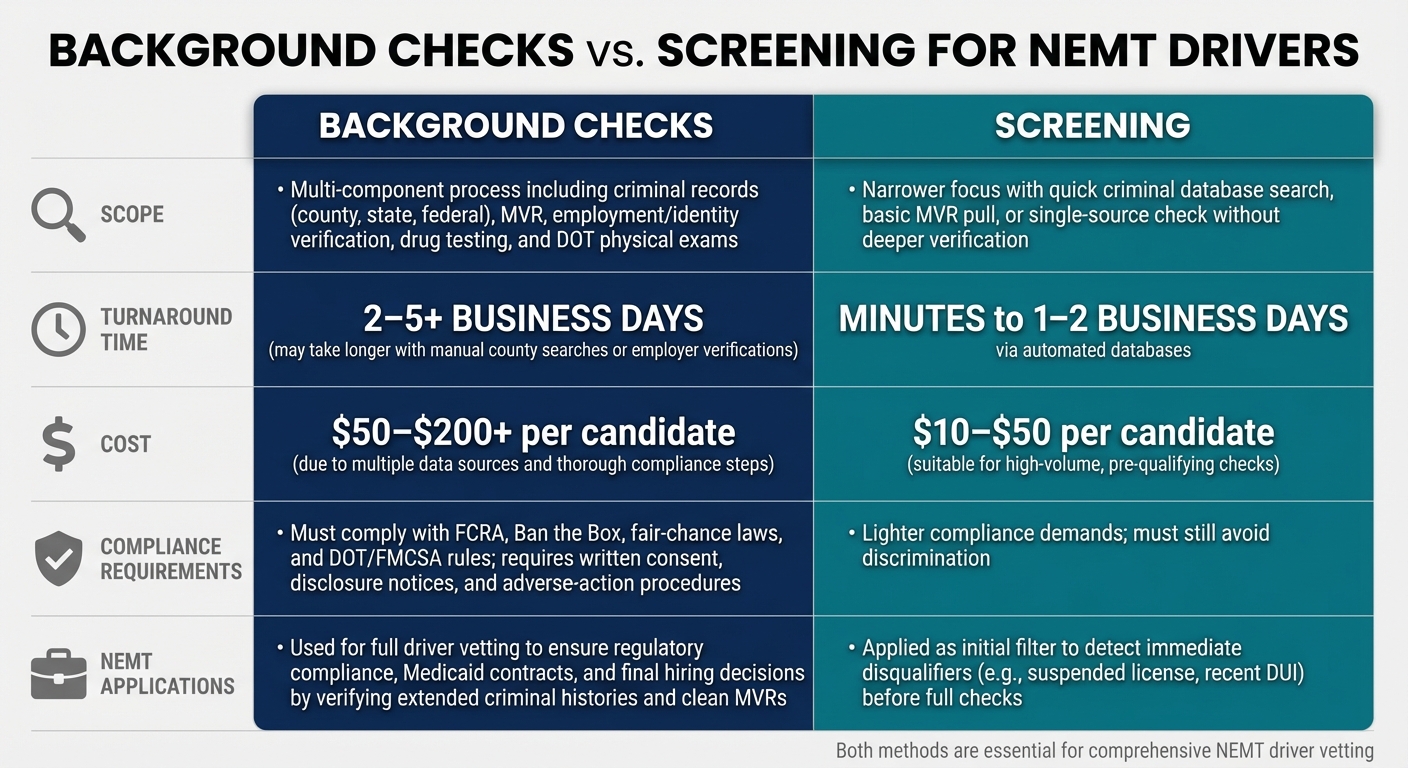
Background Checks vs Screening for NEMT Drivers: Key Differences
Building on the earlier discussion, this section dives into the key distinctions between background checks and screening processes. While both are essential tools for NEMT companies to evaluate driver candidates, they serve different roles in the hiring process. Background checks take a deep dive into records like court documents, DMV reports, federal databases, prior employment, and DOT physicals. These checks usually take 2 to 5 business days or longer to complete[7]. On the other hand, screening is a quicker process, relying on automated database queries or single-source checks, often completed in minutes or within 1 to 2 business days.
The cost difference reflects their varying levels of detail. Screening is more budget-friendly, costing $10 to $50 per candidate, which makes it a good fit for high-volume hiring when you need to quickly weed out unqualified applicants. Background checks, however, cost between $50 and $200 or more, as they include a broader range of checks such as criminal history, MVR reports, employment verification, drug testing, and sometimes DOT physical exams[7]. For NEMT providers, MVR checks alone can add an additional $20 to $40 per report due to state DMV fees.
Compliance is another area where these processes differ significantly. Background checks must meet strict FCRA and DOT standards. Third-party Consumer Reporting Agencies are required to follow FCRA rules, including obtaining written consent, providing disclosure notices, and adhering to adverse-action procedures. DOT-regulated roles demand a comprehensive background check within 30 days of hire, which includes MVR checks, previous employer safety reviews, and drug and alcohol testing history. Screening, while less compliance-heavy, still requires care to avoid discriminatory practices. Many transportation employers are unsure about fully meeting these compliance standards.
In practice, NEMT companies use background checks to meet regulatory requirements and conduct thorough final vetting. These checks verify extensive criminal, driving, and employment records to align with Medicaid and state contract standards. Screening, on the other hand, acts as a quick safety filter at the start of the hiring process. It flags immediate disqualifiers, such as suspended licenses, recent DUIs, or work authorization issues, before committing to a more detailed background check. Experts in the transportation industry emphasize that roles involving last-mile or in-home services - similar to NEMT drivers entering patients' homes - demand more rigorous background checks due to the close interaction with the public and access to vulnerable individuals.
By understanding these differences, NEMT providers can apply the right level of evaluation at each stage of hiring. The table below summarizes the main contrasts between background checks and screening processes:
Comparison Table: Background Checks vs. Screening
Multi-component: criminal records (county, state, federal), MVR, employment/identity verification, drug testing, and DOT physical exams[7].
Narrower: quick criminal database search, basic MVR pull, or single-source check without deeper verification.
Typically 2 to 5+ business days; may take longer with manual county searches or employer verifications[7].
Generally completed within minutes to 1 to 2 business days via automated databases.
Ranges from $50 to $200+ per candidate due to multiple data sources and thorough compliance steps[7].
Costs about $10 to $50 per candidate, making it suitable for high-volume, pre-qualifying checks.
Must comply with FCRA, Ban the Box, and fair-chance laws, as well as DOT/FMCSA rules; requires written consent, disclosure notices, and adverse-action procedures.
Lighter compliance demands; however, screening processes must still avoid discrimination.
Used for full driver vetting to ensure regulatory compliance, Medicaid contracts, and final hiring decisions by verifying extended criminal histories and clean MVRs.
Applied as an initial filter to detect immediate disqualifiers (e.g., suspended license, recent DUI) before full checks.
sbb-itb-cef70f4
When to Use Each Method in NEMT
Picking the right vetting method is key to ensuring safety, meeting compliance requirements, and keeping operations running smoothly in Non-Emergency Medical Transportation (NEMT).
Background Checks for Full Compliance
When hiring full-time NEMT drivers - especially those with Commercial Driver's Licenses (CDL) or roles involving direct patient interaction - comprehensive background checks are a must. These checks should include:
This thorough process helps identify serious issues like felony convictions or falsified work histories, reducing legal risks and protecting patient safety.
Before finalizing employment, it’s crucial to obtain written consent from the candidate and complete the background check after extending a conditional job offer. Skipping this step can lead to regulatory problems, increased liability, and potential harm if a driver with a problematic record is hired.
While background checks are essential for full compliance, quicker screening methods can be useful for more immediate staffing needs.
Screening for Fast Safety Checks
For situations like high-volume hiring or filling temporary positions, quick screening methods are a practical solution. These preliminary checks can include:
These screenings are effective for spotting immediate concerns like suspended licenses, recent DUIs, or substance abuse issues. They’re especially helpful for onboarding seasonal drivers, contractors, or meeting urgent staffing demands.
During busy periods, quick screenings allow NEMT operations to address immediate needs by providing a basic safety check within days. Candidates moving into long-term roles can then undergo full background checks. This phased approach balances the need for speed with the importance of safety and compliance, ensuring operations continue without unnecessary delays.
NEMT Industry Standards and Requirements
When it comes to ensuring compliance, the Non-Emergency Medical Transportation (NEMT) industry adheres to strict standards that emphasize both safety and reliability. These guidelines are built on thorough driver vetting procedures and regulatory requirements.
Required Checks for NEMT Compliance
NEMT providers must comply with a range of requirements set by the Department of Transportation (DOT), Federal Motor Carrier Safety Administration (FMCSA), state Medicaid programs, and various payers. This includes conducting criminal background checks, motor vehicle record (MVR) reviews, employment and license verifications, and drug/alcohol testing to meet these standards.[7]
For roles regulated by the DOT, employers must complete background checks and drug testing within 30 days of hiring. These processes must align with the Fair Credit Reporting Act (FCRA), which mandates consent, disclosure, and proper handling of adverse-action notices. Additionally, state Medicaid programs require both criminal and driving record checks, particularly for drivers who work with vulnerable populations. While specific requirements vary by state, the central focus remains on ensuring public safety.
However, there’s a notable compliance gap among transportation employers. While 59% rate their understanding of screening regulations as good or very good, 66% admit they lack full confidence in their policies' compliance with federal, state, and local laws. Even more concerning, nearly 9% of transportation organizations lack a documented background check policy altogether - the highest rate across all surveyed industries. For NEMT providers, this gap poses serious safety and legal risks.
These regulations highlight the importance of a layered and thorough vetting process, which is explored further below.
Using Both Methods Together
To build a robust compliance strategy, NEMT providers should combine comprehensive third-party background checks with quick in-house screenings. Third-party checks should be conducted during the hiring process and at regular intervals, while in-house screenings can be used for specific tasks like route assignments and safety verifications.[7]
For faster internal reviews, providers can use quick MVR checks before assigning new routes. This can be complemented with reference checks focusing on safety and reliability, as well as interview-based assessments tailored to NEMT-specific needs, such as wheelchair handling skills and HIPAA compliance.[7]
In addition, continuous MVR monitoring is essential for identifying violations or issues between scheduled background checks. This proactive approach ensures that potential problems are caught immediately, rather than waiting months for the next formal review. Platforms like NEMT Entrepreneur offer valuable insights on integrating these safety measures into hiring workflows, helping providers maintain compliance while prioritizing passenger safety.
Conclusion
Background checks and screening aren’t rivals - they work hand in hand to protect passengers and uphold the integrity of NEMT operations. While background checks confirm a driver’s identity, employment history, criminal record, and motor vehicle history for long-term reliability, screening focuses on the present. It asks, “Is this person still a low-risk choice for today’s assignment?” by providing tools like real-time alerts, internal reviews, and ride-along evaluations.
By combining these two approaches, NEMT providers can create a safer environment for passengers, especially seniors, individuals with disabilities, and medically fragile riders. A pre-hire background check might reveal no issues, but ongoing screening ensures that any new violations are caught in time to take action - before they pose a risk to passengers.
This dual-layered strategy isn’t just about compliance - it’s also good for business. Thorough vetting protects your reputation, reduces the costs tied to accidents and incidents, and helps lower turnover by identifying high-risk drivers early. Providers who pair strong pre-employment checks with regular screening often see fewer insurance claims, fewer service disruptions, and better contract retention, all of which boost profitability.
To implement this effectively, establish clear policies for background checks and screening intervals. For example, you might conduct annual motor vehicle record (MVR) reviews alongside quarterly screenings. Work with a screening provider familiar with transportation regulations, document your processes and results, and train your staff on consent, adverse action procedures, and recordkeeping to ensure both legal compliance and operational consistency.
For additional support, resources like NEMT Entrepreneur provide templates, strategies, and expert advice to help U.S. NEMT providers design workflows that align with payer requirements and business growth goals.
Every successful, safe trip starts with a reliable driver behind the wheel. Treating background checks and screening as essential parts of your service not only safeguards passengers and drivers but also strengthens your business. It can even give you an edge in securing and keeping NEMT contracts.
FAQs
What are the benefits of using both background checks and screening when hiring NEMT drivers?
Using both background checks and screening during the hiring process allows for a more in-depth assessment of potential drivers. Background checks delve into a driver’s past, uncovering details like criminal records or driving violations. On the other hand, screening evaluates their current qualifications and whether they’re a good fit for the role.
When these methods are combined, you can boost safety, strengthen reliability, and ensure compliance with industry regulations. This thorough approach plays a key role in creating a secure and dependable environment for passengers - something that’s especially critical in non-emergency medical transportation services.
What are the key compliance differences between background checks and screening processes?
When it comes to background checks, they’re tightly regulated by federal and state laws. These checks often include looking into criminal records, driving history, and sometimes drug testing. To stay compliant, the process must follow detailed documentation and reporting rules.
Screening processes, on the other hand, offer more flexibility. They can go beyond the basics to include things like health assessments or skills tests. However, even with this flexibility, they still need to adhere to legal standards to avoid discrimination and promote safety.
When is it better for NEMT providers to use screening instead of a full background check?
Screening serves as a practical tool for NEMT providers when there's a need to quickly evaluate a driver’s basic qualifications, recent job experience, or general reliability. It’s especially helpful for initial assessments or routine monitoring, where conducting a full background check might not be required.
When time is of the essence or consistent oversight of driver compliance is the goal, screening offers a quicker and more streamlined alternative to in-depth vetting. However, for situations requiring a deeper dive - like verifying criminal records or uncovering more detailed background information - a full background check remains the better choice.
Related Blog Posts
- NEMT Compliance: Complete Guide for Business Owners
- Federal Background Check Rules for NEMT Drivers
- How to Verify Driver Employment History
- NEMT Onboarding vs. Traditional Transportation Services
{"@context":"https://schema.org","@type":"FAQPage","mainEntity":[{"@type":"Question","name":"What are the benefits of using both background checks and screening when hiring NEMT drivers?","acceptedAnswer":{"@type":"Answer","text":"<p>Using both background checks and screening during the hiring process allows for a more in-depth assessment of potential drivers. Background checks delve into a driver’s past, uncovering details like criminal records or driving violations. On the other hand, screening evaluates their current qualifications and whether they’re a good fit for the role.</p> <p>When these methods are combined, you can boost <strong>safety</strong>, strengthen <strong>reliability</strong>, and ensure <strong>compliance</strong> with industry regulations. This thorough approach plays a key role in creating a secure and dependable environment for passengers - something that’s especially critical in non-emergency medical transportation services.</p>"}},{"@type":"Question","name":"What are the key compliance differences between background checks and screening processes?","acceptedAnswer":{"@type":"Answer","text":"<p>When it comes to background checks, they’re tightly regulated by federal and state laws. These checks often include looking into criminal records, driving history, and sometimes drug testing. To stay compliant, the process must follow detailed documentation and reporting rules.</p> <p>Screening processes, on the other hand, offer more flexibility. They can go beyond the basics to include things like health assessments or skills tests. However, even with this flexibility, they still need to adhere to legal standards to avoid discrimination and promote safety.</p>"}},{"@type":"Question","name":"When is it better for NEMT providers to use screening instead of a full background check?","acceptedAnswer":{"@type":"Answer","text":"<p>Screening serves as a practical tool for NEMT providers when there's a need to quickly evaluate a driver’s basic qualifications, recent job experience, or general reliability. It’s especially helpful for initial assessments or routine monitoring, where conducting a full background check might not be required.</p> <p>When time is of the essence or consistent oversight of driver compliance is the goal, screening offers a quicker and more streamlined alternative to in-depth vetting. However, for situations requiring a deeper dive - like verifying criminal records or uncovering more detailed background information - a full background check remains the better choice.</p>"}}]}