NEMT Entrepreneur provides expert insights, strategies, and resources to help non-emergency medical transportation professionals grow their businesses. Get industry-leading advice to succeed in NEMT.
Featured articles
One missed incident report can turn into an OSHA issue, a workers’ comp dispute, or an insurance problem later. In NEMT, I need a reporting process that starts at the scene, moves into a written report before the shift ends or within 24 hours, and ends with proper filing, storage, and trend tracking.
Here’s the short version:
- I secure the scene, check for injuries, and notify dispatch or a supervisor right away.
- I write down facts only: date, time, location, vehicle number, trip ID, injuries, damage, hazards, and witness details.
- I complete the incident report fast, then a supervisor reviews it and checks for gaps.
- I document follow-up, including training, equipment fixes, or process changes.
- I file OSHA reports on time when needed:
- Fatality: within 8 hours
- Inpatient hospitalization, amputation, or loss of an eye: within 24 hours
- Forms 300 and 301: within 7 calendar days
- I notify workers’ comp and insurance carriers without delay.
- I store records securely for at least 5 years and track patterns by route, facility, time of day, and incident type.
A few numbers stand out. Research cited in the article says 71.4% of safety events during transport sessions came from process failures, and 62.1% of harm events happened at arrival hand-off locations. That means the report is not just paperwork. It is a record of what happened, who knew about it, and what was done next.
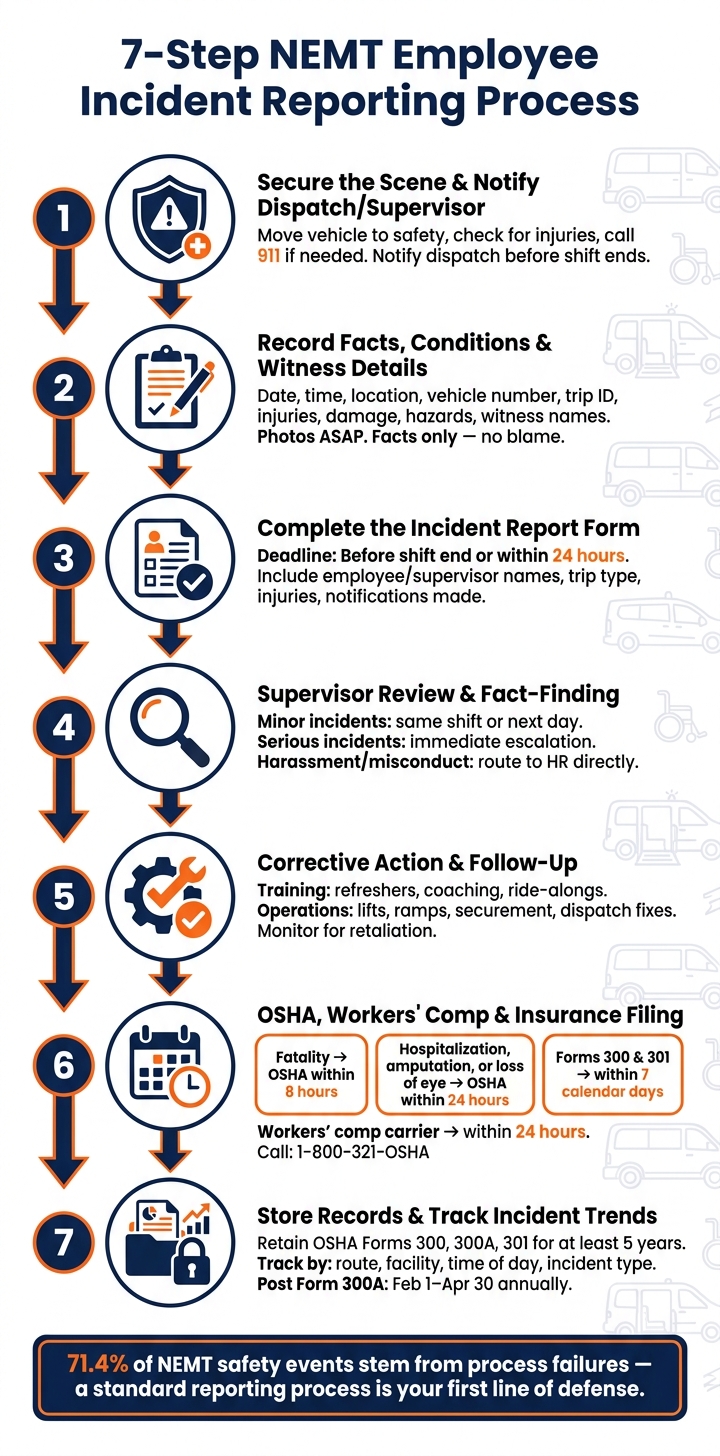
7-Step NEMT Employee Incident Reporting Process
Quick overview
| Step | What I do | Main deadline or focus |
|---|---|---|
| 1 | Secure the scene and notify dispatch/supervisor | Right away |
| 2 | Record facts, conditions, photos, and witnesses | At the scene or as soon as possible |
| 3 | Complete the incident report form | Before shift end or within 24 hours |
| 4 | Supervisor review | Same shift, next day, or at once for serious events |
| 5 | Take corrective action and follow up | After review |
| 6 | Handle OSHA, workers’ comp, and insurance | 8 hours, 24 hours, or 7 days depending on event |
| 7 | Store records and track trends | Keep OSHA logs for at least 5 years |
If I keep the process simple, fact-based, and on time, I make later claims, audits, and internal reviews much easier to handle.
sbb-itb-cef70f4
Steps 1-2: First Response and Scene Documentation
Step 1: Secure the Scene and Notify Dispatch or a Supervisor
Start with safety. Then report what happened.
Once the scene is safe, notify your internal chain of command right away. If you can, move the vehicle to a safe spot, check for injuries, and call 911 if anyone is hurt or there’s immediate danger.
You should also notify dispatch or an on-call supervisor before the shift ends. Waiting too long can make insurance claims harder to process and may even lead to denials. After things settle down and dispatch has been notified, document the scene while the details are still fresh.
Some incidents can also trigger OSHA reporting. Use the table below as a quick reference:
| Incident type | May require OSHA notification |
|---|---|
| In-patient hospitalization from a work-related incident | Yes |
| Work-related amputation | Yes |
| Work-related loss of an eye | Yes |
| Work-related fatality | Yes |
Step 2: Record Facts, Conditions, and Witness Details
Write down the basics first: the date, time, exact location, vehicle number, and trip ID. Then note scene conditions such as road or surface conditions, lighting, and any hazards you can see. Also document visible injuries, property damage, and the police report number if law enforcement responds. Take photos of the scene, vehicle damage, and any related conditions as soon as possible.
Stick to what you observed. Do not assign blame or guess about what caused the incident.
Gather witness names and contact details from anyone who saw what happened, including passengers, bystanders, and facility staff. You can use paper notes or a digital device, but keep that information stored securely.
Those details will be used in the formal incident report in Step 3.
Steps 3-5: File, Review, and Act on the Report
Step 3: Complete the Employee Incident Report Form
Turn your notes into the formal incident report within 24 hours or before the shift ends.
A standard NEMT incident report form should include:
- The employee's name and role
- The supervisor's name
- The exact date and time
- The specific location
- The trip type
Then write a short, fact-based account in time order. Include any injuries, medical care received, missed work, property damage, and who was notified and when, such as dispatch, 911, or a supervisor.
If a patient was involved, only include patient details the report needs. Once the form is filed, the supervisor can check the facts.
Step 4: Supervisor Review and Fact-Finding
After the report is submitted, the supervisor or safety lead checks the facts. That usually means following up with the employee, reviewing witness accounts, and flagging anything that doesn’t line up.
Minor incidents should get follow-up during the same shift or by the next day. Serious incidents need immediate escalation, full documentation, and management involvement.
If the report includes claims of harassment, discrimination, or misconduct, send it straight to HR - not through normal operations channels.
Step 5: Corrective Action and Post-Incident Follow-Up
Figure out what went wrong, then take steps to lower the odds of it happening again.
Corrective action usually falls into two groups:
- Training: refresher training, coaching, ride-alongs, and de-escalation practice
- Operations: fixes related to lifts, ramps, securement, transfers, dispatch, and site access
Once those actions are in place, follow up. Make sure the changes were carried out, and watch for retaliation against the employee who filed the report.
Follow-up should also include a review of lift, ramp, and transfer procedures. If a hazard is still open, it stays open until it’s fixed. And if the incident leads to a reporting duty or a claim, move it to the next compliance step.
Steps 6-7: Compliance, Claims, and Record Storage
Step 6: Handle OSHA Reporting, Workers' Compensation, and Insurance
Once you’ve confirmed the facts in Steps 3–5 and started corrective action, use that same record to file every OSHA, workers’ comp, and insurance notice on time.
Timing matters here. A work-related fatality must be reported to OSHA within 8 hours. An inpatient hospitalization, amputation, or loss of an eye must be reported within 24 hours. You can do that by calling 1-800-321-OSHA or filing online. The reporting clock starts when a supervisor, manager, or HR representative learns about the event.
OSHA-recordable injuries also need to be entered on Forms 300 and 301 within 7 calendar days.
For insurance, move fast:
- Notify your workers’ compensation carrier within 24 hours.
- If there’s property damage or a passenger injury, notify your liability and vehicle insurance carriers immediately.
| Incident outcome | OSHA reporting | Workers' compensation |
|---|---|---|
| Work-related fatality | Report within 8 hours | Notify the carrier within 24 hours |
| Inpatient hospitalization, amputation, or loss of an eye | Report within 24 hours | Notify the carrier within 24 hours |
| Recordable employee injury | Enter on Forms 300 and 301 within 7 calendar days | Notify the carrier within 24 hours |
| Property damage or passenger injury | Not a severe OSHA reporting event unless another trigger applies | Follow workers' compensation rules if an employee was injured |
A simple way to think about it: one set of facts, several filings. If your notes are clean and your timeline is clear, these deadlines are much easier to meet.
Step 7: Store Records Securely and Track Incident Trends
After filing, archive the full incident file. Then use it for something just as important: finding repeat hazards before they lead to worse outcomes.
OSHA requires employers to keep Forms 300, 300A, and 301 for at least 5 years after the end of the calendar year they cover. Keep the backup material in that same file too, including photos, witness statements, and corrective action logs.
Store records in a secure system with role-based access for HR, safety, and legal staff. If you still rely on paper files, keep them in a locked cabinet and maintain a clear access log.
There’s also a posting rule to stay on top of. OSHA Form 300A must be posted in a visible workplace location from February 1 through April 30 each year. And if an establishment has 20–249 employees in high-hazard industries, it must submit 300A data electronically through OSHA’s Injury Tracking Application by March 2 each year.
Don’t let those records just sit there. Track incidents by:
- Route
- Facility
- Time of day
- Incident type
That kind of tracking helps you spot patterns early. Maybe one route keeps producing near misses. Maybe one shift has more lift injuries. Maybe one site has repeat equipment issues. Use those patterns to adjust training, route planning, and equipment checks before the same problem shows up again in a worse way.
Conclusion: A 7-Step Reporting Process for Safer NEMT Operations
A solid incident reporting process is more than paperwork. It helps protect employees, passengers, and the business itself. And each step builds on the last, turning one incident into a clear record that supports safety, compliance, and claims.
In NEMT, many safety events can be prevented. Process failures cause 71.4% of safety events in transport sessions. That’s a big share, and it shows why a standard reporting process matters. It’s one of the first ways to cut risk instead of just reacting to it.
Speed and accuracy both matter at every stage. When your team knows the process, meeting deadlines gets a lot easier. There’s less confusion, less back-and-forth, and less chance that key details slip through the cracks.
Each incident report you file and store gives you something useful to work from later. Over time, steady tracking helps patterns stand out. Maybe the same handoff issue keeps showing up. Maybe one route, one shift, or one type of delay leads to more problems than expected. That’s where reporting starts to pay off: it helps you spot trouble early and fix it before it happens again.
FAQs
What counts as an employee incident in NEMT?
In NEMT, an employee incident is any unwanted event tied to someone’s job duties that causes harm, could have caused harm, damages property, or leads to some other type of loss.
That can include things like:
- accidents
- passenger injuries or fatalities
- vehicle collisions
- allegations such as abuse, neglect, or molestation
- incidents involving fraud, waste, or abuse
- any situation that calls for a safety or response policy because it puts passengers or day-to-day operations at risk
Put simply, if something goes wrong on the job - or comes close enough that it needs attention - it may count as an employee incident.
Who should complete the incident report?
The employee involved in the incident should usually complete the first formal incident report.
They should use their on-scene notes to write a factual, detailed account of what happened. That includes the time, place, and sequence of events.
The report should stick to observed facts. It should not include medical diagnoses, guesses, or assumptions.
What if key details are missing at first?
Document what you know first. Then move right away to fill in the gaps. Contact witnesses or the responding agencies, like the police or fire department, within 24 to 48 hours to get official reports.
Next, review dispatch logs and security footage to confirm the timeline and the order of events. As more facts come in, update the report so it stays accurate and complete.