The operator's publication for non-emergency medical transportation. State licensing guides, broker intel, a 2,000+ provider directory and The Dispatch, our weekly newsletter.
If your NEMT vehicle falls under the federal CMV rules, Part 396 comes down to this: keep it safe, inspect it on time, fix defects fast, and keep the records. Miss an annual inspection, fail to close a DVIR, or ignore a roadside report, and a vehicle can be parked fast. In some cases, federal civil penalties can reach $19,246 per violation, and a missing or incomplete required record can cost up to $1,584 per day, capped at $15,846 (49 CFR Part 386, Appendix B).
First, confirm that Part 396 applies to your fleet. The federal motor carrier safety rules, Part 396 included, apply to commercial motor vehicles (CMVs) operated in interstate commerce (49 CFR 390.3T). Under 49 CFR 390.5T, a vehicle used in interstate commerce is a CMV if it has a GVWR, GCWR, or actual weight of 10,001 pounds or more (whichever is greater), is designed or used to carry 9 or more people including the driver for compensation, is designed or used to carry 16 or more people including the driver without compensation, or hauls placarded hazardous materials. Interstate commerce covers trips that cross a state line, plus in-state legs of a trip that starts or ends in another state. Many NEMT minivan and wheelchair van fleets fall outside federal Part 396, either because their vans are under 10,001 pounds and seat fewer than 9 people including the driver, or because they run only in-state trips. That does not mean no rules apply. States that take federal motor carrier safety grants must keep intrastate rules that are identical to or have the same effect as the federal ones, apart from limited variances such as exempting intrastate vehicles under 26,001 pounds that are not built or used to carry 16 or more people (49 CFR 350.305). Your state Medicaid program, broker contract, or local permit may also set its own vehicle inspection rules. Check your state's rules before you assume you are exempt.
If I had to boil the article down, I’d put it this way:
- Part 396 applies based on CMV status and interstate operation, including weight and passenger count
- Carriers must inspect, repair, and maintain vehicles on a set schedule
- Unsafe vehicles cannot be used
- Drivers, mechanics, and carriers each have paperwork duties
- Annual inspections, DVIRs, and 90-day passenger checks all have set deadlines
- Records must be kept for set time periods and filed by vehicle
A few numbers matter most:
- 10,001 lb or more GVWR, GCWR, or actual weight (whichever is greater) can trigger CMV status
- 9+ passengers including the driver for compensation (or 16+ not for compensation), by design or use, can trigger CMV status
- Annual inspection: every 12 months
- Roadside violation follow-up: 15 days
- DVIR retention: 3 months
- Annual inspection report retention: 14 months
- Roadside report retention: 12 months
Here’s the plain-English takeaway: this rule is not just about shop work. It affects dispatch, driver sign-off, return-to-service decisions, and audit files. If I were reading this for a quick answer, I’d want to know that Part 396 is mostly about three things: safe vehicles, timely repairs, and clean records.
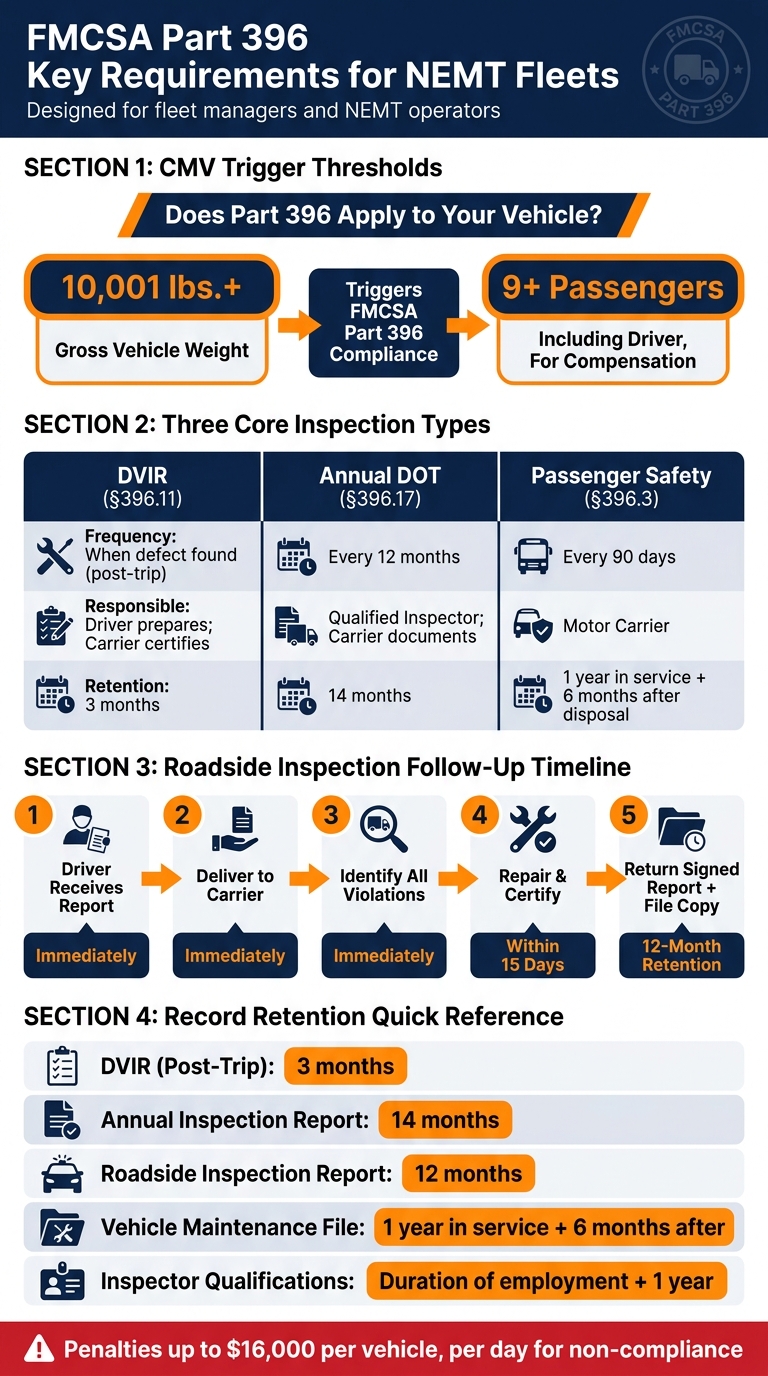
FMCSA Part 396 Inspection & Record Retention Requirements for NEMT Fleets
FMCSA Compliance: Avoiding Violations with Proper Inspections ⚠️
sbb-itb-cef70f4
Core Part 396 Duties for Carriers and Fleet Managers
Part 396 boils down to three day-to-day jobs: keep vehicles maintained, keep unsafe units off the road, and fix roadside findings fast.
Systematic Inspection, Repair, and Maintenance Under §396.3
§396.3 says every carrier must systematically inspect, repair, and maintain all vehicles under its control. In plain terms, you need a written preventive maintenance schedule and an inspection checklist that people actually use.
That program needs to cover key vehicle parts, including frames, suspension systems, axles, wheels, rims, and steering systems. If your fleet uses ADA lifts, the PM plan should also cover lift service on the lift manufacturer's schedule; Part 396 does not set a lift-specific interval. And if someone is responsible for brake work or brake inspections, you need proof that person is qualified, kept at your principal place of business or where that person works, for as long as they do that work plus one year (§396.25).
Unsafe Vehicle Prohibition Under §396.7
§396.7 prohibits operating any vehicle that is likely to cause an accident or breakdown. That duty belongs to the carrier. It does not stop with the driver or mechanic.
That means dispatch can’t send out a vehicle with an open safety defect. If a reported defect is reviewed and you decide it does not need immediate repair, write down the exact reason it does not affect safe operation. If the defect makes unsafe operation likely, the unit needs to come out of service at once.
Roadside inspections are where this gets very real. They show whether your process works on paper and on the road.
Roadside Inspection Follow-Up Under §396.9
Drivers must hand roadside inspection reports to the carrier on arrival at the next terminal or facility, or send them right away if they will not reach one within 24 hours. Out-of-service items must be repaired before the vehicle runs again. Within 15 days of the inspection, the carrier must certify that the violations were corrected, return the signed form to the issuing state agency if that agency asks for it, and keep a copy for 12 months (§396.9).
It helps to put one person in charge of the whole process so nothing slips through the cracks. That person should track each roadside report from start to finish: repair, sign-off, submission, and file retention. Roadside defects should also feed back into your PM schedule, so the same issue doesn’t keep showing up.
| §396.9 Step | Action Required | Deadline |
|---|---|---|
| Driver receipt | Deliver report to carrier | At the next terminal or facility (send right away if not arriving within 24 hours) |
| Identify violations and assign repairs | Identify all cited violations | Immediately |
| Repair & certification | Correct defects and sign report | Safety defects before next use; signed certification within 15 days |
| Report submission | Return signed report to the issuing state agency, if it requests it | Within 15 days |
| Record retention | Keep copy on file | 12 months |
Inspections That Shape Driver and Shop Workflow
These are the inspection deadlines that turn §396.3 into day-to-day dispatch and shop work. Three recurring inspection duties under Part 396 directly affect when vehicles roll, when they stay parked, and how much work lands in your shop on a given day. Miss one, and the fallout shows up fast.
Driver Vehicle Inspection Reports Under §396.11
Passenger-carrying NEMT vehicles need a post-trip report only when a defect or deficiency is found (§396.11). The DVIR rule does not apply to a carrier operating only one commercial motor vehicle. Once a defect is reported, you need to track the issue, the repair certification, and the return-to-service sign-off in the maintenance file. That report kicks off the repair trail your shop has to finish.
This is where things get serious. The process depends on a three-signature chain: the driver who reported the defect, the mechanic who certified the repair or stated that repair was unnecessary, and the next driver who acknowledged the repair before the vehicle went back into service. If even one link is missing, the record is incomplete (§396.13 covers the next driver's review and signature). A missing or incomplete DVIR is a recordkeeping violation, with a maximum civil penalty of $1,584 per day, up to $15,846 (49 CFR Part 386, Appendix B).
Annual DOT Inspections Under §396.17
Every qualifying commercial motor vehicle must pass a full DOT inspection at least once every 12 months, and proof of it (the inspection report or a decal) must be on the vehicle (§396.17). If that inspection expires, the vehicle is out of dispatch.
The inspection must be done by a qualified inspector with training or experience in Part 393 and Appendix A to Part 396 (formerly Appendix G). The carrier also has to keep proof of that inspector's qualifications for as long as that person does its annual inspections, plus one year (§396.19). In practice, many fleets schedule each unit's annual inspection 30 to 60 days before expiration. That gives the shop some breathing room instead of forcing a last-minute scramble.
Passenger carriers also have a separate 90-day check for emergency exits.
Passenger-Carrier Safety Checks Every 90 Days
Passenger-carrying vehicles with emergency exits must have their emergency exits and marking lights inspected and tested at least every 90 days (§396.3(a)(2)). This isn't just a glance-and-go task. Each item should be physically tested and documented in the maintenance file.
Those records must be kept for one year, and for six months after the vehicle leaves your control (§396.3(c)).
| Inspection Type | Frequency | Who Is Responsible | Retention Period |
|---|---|---|---|
| DVIR (§396.11) | At the end of each day; passenger-carrying vehicles file only when a defect or deficiency is found | Driver prepares; carrier reviews and certifies | 3 months |
| Annual DOT (§396.17) | Every 12 months | Qualified inspector; carrier documents | 14 months |
| Passenger Safety (§396.3) | Every 90 days | Motor carrier | 1 year, plus 6 months after the vehicle leaves your control |
Records NEMT Fleets Must Keep Under Part 396
Inspections only count when your records back them up. If an inspection happens, the paper trail has to show it. That means every inspection, defect report, repair, and correction needs to land in the right place.
Vehicle Maintenance Files and Retention Rules
If you control a vehicle for 30 consecutive days or more, Part 396 requires a dedicated maintenance file for that unit. That file needs to include:
- Company number, if the vehicle is marked with one
- Make
- VIN
- Year
- Ownership or lease details, if they apply
It also has to show the due date for each inspection or maintenance task. And it must log every inspection, repair, and maintenance action, along with the date and type.
For passenger-carrying buses, the file also needs the results of emergency exit tests done at least every 90 days. Keep these records for 1 year where the vehicle is housed or maintained, and for 6 months after it leaves your control (§396.3).
File every record by unit number, not by date or vendor.
DVIRs, Annual Inspection Reports, and Roadside Reports
These records should stay separate from the maintenance file. Each one follows its own retention period, so mixing them together can make a mess fast.
Keep:
- DVIRs for 3 months
- Annual inspection reports for 14 months
- Roadside inspection reports for 12 months
If a roadside inspection lists violations, fix them, certify the correction within 15 days, and send the signed report back to the issuing state agency if it asks for it.
Records Reference Tables by Rule Section and Shop Step
These records are the proof behind your maintenance program. The tables below map each record to the rule section and the shop step where it shows up.
Required Records by Rule Section
| Rule Section | Record Type | Key Data Elements | Retention Period |
|---|---|---|---|
| §396.3(b) | Vehicle Maintenance File | Company number (if marked), make, VIN, year, ownership or lease information, maintenance schedule, repair/inspection history | 1 year; and 6 months after vehicle leaves control |
| §396.3(b) | Passenger Exit Tests | 90-day test results for pushout windows, emergency doors, and marking lights | 1 year; and 6 months after vehicle leaves control |
| §396.9 | Roadside Inspection Report | Violation list, certification of corrections | 12 months from inspection date |
| §396.11 | DVIR (Post-Trip) | Vehicle ID, defect list, repair certification, next-driver acknowledgment | 3 months from report date |
| §396.17 / §396.21 | Annual Inspection Report | Inspection date, components checked, inspector ID | 14 months from report date |
| §396.19 / §396.25 | Inspector Qualifications | Training certificates or evidence of qualifying experience for annual and brake inspections | While the person does that work, plus 1 year |
Shop Workflow vs. Record Type
| Workflow Step | Records Created | Responsible Role |
|---|---|---|
| Post-trip | Driver Vehicle Inspection Report (DVIR) | Driver |
| Defect identification | Repair order / work order | Shop manager / mechanic |
| Defect correction | Repair certification (on DVIR or roadside report) | Mechanic / carrier official |
| Scheduled service | Maintenance log / repair order | Mechanic |
| 90-day safety check | Emergency exit test record | Qualified inspector |
| Annual certification | Annual DOT inspection report and sticker | Qualified inspector |
| Hiring maintenance staff | Brake inspector qualification file | HR / fleet manager |
Every shop invoice or work order should include the specific vehicle unit number.
Building a Practical NEMT Maintenance Program
How to Align Preventive Maintenance With Part 396
Use the inspection rules above to build a calendar-based PM program. Set service intervals by mileage, engine hours, or date. Don’t wait until something fails on the road.
In practice, that means putting routine service, lift checks, and inspections on a fixed schedule. Fold the 90-day passenger safety checks and the 12-month annual inspection cycle straight into that plan.
Your checklists should cover the parts that matter most for safe driving:
- Brakes
- Tires
- Steering
- Lights
Once the schedule is in place, the next weak spot is paperwork. A defect only helps you if it moves cleanly into a work order, gets fixed, and gets signed off. DVIR defects should go through the same repair and sign-off flow as scheduled PM work. Digital workflows make this much easier because they keep defects, repairs, and certifications together in one system.
Where NEMT Fleets Fall Short of FMCSA Requirements
Most FMCSA misses come from paperwork, not from skipped repairs. The issue is often simple: the work gets done, but no one records it the right way.
| FMCSA Requirement | Common Current Practice | Risk Level |
|---|---|---|
| Systematic Program (§396.3) | Ad-hoc repairs only when parts break | High - leads to out-of-service violations and poor CSA scores |
| DVIR Follow-up (§396.11) | Defects are reported, but repairs are not certified in writing | High - contributes to maintenance OOS rates |
| Maintenance Files (§396.3(b)) | Loose receipts in a glovebox or kept only at the dealer | Medium - fails DOT audits because records aren't centralized |
| Annual Inspections (§396.17) | Scheduling on the day of expiration | High - no grace period; civil penalties can reach $19,246 per violation (49 CFR Part 386, Appendix B) |
| Roadside Report Follow-up (§396.9) | Filing the report without signing the correction certification | Medium - increases audit risk |
A simple fix: schedule annual inspections 60 days early, then confirm the appointment 30 days before the expiration date. That buffer helps you avoid the last-minute rush that can leave a vehicle with an expired annual inspection and an immediate out-of-service violation.
Conclusion: Part 396 Duties NEMT Teams Cannot Miss
The main duties are pretty clear: run a systematic maintenance program, keep unsafe vehicles off the road, complete DVIRs and annual inspections the right way, and store every record where it’s easy to pull during an audit.
Part 396 compliance comes down to three things: a written schedule, complete records, and one clear owner for follow-up.
FAQs
Does Part 396 apply to all NEMT vehicles?
No. Part 396 applies to commercial motor vehicles operated in interstate commerce, not every vehicle used in NEMT.
Under federal rules (49 CFR 390.5T), a vehicle is a CMV if it has a GVWR, GCWR, or actual weight of 10,001 pounds or more, is designed or used to carry 9 or more people including the driver for compensation, or is designed or used to carry 16 or more without compensation. Vehicles hauling placarded hazardous materials also count.
So if a vehicle is under those limits, or only runs in-state trips, it may not fall under these specific FMCSA inspection and maintenance rules. Your state may still apply similar rules to intrastate carriers.
What happens if a DVIR defect is not signed off?
If a DVIR defect isn't signed off, the motor carrier is out of line with federal rules. Under FMCSA Part 396, the carrier or its agent must certify on the DVIR that the defect was fixed or that no repair was needed before the vehicle is used again.
Running a vehicle with an uncertified, safety-critical defect is prohibited. That can lead to civil penalties, CSA score impacts, and compliance reviews.
Which Part 396 records should I keep separate?
Keep annual inspection reports separate from general maintenance logs. That way, they’re easy to pull during an audit and easier to keep on file for the full 14-month retention period.
Do the same for DVIRs. Give them their own section, since they must stay on file for three months from the date the report was prepared.
This simple setup helps a lot. When you separate annual inspections, DVIRs, and general repair or service records, it’s much easier to track each record type and follow the right retention timeline.