

NEMT Entrepreneur provides expert insights, strategies, and resources to help non-emergency medical transportation professionals grow their businesses. Get industry-leading advice to succeed in NEMT.
Featured articles
Switching to electric vehicles (EVs) for your Non-Emergency Medical Transportation (NEMT) fleet can lead to major cost savings and improved efficiency. Here's why:
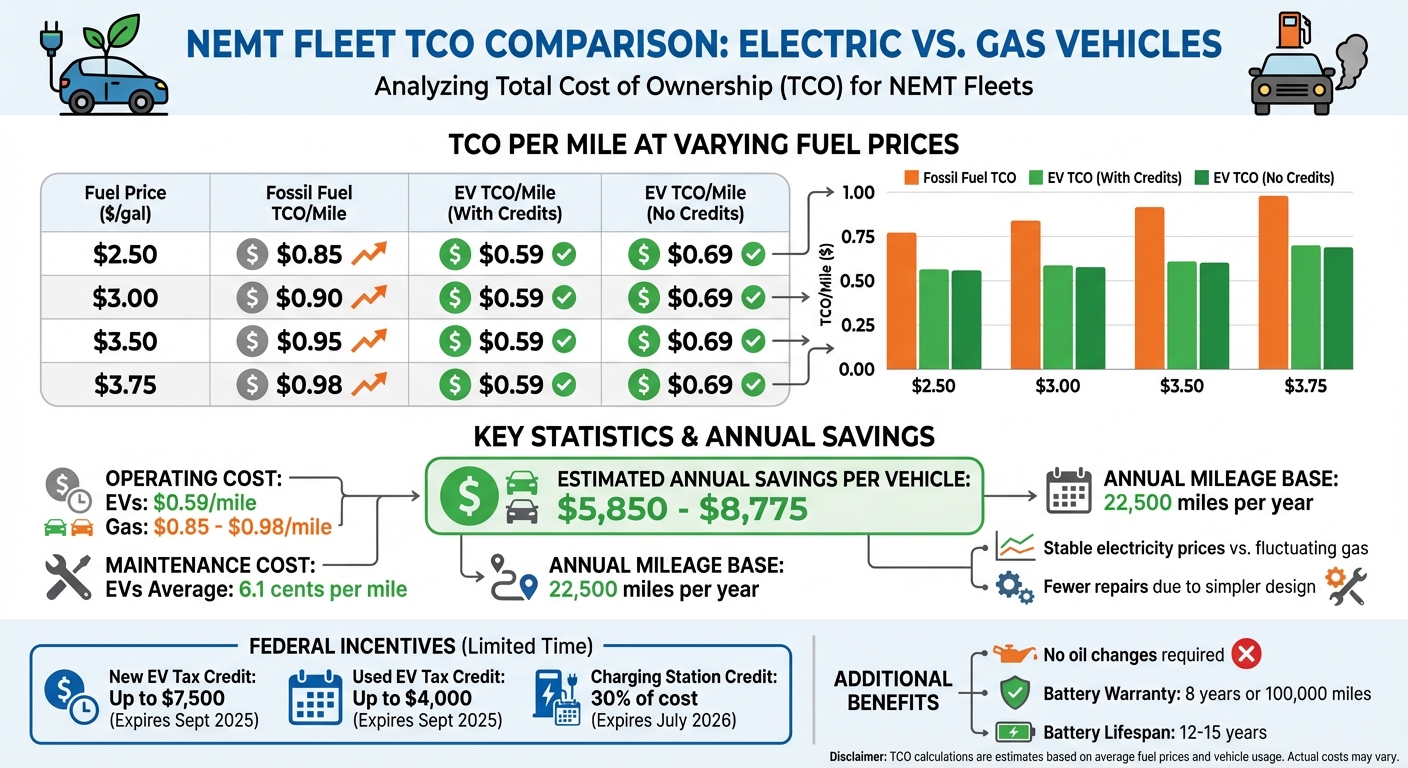
- Lower Costs: EVs cost $0.59 per mile to operate compared to $0.85–$0.98 per mile for gas vehicles. This saves $5,850 to $8,775 annually per vehicle.
- Stable Fuel Prices: Electricity rates are more predictable than fluctuating gas prices, making budgeting easier.
- Minimal Maintenance: EVs require fewer repairs due to simpler designs, saving time and money.
- Federal Incentives: Tax credits of up to $7,500 for new EVs and $4,000 for used EVs are available until September 2025. Charging station credits are valid through July 2026.
EVs are especially suited for NEMT fleets since most trips are short (under 20 miles), and they align well with stop-and-go routes. Additionally, tools like the AFLEET Tool and DRVE can help you calculate costs and emissions reductions, ensuring a smooth transition.
To get started, evaluate your fleet's needs, plan charging infrastructure, and consider launching a small pilot program. This is one of many strategies to grow your NEMT business while optimizing margins. The numbers show that EVs can reduce expenses and improve reliability, aligning with sustainability trends in NEMT.
Fleet Electrification Without the Headache: Smarter Data, Faster ROI | #ElectrifyExpo EVRC Dallas 25
Transitioning to an electric fleet is a key component of modern NEMT sustainability practices for growing providers.
sbb-itb-cef70f4
Cost Savings from Electric Vehicles
EV vs Gas Vehicle Cost Comparison for NEMT Fleets
Reduced Fuel and Maintenance Expenses
Switching to electric vehicles (EVs) can lead to significant savings, particularly in fuel and maintenance costs. This is especially true for short, stop-and-go trips, where EVs shine.
For light-duty EVs, operating and maintenance costs average just 6.1 cents per mile. Unlike traditional vehicles, EVs don’t require oil changes and rely on simpler electrical systems, which means fewer maintenance headaches. Additionally, electricity prices tend to be more stable than fluctuating gasoline prices, offering more predictable budgeting. By using managed charging - charging during off-peak hours when electricity rates are lowest - these savings can stretch even further. Combine these operational advantages with federal incentives, and the financial benefits only grow.
Federal Tax Credits and Financial Incentives
Federal programs provide a major boost to EV affordability. The New Clean Vehicle Credit (Section 30D) offers up to $7,500 for qualifying EVs, while the Used Clean Vehicle Credit (Section 25E) provides up to $4,000 for pre-owned EVs priced at $25,000 or less. However, these credits are only available for vehicles purchased before September 30, 2025.
For those looking to install charging equipment, the Alternative Fuel Vehicle Refueling Property Tax Credit (Section 30C) covers 30% of the cost of EV chargers and installation, applicable to equipment placed in service before July 1, 2026. With Level 2 chargers priced between $400 and $6,500 and installation costs ranging from $600 to $12,700, this tax credit can significantly reduce upfront expenses. Businesses can even transfer these credits to registered dealers at the point of sale, lowering costs instantly - though filing Form 8936 with a federal tax return is still required.
Total Cost of Ownership Over Time
When you combine immediate savings with federal incentives, EVs offer a compelling long-term financial advantage. For example, a paratransit vehicle traveling 22,500 miles annually achieves a total cost of ownership (TCO) of about $0.59 per mile with tax credits. This is considerably lower than the $0.85 to $0.98 per mile for fossil-fuel vehicles. Even without tax credits, EVs still come out ahead at $0.69 per mile.
| Fuel Price (per gallon) | Fossil Fuel TCO/Mile | EV TCO/Mile (With Credits) | EV TCO/Mile (No Credits) |
|---|---|---|---|
| $2.50 | $0.85 | $0.59 | $0.69 |
| $3.00 | $0.90 | $0.59 | $0.69 |
| $3.50 | $0.95 | $0.59 | $0.69 |
| $3.75 | $0.98 | $0.59 | $0.69 |
This cost advantage holds steady across varying fuel prices. Over time, the combination of lower operating costs and reduced downtime makes EVs an efficient choice. Plus, modern EV batteries are built to last 12 to 15 years in moderate climates and often come with 8-year or 100,000-mile warranties, providing peace of mind against unexpected replacement costs.
Practical Factors for Adding EVs to Your Fleet
Once you've considered cost savings, it's time to dive into the operational aspects of integrating electric vehicles (EVs) into your fleet.
Vehicle Range and NEMT Route Requirements
Before choosing an EV, take a close look at your fleet's daily operations. Daily mileage, stop-and-go traffic patterns, and dwell times are critical factors in deciding whether a Battery Electric Vehicle (BEV) or Plug-in Hybrid Electric Vehicle (PHEV) is the better fit for your needs. BEVs are ideal for routes ranging between 100 to 300 miles, especially if overnight charging is available. Meanwhile, PHEVs provide added flexibility by switching to gasoline when the battery runs low.
Keep in mind that factors like extreme weather, challenging terrain, and heavier passenger loads can reduce an EV's range. For Non-Emergency Medical Transportation (NEMT) operations, additional equipment such as wheelchair lifts, ramps, and climate controls can further impact range. Using telematics can help identify which routes are most suitable for electrification.
If range becomes an issue during shifts, Direct-Current Fast Charging (DCFC) offers a practical solution. These chargers can add 100 to 200+ miles in just 30 minutes, allowing vehicles to recharge quickly between routes instead of relying solely on overnight charging. However, incorporating DCFC into your operations requires careful scheduling around available charging locations.
Charging Station Setup and Management
The type of EV you choose will determine the kind of charging infrastructure you need. Level 2 chargers are a great option for overnight charging, providing 10 to 20 miles of range per hour. Typically, you’ll need one Level 2 charger per vehicle. On the other hand, DCFC becomes essential if your vehicles have short breaks between shifts or cover more than 100 miles daily.
Installation costs for charging stations can vary significantly, depending on your facility's electrical setup. Level 2 chargers range from $400 to $6,500, with installation costs between $600 and $12,700. DCFC equipment is more expensive, costing $10,000 to $40,000, while installation can range from $4,000 to $51,000. To cut costs, consider placing chargers near existing electrical panels to avoid expensive trenching. Installing extra circuits and conduits during the initial setup can also save money on future expansions.
Managed charging schedules can help reduce costs by taking advantage of off-peak electricity rates and avoiding high demand charges from utilities. Networked chargers that meet Open Charge Point Protocol (OCPP) version 1.6 or higher offer flexibility, allowing you to switch charging networks without replacing hardware. It's also smart to engage with your local utility provider early on to confirm electrical capacity and explore fleet-specific rate structures.
Meeting Emissions Standards and Regulations
Switching to EVs can help your fleet comply with the Energy Policy Act (EPAct) and various state or local transportation policies. Tools like the AFLEET Tool are invaluable for calculating greenhouse gas reductions when replacing internal combustion vehicles. This software helps estimate petroleum use and emissions, providing the documentation needed for regulatory compliance.
Collaborating with utilities early is crucial for managing electrical demand and addressing grid interconnection requirements. Smart charging systems can stagger charging times, reducing peak power usage and minimizing the risk of high demand charges. Additionally, training drivers on regenerative braking and efficient charging habits can go a long way in improving vehicle range and overall fleet efficiency.
Assessing Your Fleet's Readiness for Electric Vehicles
Evaluating whether your fleet is ready for electric vehicles (EVs) goes beyond just the purchase price. You’ll need to examine operations, infrastructure, and financial factors to make an informed decision.
ROI Calculation Methods and Tools
When calculating the return on investment (ROI) for EVs, it’s crucial to consider the total cost of ownership (TCO). This includes fuel savings, lower maintenance costs, charging infrastructure expenses, and potential tax credits. To simplify these calculations, tools like DRVE, AFLEET, EVI-LOCATE, and the VICE Model provide valuable insights by incorporating local electricity data and emissions forecasts.
- DRVE Tool: This Excel-based calculator compares your current fleet to EV alternatives using regional electricity grid data.
- AFLEET Tool: Developed by Argonne National Laboratory, this tool estimates economic and environmental costs while projecting payback periods for charging infrastructure.
- EVI-LOCATE: Helps with planning charger placement and estimating electrical upgrades required at your facility.
- VICE Model: Focuses on cash flow and payback periods for battery-electric vehicles and related infrastructure.
These tools offer a clear picture of costs and benefits, helping you make data-driven decisions about transitioning to EVs.
Real Examples of NEMT Providers Using EVs
Real-world data can validate these financial models. While EV adoption in Non-Emergency Medical Transportation (NEMT) is still gaining traction, lessons from the paratransit sector are insightful. For instance, modern NEMT systems leveraging digital platforms have reduced ride costs by 30% to 70%. One pilot program reported a 32.4% reduction in per-ride costs within just two months.
Additionally, studies suggest that even a small improvement in NEMT efficiency can yield significant returns. If just 1% of NEMT rides prevent a single hospitalization, the ROI could reach as high as 11 to 1. On top of that, electric paratransit vehicles consistently show lower TCO compared to gas-powered alternatives, regardless of fuel price fluctuations - and that’s before accounting for tax credits.
How to Transition Your Fleet to Electric
Once you’ve assessed the financial and infrastructure benefits, the next step is to identify which vehicles and routes are best suited for electrification. Focus on vehicles with predictable "return-to-base" duty cycles - those that follow consistent, shorter routes and can charge overnight. Use telematics to analyze daily mileage and duty cycles to confirm suitability.
Engage with your local utility provider early in the process. They can help you understand demand charges, explore EV-specific charging rates, and assess your facility’s electrical capacity for potential upgrades.
When planning charging infrastructure, think ahead. Installing extra circuits and conduit during the initial setup is far cheaper than retrofitting later. Opt for networked chargers that support Open Charge Point Protocol (OCPP) version 1.6 or higher, ensuring flexibility and avoiding dependence on a single network provider.
Smart charging systems can help manage electricity use by staggering charging times, which reduces peak demand and lowers utility bills. Additionally, invest in training programs for drivers (covering topics like regenerative braking and efficient charging) and maintenance staff (focused on fleet maintenance tracking and high-voltage system safety).
Starting small is key. Begin with a pilot program - just one or two EVs on your most suitable routes. This allows you to fine-tune operations, optimize charging schedules, and build expertise before scaling up across your entire fleet.
Conclusion: Determining If EVs Fit Your NEMT Fleet
Throughout this guide, we've explored how integrating EVs can transform costs and improve passenger experiences for NEMT fleets. With operating and maintenance costs averaging just 6.1 cents per mile and electricity prices being far more stable than gasoline, EVs offer a clear path to more predictable budgets and significant savings.
Beyond the financial benefits, consider how EVs enhance day-to-day operations. Their instant torque makes stop-and-go traffic a breeze, while quieter rides create a more pleasant experience for passengers. Plus, with fewer moving parts, EVs require less maintenance, reducing downtime and keeping your vehicles in service.
To assess the fit for your fleet, start with the numbers. Use ROI calculators and telematics data to pinpoint vehicles with predictable daily mileage and access to overnight charging. These are the best candidates for electrification.
Once you've identified the potential savings, take a phased approach. Launch a pilot program on select routes to gain hands-on experience, refine charging strategies, and showcase results. Partnering with your local utility early is key - understanding demand charges and exploring EV-specific rate plans can cut costs even further.
The data is clear: EVs can deliver real savings and operational improvements. By focusing on high-impact vehicles first, you can make the most of what EVs bring to your fleet and take a confident step toward electrification.
FAQs
What financial benefits can NEMT providers expect by switching to electric vehicles?
Switching to electric vehicles (EVs) can bring major cost savings for NEMT providers. EVs generally have a lower total cost of ownership (TCO) compared to traditional gas-powered vehicles. Why? Because they’re cheaper to fuel and maintain. On top of that, federal tax credits and rebates can significantly offset the upfront costs of buying EVs or setting up charging stations, making the switch easier on your budget.
There’s more: government grants and programs offer additional financial incentives, and policies favoring zero-emission vehicles can help ensure your fleet stays compliant with future regulations. Over time, these combined savings and incentives don’t just cut operational costs - they also speed up your return on investment, making EVs a smart financial move for NEMT providers.
What’s the best way for NEMT fleets to manage the costs and setup of EV charging infrastructure?
To manage the costs and setup of EV charging infrastructure for your NEMT fleet, start by evaluating your site’s power capacity and your fleet’s daily operational needs. This ensures you avoid unnecessary upgrades and build a system that matches your vehicles' charging demands. Selecting the right chargers - whether Level 2 or DC fast chargers - depends on how often and how far your vehicles travel each day.
You can also tap into federal and state funding programs to help cover installation expenses. Planning ahead is key - use financial tools to analyze costs and estimate payback periods. With thoughtful preparation and smart use of resources, you can integrate EV charging infrastructure into your fleet while keeping costs under control.
What changes are needed to integrate EVs into your NEMT fleet?
Integrating electric vehicles (EVs) into your Non-Emergency Medical Transportation (NEMT) fleet takes some preparation and strategic changes. One of the first steps is setting up charging infrastructure tailored to your fleet. This means choosing the right chargers, organizing efficient charging schedules, and possibly upgrading your facility’s electrical system to handle the demand.
Your team will also need training since EV maintenance differs from that of traditional vehicles. This includes understanding battery care, using software for diagnostics, and performing routine upkeep specific to EVs. Additionally, you’ll likely need to tweak your scheduling and route planning to factor in EV range and charging times. This ensures your services remain dependable without unnecessary delays.
Lastly, updating your fleet management systems can make a big difference. Real-time tools to track charging status, battery health, and vehicle locations can streamline operations and help you get the most out of your EVs while keeping costs down and reducing your fleet’s environmental impact.


