

NEMT Entrepreneur provides expert insights, strategies, and resources to help non-emergency medical transportation professionals grow their businesses. Get industry-leading advice to succeed in NEMT.
Featured articles
Starting a non-emergency medical transportation (NEMT) business in 2026 is a promising opportunity. With a growing demand for medical transportation services, particularly for seniors and individuals with disabilities, this industry offers a stable and profitable path for entrepreneurs. Here’s a quick breakdown of what you need to know:
Key Facts:
- Market Size: Expected to grow to $15.57 billion by 2028.
- Revenue Potential: Average annual revenue per provider is $500,000, with profit margins of 20%-30%.
- Demand Drivers: Aging population, Medicaid coverage, and recurring medical needs like dialysis and therapy.
- Startup Costs: Typically $40,000-$80,000, including vehicles, insurance, and licensing.
Steps to Launch:
- Research Your Market: Identify local demand, Medicaid reimbursement rates, and competitors.
- Create a Business Plan: Outline your services (ambulatory, wheelchair, stretcher), financial projections, and operational strategy.
- Secure Funding: Explore SBA loans or other financing options.
- Meet Legal Requirements: Register your business, obtain an EIN, NPI, and required state licenses.
- Acquire Vehicles: Invest in ADA-compliant vans with wheelchair lifts or ramps.
- Hire and Train Staff: Employ drivers with clean records and provide CPR and safety training.
- Set Up Operations: Use NEMT software for scheduling, dispatching, and billing.
- Build Partnerships: Contract with Medicaid brokers and private healthcare facilities.
This guide covers everything you need to know about starting your NEMT business - from compliance to vehicle setup - so you can launch successfully in 2026.
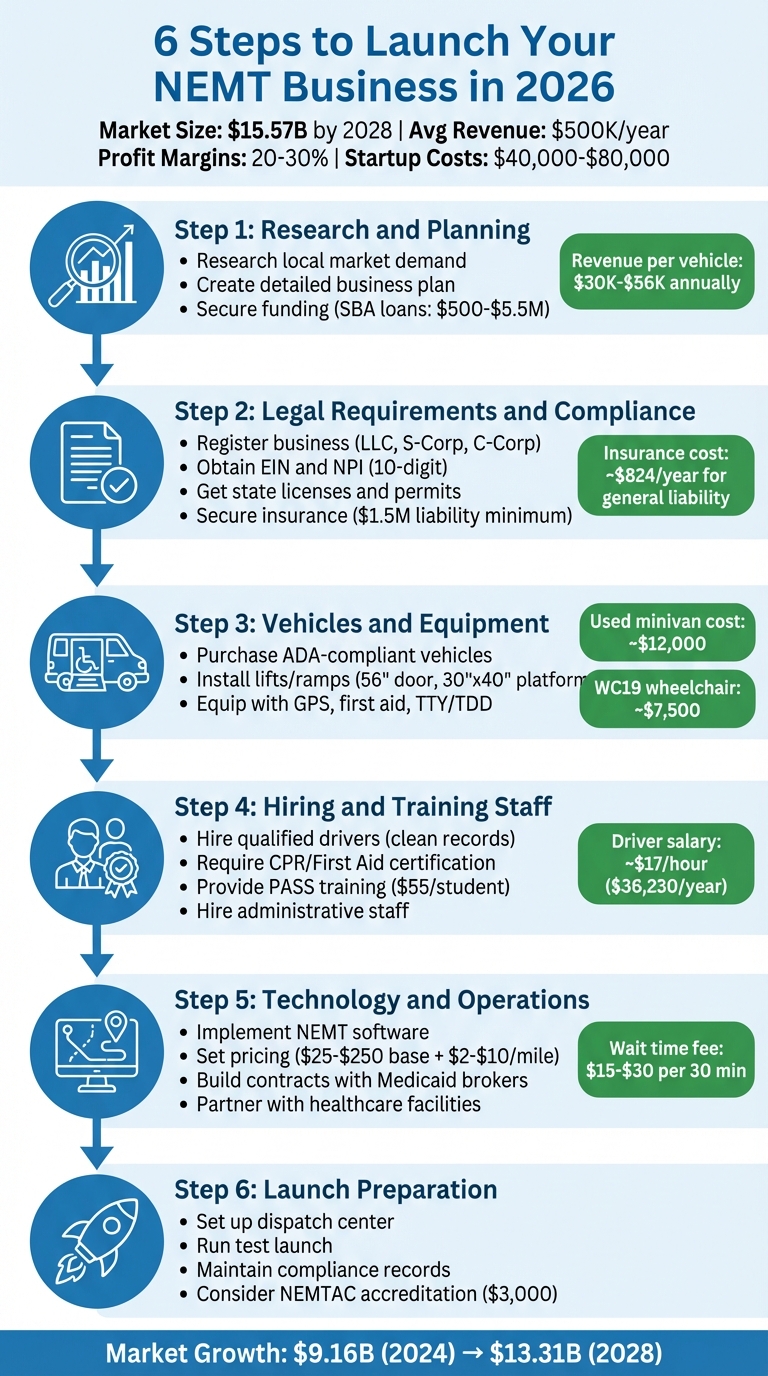
6-Step Process to Launch an NEMT Business in 2026
The Ultimate Guide for Starting a Non-Emergency Medical Transportation (NEMT) Business!
Step 1: Research and Planning
The first step in starting your NEMT business is all about laying the groundwork with solid research and strategic planning. Before spending any money, confirm there’s a demand for NEMT services in your area. Start by identifying your target audience - this typically includes groups like seniors, individuals with disabilities, and low-income patients who rely on transportation assistance. Look into your county’s demographics to estimate the number of people aged 65 and older, and check with local Medicaid offices to find out how many beneficiaries qualify for NEMT services. These initial steps will help you shape a business plan tailored to your market.
Research Your Local Market
Dive into the specific healthcare needs of your community. For example, dialysis patients often need transportation three times a week, while chemotherapy and physical therapy appointments create consistent, recurring demand. Reach out to local social workers, care coordinators, and case managers to uncover gaps in existing services. It’s also helpful to study your competition - what types of transportation services do current NEMT providers offer? Are they focused on ambulatory, wheelchair-accessible, or stretcher transport? How do they price their services?.
Don’t overlook the differences between rural and urban areas. Rural communities often have a higher demand for NEMT services because of limited public transit options and greater distances between healthcare facilities.
Additionally, take time to understand the payer landscape in your state. Medicaid reimbursement rates vary by state, so review your state’s guidelines to create accurate financial projections. Research which NEMT brokers operate in your area - companies like Modivcare and Access2Care manage Medicaid contracts and can play a key role in trip assignments. All of this research will feed directly into your business plan.
Create a Business Plan
A well-thought-out business plan transforms your research into a clear strategy. Start with a market analysis that outlines local demographics, nearby healthcare facilities, and gaps in existing services. Decide on the type of transportation you’ll offer - ambulatory, wheelchair-accessible, or stretcher transport. You’ll also need to choose a legal structure, such as an LLC, C-Corp, S-Corp, or Sole Proprietorship, and define management roles for areas like dispatch, customer service, and finance.
Your financial projections should include all major expenses like fuel, insurance, and vehicle maintenance, as well as your expected revenue per vehicle. On average, an NEMT vehicle can bring in between $30,000 and $56,000 annually. Don’t forget to outline your operational strategy, covering everything from scheduling and dispatching technology to vehicle upkeep.
"Your attention to detail [in a business plan] will encourage confidence in potential investors and help to secure financing for the best start possible" – Kelly Richardson, freelance marketing consultant
Get Startup Funding
Starting an NEMT business typically requires an initial investment of $40,000 to $80,000. The U.S. Small Business Administration (SBA) offers several funding options that can help. For example, their 7(a) loans cover general startup costs and operating capital, with loans ranging from $500 to $5.5 million. For smaller needs, SBA Microloans provide up to $50,000. The SBA’s Lender Match tool can connect you with approved lenders offering flexible terms.
To secure funding, you’ll need to prepare essential documents, including an Employer Identification Number (EIN) from the IRS and a National Provider Identifier (NPI) if you plan to bill Medicaid or Medicare. To save money, consider buying used minivans. For instance, a Toyota Sienna with less than 150,000 miles might cost around $12,000 - significantly less than a new vehicle. Don’t forget to get insurance quotes early, as liability coverage is a major ongoing expense (typically requiring about $1.5 million in coverage). Lastly, show lenders financial projections backed by Medicaid contracts to demonstrate a steady revenue stream.
Step 2: Legal Requirements and Compliance
After completing your research and planning, the next step is to officially establish your non-emergency medical transportation (NEMT) business. Since NEMT operates within healthcare, transportation, and government contracting, you'll need to navigate a maze of federal, state, and local regulations to remain compliant and qualify for Medicaid reimbursements.
Register Your Business
Start by choosing your business structure - options include LLC, S-Corp, C-Corp, or Sole Proprietorship. Check your state's Secretary of State database to ensure your desired business name is available. Once registered, apply for your Federal Tax Identification Number (EIN) through the IRS website. This EIN is essential for tax filings, opening a business bank account, and applying for necessary licenses.
Next, secure your National Provider Identifier (NPI), a unique 10-digit number required for healthcare providers. You can apply for this free of charge on the NPPES website. An NPI is crucial for Medicaid and Medicare billing, and most NEMT brokers will require it to work with your business. If you're operating from home, confirm zoning permits to avoid any legal hiccups.
Get Licenses and Permits
Licensing requirements vary widely by state, so it's important to contact your state's Medicaid office early for the specific NEMT provider enrollment packet. For instance, Arizona requires the PT-28 enrollment packet, California mandates a Public Transportation Permit from the Public Utilities Commission (CPUC), and Minnesota requires Special Transportation Service (STS) certification. In Florida, you'll need a Certificate of Public Convenience and Necessity from local authorities.
Some states also require additional permits, such as a "Seller's Permit" or another type of Certificate of Public Convenience and Necessity, often issued by state revenue or health agencies. For example, in Texas, you may need to pay a $599 fee when submitting your Medical Transport Provider application if you're not already enrolled in Medicare. Check with your local Department of Health and Human Services to determine the exact licenses required for your area.
Driver compliance is another critical area. Ensure all drivers meet the following criteria:
- Negative drug test results
- A clean criminal background check
- Valid health certification
- A driving record with minimal infractions
Additionally, you must screen all employees against federal exclusion lists to confirm they are not barred from participating in healthcare programs. Hiring excluded individuals and billing for their services could result in prosecution under the False Claims Act.
"The regulatory requirements create a natural barrier to entry... because NEMT operates at the intersection of three regulated sectors - healthcare, transportation, and government contracting." - Ryde Central
Once you've secured all necessary registrations and permits, the next step is to protect your business with the right insurance policies.
Get Insurance Coverage
Insurance will likely be one of your largest ongoing expenses, so it's important to choose the right coverage. At a minimum, you'll need commercial auto liability insurance, which many states require to have limits around $1.5 million. Unlike standard personal auto insurance, commercial policies are tailored to cover the specific risks associated with NEMT operations.
In addition to auto insurance, you'll need general liability insurance to protect against non-vehicle-related incidents, such as a client slipping while being helped into your vehicle. On average, a $1 million general liability policy for small businesses costs about $69 per month or $824 annually. You'll also want professional liability insurance (sometimes called errors and omissions insurance) to cover claims of negligence by drivers or staff during transportation.
If you're planning to hire employees, workers' compensation insurance is usually required by law. This coverage handles medical bills and lost wages if an employee gets injured while working. Before hiring any driver, send their license details to your insurance provider for pre-approval. This ensures they meet the insurer's standards and helps prevent unexpected increases in your premiums. To simplify the process, consider working with insurance agencies that specialize in NEMT, such as S.W.A.N. Insurance, as they are familiar with the unique risks of this industry.
"NEMT insurance is not optional: It is mandatory for all vehicles and drivers, to safeguard your business against liability claims and accidents." - Jaycee Morrill, Contributor, Broda
Step 3: Vehicles and Equipment
With your legal groundwork set, the next step is acquiring the essential tools and vehicles to launch your NEMT (Non-Emergency Medical Transportation) service. These choices will directly influence your ability to meet client needs, comply with regulations, and maintain a sustainable operation.
Choose the Right Accessible Vehicles
For NEMT services, minivans and full-size vans are the go-to options. Models like the Toyota Sienna are known for their reliability, while the Ford Transit offers flexible floor plans and extra headroom - ideal for passengers needing additional space. If your services include transporting clients on stretchers, you’ll need specially designed vehicles, such as stretcher-equipped buses or cars built for horizontal transport.
To meet ADA standards and accommodate diverse mobility needs, vehicles should include features like hydraulic lifts or ramps, 4-point tie-down systems, and non-slip flooring. Specific ADA requirements include a 56-inch door opening, a 30" x 40" lift platform, and wheelchair attachments that can handle up to 2,500 lbs of pressure per leg.
For smaller budgets, used minivans with fewer than 150,000 miles are a smart choice, with current prices averaging around $12,000. Focus on mechanical reliability and safety over cosmetic concerns. Before finalizing any purchase, have a trusted mechanic inspect the vehicle to ensure it meets safety and operational standards.
"Transportation issues shouldn't prevent anyone from getting to or from a doctor's appointment." - Imran Cronk, Staff Writer, STAT
Ensure Compliance with Vehicle Regulations
Once you’ve selected your vehicles, the next step is making sure they meet all regulatory requirements. This includes registering them with the appropriate commercial or livery plates. Contact your local bureau of motor vehicles to understand the registration process and associated fees. Additionally, schedule regular safety inspections through your state DOT agency or Medicaid-approved inspectors.
Federal regulations, including those from the Department of Transportation (DOT) and the Americans with Disabilities Act (ADA), set the baseline for compliance. However, state Medicaid agencies often impose additional requirements. Keep detailed vehicle maintenance logs to document inspections, repairs, and services. These records are crucial, as incomplete documentation can jeopardize your eligibility for Medicaid reimbursements.
To stay on top of compliance, create a calendar system to track important deadlines like inspections, license renewals, and scheduled maintenance. Missing these deadlines could sideline your vehicles, disrupting service and impacting clients who rely on you for critical medical appointments.
Equip Vehicles with Safety and Communication Tools
Outfitting your vehicles with the right safety and communication equipment is essential for reliable operations. Install GPS systems for real-time tracking and accurate dispatching. Each vehicle should also carry a first aid kit, and you may want to include CPR equipment, especially since many states require drivers to have CPR certification.
To serve passengers with hearing or speech impairments, consider TTY/TDD (teletype/telecommunications device) equipment. These tools enable text-based communication, ensuring accessibility for all clients. Additionally, enhance passenger safety by installing grab bars and ensuring interior lighting offers at least one-foot candle of illumination, as required by ADA standards.
For clients needing medical support during transit, allocate space for equipment like oxygen tank holders or gurneys, depending on your service scope. If your operation includes wheelchair-bound passengers, consider WC19-compliant transport wheelchairs like the Broda Traversa. These chairs meet federal safety standards for vehicle use and cost around $7,500, offering a practical alternative to traditional stretchers, which can cost $15,000 and often require two operators.
sbb-itb-cef70f4
Step 4: Hiring and Training Staff
A strong team is just as important as dependable vehicles when it comes to running a successful NEMT operation. Building this team starts with hiring qualified drivers and support staff, followed by thorough training to ensure they provide safe, compassionate service while meeting all legal and operational requirements.
Hire Qualified Drivers
Your drivers are the backbone of your service, so it's crucial to hire individuals who meet high standards. Look for candidates with valid licenses, clean driving records, and criminal background clearances. Health certifications are also a must, and you’ll want to verify their licenses with your insurer to avoid unexpected premium hikes.
To comply with Medicaid guidelines, require periodic drug tests and ensure drivers are certified in CPR and First Aid - skills that can make a critical difference during emergencies. Offering Certified Transport Specialist (CTS) training (currently $55 per student as of April 2, 2025) can further elevate their professional qualifications.
Federal compliance is another key consideration. Check that drivers are not listed on the OIG (Office of Inspector General) exclusion list, as employing an excluded individual can result in denied claims or even legal action under the False Claims Act. For context, the average NEMT driver earns about $17 per hour, translating to roughly $36,230 annually.
| Qualification/Certification | Description | Why It Matters |
|---|---|---|
| PASS Certification | Training in Passenger Assistance Safety and Sensitivity. | Sets the standard for assisting passengers with disabilities and those using wheelchairs. |
| CPR & First Aid | Emergency medical response skills. | Vital for handling medical situations during transit. |
| Clean MVR | Motor Vehicle Record free of significant violations. | Ensures driver safety and insurance compliance. |
| Drug Screening | Negative results from initial and random tests. | Mandatory for Medicaid and federal regulations. |
| HIPAA Training | Knowledge of patient data privacy laws. | Essential for handling sensitive medical information. |
| CTS Certification | Advanced transport training for NEMT professionals. | Enhances driver expertise and service quality. |
Once your drivers are in place, focus on assembling a reliable administrative team to keep operations running smoothly.
Hire Administrative Staff
Your administrative team handles critical behind-the-scenes tasks like scheduling, dispatching, and billing. Look for individuals who are skilled in HIPAA compliance and familiar with the specific demands of NEMT services. Conduct regular performance evaluations and budget appropriately based on local wage standards to attract and retain top talent.
Train Your Team
Hiring the right people is only the first step - effective training is what ensures your team delivers safe and efficient service. Role-playing exercises can help staff practice handling difficult passenger interactions or emergency scenarios. For larger teams, consider a train-the-trainer model. Certifying internal instructors through programs like PASS allows you to provide ongoing in-house training.
Training should cover both technical and interpersonal skills. Teach your team how to operate lifts, ramps, securement systems, and other specialized equipment. Equally important is training them in sensitivity and empathy to ensure they provide a service that’s not only competent but also compassionate.
"The PASS program is designed... to ensure that community transportation drivers have current expertise in passenger assistance techniques and sensitivity skills appropriate for serving persons with disabilities." - Community Transportation Association of America (CTAA)
Keep detailed records of all certifications, health clearances, and drug test results to stay compliant with state and Medicaid audits. Regular refresher courses, especially after incidents, can reinforce safety practices and address any gaps in knowledge. This ongoing commitment to training helps maintain high standards and ensures your team is always prepared.
Step 5: Technology and Operations Setup
Once your team is in place, it's time to focus on building a reliable and efficient operations system. The right mix of technology and strategic planning can reduce manual tasks, improve service quality, and boost customer satisfaction.
Use NEMT Software
Investing in NEMT (Non-Emergency Medical Transportation) software can simplify key operations like scheduling, routing, dispatching, and billing. This helps minimize errors and ensures smoother workflows. Such software can also tackle common challenges like traffic delays, vehicle breakdowns, driver call-offs, and last-minute cancellations.
Key features to look for include compliance tools, incident reporting, vehicle maintenance tracking, and Medicaid reimbursement capabilities. GPS tracking and accessibility support, such as TTY/TDD, are also essential. Additionally, robust data security measures are critical to protecting sensitive patient information.
It’s wise to wait until you have at least five vehicles and established broker partnerships before investing in a comprehensive software suite. This allows you to better understand your operational needs and ensure the platform aligns with Medicaid billing guidelines and updates. Popular options in the industry include RoutingBox, TripMaster, and MediRoutes.
Once your operations are streamlined, the next step is to determine a pricing strategy that balances costs and competitiveness.
Set Your Pricing
Pricing is a critical component of your business. It needs to cover your costs while remaining competitive in the market. Start by researching local competitors to identify standard rates in your area. Factor in operational expenses such as vehicle maintenance, which can range from $1,500 to $3,000 monthly, and commercial auto insurance, which often requires liability limits of around $1.5 million. With efficient planning, profit margins in the NEMT industry can hover between 20-30%.
A typical pricing model includes a base pickup fee (ranging from $25 to $250) and a per-mile charge ($2 to $10). You can also adjust pricing based on the type of service provided - ambulatory, wheelchair, or stretcher - since each requires different equipment and staffing. To safeguard profitability during delays, consider adding a driver wait-time fee (commonly $15 to $30 per half hour). Additionally, apply surcharges for off-hours (around 25% more) and holidays (approximately 45% more).
While Medicaid and broker contracts often pay lower rates than private clients, they provide consistent volume. To attract and retain customers, consider offering incentives like multi-service package discounts, referral programs, or loyalty rewards.
With your pricing in place, the next focus should be on securing dependable contracts to ensure a steady flow of business.
Build Contracts with Partners
Securing reliable contracts is key to sustaining your business. Start by working with healthcare providers, insurance companies, and Medicaid brokers. To register with state Medicaid programs, you’ll need to go through Managed Care Organizations or specialized Transportation Brokers. Make sure you have your National Provider Identifier (NPI) - a 10-digit number required for broker contracts.
Registering with major brokers like Modivcare, MTM, or Veyo can connect you to a wide network of patients. For higher profit margins, consider pursuing direct contracts with private medical facilities, such as dialysis centers, hospitals, rehabilitation clinics, nursing homes, and assisted living facilities. Building relationships with case managers, discharge planners, and social workers can also lead to valuable referrals.
To stand out, emphasize features like 24/7 availability, multi-language support, and CPR-certified drivers. A professional website and active social media presence can highlight your fleet's ADA compliance and professionalism. Additionally, distribute marketing materials to local healthcare facilities, monitor government Request for Proposals (RFPs), and join professional organizations like the National Association for Healthcare Transportation Management to build credibility.
The NEMT market was valued at $9.16 billion in 2024 and is projected to grow to $13.31 billion by 2028. This indicates a promising opportunity for providers who position themselves strategically in the industry.
Step 6: Launch Preparation
Now that your contracts are secure and your operational framework is ready, it’s time to gear up for your launch. This stage involves setting up essential systems, ensuring compliance, and conducting final checks to make sure everything runs smoothly.
Set Up Your Office and Dispatch Center
Your dispatch center is the nerve center of your business. Set it up with a reliable computer, high-speed internet, and specialized NEMT dispatch software. If you’re working from home, double-check that your space complies with local zoning regulations. This setup should also include accounting software to track revenue and GPS systems for real-time vehicle monitoring.
To meet ADA requirements, equip your center with telecommunications devices for the deaf (TTY/TDD). The right technology stack is essential - your NEMT dispatch software should handle scheduling, routing, and billing efficiently.
Beyond tech, establish systems for key operations like booking appointments, maintaining vehicle logs, handling customer communication, and tracking incidents. Don’t forget to implement an "exclusion screening" policy to ensure employees and contractors are not barred from participating in federal healthcare programs.
Run a Test Launch
Before opening for business, run a controlled test to confirm that your systems and staff are fully prepared. Take advantage of free demo versions of NEMT software to test whether the platform meets your routing and billing needs. Make sure all drivers have completed essential training, such as PASS (Passenger Assistance Safety and Sensitivity), CPR, First Aid, and Wheelchair Securement.
Check that your drivers’ insurance policies include necessary pre-approvals and meet liability requirements. Also, inspect your fleet to ensure ADA compliance, including lift door heights of at least 56 inches and wheelchair attachments that can withstand 2,500 pounds of pressure per leg.
During this phase, define your services and billing structure clearly to manage customer expectations. Build your digital presence by creating a Google My Business page and a professional website, making it easier for potential clients to find you through searches like "NEMT service near me". This preparation helps avoid common pitfalls like missed pick-ups, cancellations, or no-shows.
Maintain Compliance
Once your operations are underway, staying compliant is absolutely essential to protect your business and ensure Medicaid reimbursements. The Social Security Act requires you to keep detailed records for every trip, including passenger names, pick-up and drop-off locations, dates, times, and mileage. These records must be available for state audits upon request. Regularly audit your trip logs and maintain a compliance calendar to keep track of license renewals, inspections, and certifications, minimizing your risk of violating the False Claims Act.
"Providers who are excluded from one State's Medicaid program must also, by law, be excluded from all States' Medicaid programs as well as from Medicare programs nationwide." - Ryde Central
To meet Medicaid requirements, conduct random drug testing for drivers and periodically check their penalty points to ensure they continue to meet safety standards. Make sure your commercial auto, general liability, and professional liability insurance policies are always up to date, as these are mandatory for maintaining your licenses.
If you’re looking to stand out, consider pursuing NEMTAC accreditation. While the accreditation costs $3,000 upfront (including a $600 non-refundable application fee), it’s valid for three years. In some states, this accreditation can simplify regulatory requirements - Mississippi, for example, accepts it instead of a state license, and Minnesota brokers offer financial benefits to accredited providers.
Stay informed about Medicaid program changes and billing updates to avoid delays in reimbursements. For instance, in October 2023, the Centers for Medicare and Medicaid Services (CMS) imposed a six-month moratorium on new NEMT provider enrollments in Colorado’s Health First Colorado program to address fraud and abuse concerns.
Conclusion
Launching a Non-Emergency Medical Transportation (NEMT) business in 2026 requires thorough planning, strict adherence to regulations, and a focus on delivering high-quality service. With the industry expected to grow significantly, there’s no better time to step into this market. However, success hinges on meeting legal requirements, ensuring ADA-compliant vehicles, and forming strong partnerships with Medicaid brokers.
To get started, it’s essential to follow the necessary steps for setting up your business. Proper registration, investment in ADA-compliant vehicles, and the use of specialized dispatch software are key to building a strong foundation. Striking a balance between Medicaid contracts and private-pay clients can also help you maintain steady revenue streams.
Compliance plays a critical role in your business’s success. Accurate trip records, regular driver drug testing, and up-to-date insurance policies are non-negotiable. Staying informed about Medicaid program updates will help you avoid reimbursement delays and steer clear of legal complications. By prioritizing compliance, you set your business up for long-term stability and profitability.
Start small with a limited fleet, focus on mastering your local market, and gradually expand as you develop partnerships with healthcare providers and social workers. With careful planning and a commitment to providing reliable service, your NEMT business can fulfill vital transportation needs while achieving steady growth.
FAQs
What legal steps are required to start an NEMT business?
To legally establish a Non-Emergency Medical Transportation (NEMT) business, there are several key steps to follow. Start by deciding on your business structure - many opt for forming a Limited Liability Company (LLC). Then, register your business name with your state and apply for a Federal Employer Identification Number (EIN) through the IRS. Depending on your state’s requirements, you might also need to file for a Doing Business As (DBA) name and secure a state-specific NEMT permit.
Since NEMT services often involve Medicaid reimbursements, obtaining a National Provider Identifier (NPI) is essential, along with enrolling in your state’s Medicaid program. Additionally, compliance with healthcare regulations like HIPAA is critical to safeguard patient information. Drivers may also need certifications, such as CPR, First Aid, and wheelchair-securement training, to meet safety and care standards. Vehicles used for transportation must comply with state and ADA requirements, undergoing regular inspections to ensure they’re fit for service.
Lastly, securing the right insurance coverage is a must. This includes commercial auto insurance, general liability insurance, and workers’ compensation for your employees. These policies not only protect your business but are often mandatory for Medicaid contracts, providing peace of mind as you operate.
What are the best ways to secure funding for my NEMT startup?
To get your NEMT business off the ground, one option to consider is applying for U.S. Small Business Administration (SBA) loans, which are tailored to support new businesses in accessing funding. Start by crafting a comprehensive business plan that highlights your services, expected cash flow, and key expenses like vehicle purchases and insurance. With this plan in hand, you can explore SBA-backed funding options such as:
- 7(a) Loan Program: Offers up to $5 million for working capital, equipment, or other business needs.
- CDC/504 Loan Program: Designed specifically for purchasing vehicles or facilities.
- Microloan Program: Provides loans of up to $50,000, ideal for smaller startup expenses.
These loans are available through participating banks and credit unions, making them accessible to many entrepreneurs.
Beyond SBA loans, there are other funding avenues to explore. Look into local grants, Medicaid-related contracts, or even private investors who have an interest in healthcare logistics. Keep in mind that lenders and grant committees typically require documents like proof of licensing, insurance, and a clear repayment strategy. Pairing SBA programs with these additional resources can help you secure the funding needed for vehicles, staff, and the necessary technology to successfully launch your NEMT business.
What technology do I need to run a successful NEMT business?
Running a Non-Emergency Medical Transportation (NEMT) business comes with its own set of challenges, and scheduling and dispatch software can make a world of difference. This technology simplifies trip planning, optimizes routes, and allows you to monitor vehicles in real time - all of which help ensure your clients receive timely and reliable service.
When choosing software, prioritize options that integrate seamlessly with billing systems, comply with industry regulations, and include helpful features like automated reminders and GPS tracking. These tools not only boost operational efficiency but also minimize errors and improve the overall experience for your customers. The right software can be a game-changer for managing your business effectively.


