

NEMT Entrepreneur provides expert insights, strategies, and resources to help non-emergency medical transportation professionals grow their businesses. Get industry-leading advice to succeed in NEMT.
Featured articles
Managing dialysis transportation is a logistical challenge. Patients with ESRD often need six trips weekly for life-saving treatments, requiring precision and reliability. Missed or delayed sessions can lead to severe health risks, making efficient transportation critical. Non-Emergency Medical Transportation (NEMT) providers face hurdles like overlapping schedules, traffic, and accessibility needs. Manual systems often fail under this complexity, leading to inefficiencies, higher costs, and patient dissatisfaction.
Key Insights:
- Dialysis patients require over 300 trips annually, with many needing wheelchair-accessible vehicles.
- Manual scheduling struggles with traffic, cancellations, and overlapping appointments.
- Automation tools streamline trip creation, optimize routes, and reduce no-shows.
- Real-time GPS and AI-powered systems improve fleet use and ensure on-time arrivals.
- Integrated billing systems cut errors, ensure compliance, and boost revenue.
Automation transforms dialysis transportation by reducing administrative burdens, improving fleet efficiency, and enhancing patient care. For providers, these tools are not just helpful - they’re essential for managing growing demand while maintaining service quality.
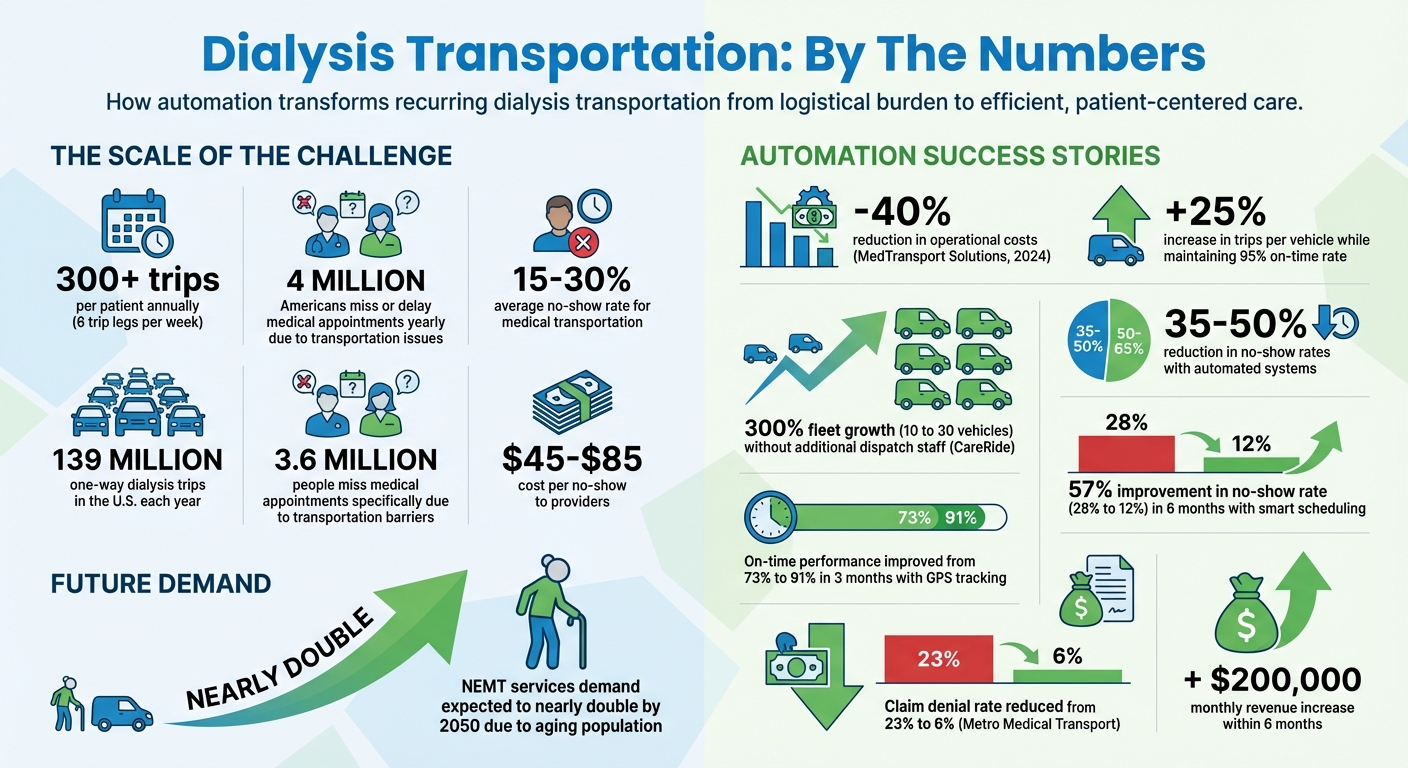
Dialysis Transportation Statistics and Impact of Automation on NEMT Operations
Non-emergency medical transportation: Route planning with Pickup Time Optimisation
Challenges of Managing Recurring Dialysis Transportation
Coordinating recurring dialysis transportation is a whole different ballgame compared to managing one-time medical trips. Sure, the schedules seem predictable - three sessions a week, every week - but that consistency often reveals cracks in the system. These challenges become glaringly obvious during daily operations.
How Recurring Schedules Impact Operations
Dialysis patients typically require six trip legs per week. Multiply that by the number of patients, and the administrative workload grows exponentially. Dispatch teams often find themselves overwhelmed, especially when overlapping appointments and urban traffic push fleet capacity to its limits.
The stakes here are not just logistical - they’re deeply personal. Late arrivals don’t just inconvenience staff; they can cut treatment sessions short, putting patients' health at risk. After dialysis, many patients feel drained, making long waits or extended travel times not just uncomfortable but potentially harmful. To complicate matters further, many of these patients rely on wheelchair-accessible vehicles and need assistance with mobility aids, adding another layer of coordination to an already complex system.
Why Basic Scheduling Falls Short
This level of complexity exposes the limitations of traditional scheduling methods. Paper-based systems, spreadsheets, and basic calendars might work for simpler tasks, but they crumble under the weight of real-time challenges like traffic jams, vehicle breakdowns, or last-minute driver absences. RouteGenie highlights this issue:
"Inefficient scheduling, no-shows, cancellations, traffic problems, vehicle breakdowns, driver call-offs, and many other inconveniences can interfere with daily trip schedules."
Basic dispatch systems just can’t juggle the countless variables - like overlapping time slots, vehicle availability, and traffic conditions - needed to create efficient routes. The result? Around 4 million Americans miss or delay medical appointments every year due to transportation issues. For dialysis patients, these delays aren't just inconvenient; they can be life-threatening. Traditional methods also overlook opportunities for multi-loading (transporting multiple patients in one trip), leading to higher costs and unnecessary mileage.
Using Automation to Manage Recurring Schedules
Managing the recurring demands of dialysis transportation can be a logistical challenge, but automation provides a powerful way to streamline the process. By eliminating the need for manual scheduling, modern tools can handle the creation of recurring trips, sync with brokers, and make real-time route adjustments. These features tackle the complexities of scheduling head-on.
Automated Trip Creation and Schedule Templates
Standing orders are the foundation of dialysis transportation. These physician-approved recurring treatment plans are typically for patients requiring transportation three times a week. With modern software, these standing orders can now be processed digitally, creating trips weeks or even months in advance. This eliminates the need for faxes and reduces the volume of phone calls.
Fred Potts, owner of FPE LLC, experienced the transformative power of automation firsthand. Over the course of a year ending in 2024, his company doubled its trip volume after adopting automated scheduling. By removing the need for manual trip creation, his team could shift their focus to delivering better service instead of being bogged down by paperwork. As Fred explains:
"With Nemt we have been able to save time, energy and efficiency and revenue."
The software doesn’t stop at just scheduling - it also assigns the best vehicle and driver for each trip. Plus, it can make instant adjustments to schedules when changes arise.
Reducing Data Entry Through System Integration
Automation goes beyond scheduling. System integration significantly cuts down on administrative tasks by pulling trip details directly from broker portals. With just one click, patient information, appointment times, pickup addresses, and special requirements are seamlessly added to the schedule - no manual entry required.
Raquel Purvis, who oversees more than 300 trip legs daily at Goodwill Transportation Services, highlights how this integration has revolutionized her billing process. She shares:
"One of my biggest issues before utilizing them was billing. They handle that process with ease ensuring all claims are filed timely and fix errors as needed quickly to ensure timely payments."
Features like bulk import allow providers to upload ride bookings, payments, and driver details all at once. The system even validates insurance and flags missing authorizations, ensuring smooth operations. For NEMT providers managing the 139 million one-way dialysis trips that take place each year in the U.S., automation isn’t just a helpful tool - it’s a game-changer.
Improving Fleet Utilization for Recurring Trips
Making the most of your fleet means cutting down on unnecessary miles and ensuring vehicles operate as efficiently as possible. Tools like smart routing and real-time adjustments can play a big role in achieving this.
Route Optimization to Reduce Costs and Mileage
Route optimization tools use advanced algorithms to group passengers heading to the same destinations, such as dialysis centers. This minimizes deadhead miles - those empty trips between stops - and ensures vehicles are used efficiently. These tools also consider critical factors like appointment time windows (arriving 5–15 minutes early) and traffic patterns to create routes that are both timely and cost-effective.
The impact of these tools is evident. MedTransport Solutions, a regional NEMT provider, adopted AI-driven route optimization in 2024 and saw a 40% drop in operational costs. They also managed to increase trips per vehicle by 25% while maintaining an impressive 95% on-time rate. Similarly, CareRide expanded its fleet from 10 to 30 vehicles - a 300% growth - without needing to hire additional dispatch staff, all while maintaining a 99% patient satisfaction rate.
The software also ensures the right vehicle is assigned for each trip. For instance, a wheelchair-accessible van is allocated to patients who need it, while ambulatory passengers are matched with sedans. This approach avoids using larger, fuel-intensive vehicles for single-passenger trips, cutting down on waste. Additionally, traffic-aware routing adjusts estimated arrival times (ETAs) based on real-time congestion, especially during peak dialysis shifts, ensuring patients spend as little time as possible in transit.
These optimized routes form the backbone for dynamic adjustments made through real-time dispatching.
Real-Time Dispatching and Schedule Adjustments
GPS-enabled systems make it possible to track vehicles in real time, allowing providers to respond instantly to delays, cancellations, or breakdowns. For example, if a patient reschedules, the system can quickly reassign the trip to the nearest available vehicle.
One regional NEMT provider in New York City successfully managed overlapping dialysis appointments during peak traffic hours by using the NextBillion.ai Route Optimization API in August 2024. By setting strict time windows (e.g., 1:45 PM–1:55 PM drop-offs for 2:00 PM appointments) and leveraging real-time traffic data, they navigated NYC’s congestion and ensured every patient arrived on time. As highlighted by NextBillion.ai:
"The optimizer will prioritize fulfilling the tasks over minimizing operational costs."
Real-time systems also enable multiloading opportunities. For instance, if a driver completes a trip early, GPS tracking can identify nearby pickups, allowing dispatchers to add passengers without disrupting the schedule. This adaptability helps providers handle an increasing number of recurring trips without constantly needing to expand their fleet.
sbb-itb-cef70f4
Reducing No-Shows and Scheduling Conflicts
Continuing with automation strategies, tackling no-shows and scheduling conflicts takes service reliability to the next level.
Missed appointments aren't just inconvenient - they’re costly. Each no-show can cost providers between $45 and $85, and with a no-show rate hovering around 15%–30%, every missed dialysis trip puts patient care at risk while driving up operational expenses. Automated systems have proven effective, cutting no-show rates by 35% to 50%.
Automated Reminders for Patients and Drivers
Sending reminders through multiple channels - text, email, phone calls, and app notifications - helps prevent miscommunications. These interactive reminders allow patients to confirm, cancel, or reschedule appointments instantly, addressing a major cause of missed appointments: poor communication, which accounts for 40% of no-shows.
Take this example: a regional healthcare provider serving over 150,000 patients adopted smart scheduling with EHR integration and automated reminders in 2025. Within just six months, their no-show rate plummeted from 28% to 12% - a 57% improvement. This meant 2,400 more completed trips annually, and patient satisfaction scores jumped from 3.2 to 4.6 out of 5.
Real-time GPS tracking further enhances reliability by providing accurate ETAs, which reduces patient anxiety and delays. One rural NEMT provider with a fleet of 12 vehicles saw its on-time performance improve from 73% to 91% in just three months, along with a 31% drop in missed appointments.
These communication tools lay the groundwork for smarter conflict resolution in scheduling.
Detecting and Resolving Scheduling Conflicts
AI-powered scheduling tools help identify and resolve issues like double bookings, overlapping driver schedules, and vehicle mismatches.
For dialysis patients, where precise timing is critical, traffic-aware routing tools ensure drivers arrive within a tight 10–15 minute window. These tools can dynamically adjust routes or dispatch additional vehicles during busy periods. Combined with real-time GPS tracking, dispatchers can quickly reassign trips to the closest available vehicle, minimizing disruptions and keeping services running smoothly.
Managing Billing and Compliance for Recurring Services
Once your scheduling and dispatch systems are running smoothly, the next step is ensuring accurate, timely payments while adhering to all necessary regulations. Effective billing automation ties together the earlier efficiencies, creating a seamless service cycle.
Automated Invoicing and Trip Documentation
With scheduling and dispatch optimized, the focus shifts to streamlining billing, the final link in the chain.
Handling manual billing for recurring dialysis trips - often six trips per week per patient - can lead to mountains of paperwork and frequent errors. Automated billing systems solve this by consolidating multiple recurring charges into a single, clear, and accurate invoice.
The real power lies in integration. When billing software connects with GPS tracking and dispatch systems, it automatically records mileage, applies contracted rates, and attaches critical documentation like pick-up and drop-off times, driver names, and vehicle IDs. This eliminates manual data entry, reduces errors, and prevents unexpected charges, cutting down on billing disputes.
Take Metro Medical Transport, for instance. In early 2024, they faced a 23% claim denial rate, losing $150,000 monthly in revenue. By adopting integrated billing software with GPS tracking, they slashed claim denials to 6% and boosted monthly revenue by $200,000 within six months. This transformation significantly improved their dialysis transportation operations.
These systems also streamline standing order management, automatically broadcasting recurring schedules. Plus, they perform real-time eligibility checks before trips, catching potential payment issues before vehicles hit the road.
Meeting Regulatory Requirements
Automated documentation doesn’t just make billing easier - it also ensures compliance with strict regulatory standards.
Compliance isn’t optional, and penalties for non-compliance can be severe. Drivers and vehicles must have proper state credentials before providing services. Linking your billing system to credentialing software ensures you don’t bill for services provided by unapproved drivers or vehicles, avoiding costly mistakes.
For longer trips, documentation requirements increase. Trips over 25 miles require more than basic logs; they must include the treating provider’s explanation for why a closer facility wasn’t used. In Colorado, for example, NEMT claims exceeding 52 miles (or 125 miles in rural areas) are automatically flagged for review.
Security standards are also tightening. Starting in 2025, HIPAA compliance mandates two-factor authentication (2FA) for billing systems, encrypted data transmission, and detailed audit trails to track every system access. GPS validation has also become critical, with payers cross-referencing driver logs against GPS data to prevent fraud and mileage inflation.
Consider the case of Regional Transport Solutions. GPS monitoring revealed a fraud scheme involving $45,000 in inflated mileage claims across 200 trips. Their automated mileage system not only stopped further losses but also helped recover $38,000 through corrected claims and negotiations with payers. These digital systems provide tamper-proof records, protecting you during audits and giving payers the verification they need.
Conclusion
Managing recurring dialysis transportation can be a complex task, but tools like automation, route optimization, and real-time scheduling make it significantly easier.
Features such as automated standing orders, traffic-aware routing, and real-time GPS tracking streamline operations by cutting out repetitive tasks, ensuring on-time arrivals, and reducing patient no-shows. These improvements don’t just enhance workflows - they directly contribute to better patient care.
The benefits extend well beyond operational efficiency. Reliable transportation addresses critical challenges in both logistics and healthcare. Every year, around 3.6 million people in the United States miss medical appointments due to transportation issues. For dialysis patients, even a single missed treatment can lead to serious health risks. Research consistently highlights transportation barriers as a key reason for missed or shortened dialysis sessions, which can result in poor health outcomes. By ensuring dependable transportation, you're not just improving your operations - you’re playing a vital role in enabling patients to receive essential, life-saving care.
Adopting modern tools also positions providers for scalable growth. With the number of older adults relying on NEMT services expected to nearly double by 2050, it’s crucial to establish systems that can expand without increasing costs proportionally. By incorporating automated billing, digital documentation, and optimized routing, providers can grow their services while maintaining excellent care standards.
FAQs
How can automation make dialysis transportation more efficient?
Automation streamlines dialysis transportation by replacing tedious manual tasks with smart, software-based solutions. With advanced scheduling tools, recurring dialysis trips can be organized in just minutes. These tools match patients with the nearest available vehicle and create efficient daily routes, cutting down on dispatch time and reducing the chances of errors. Plus, they ensure that specific patient needs - like wheelchair or walker accommodations - are carefully accounted for.
These automated systems also leverage real-time traffic updates and dynamic routing to adjust routes on the fly. This helps drivers avoid unexpected delays and stay on schedule, ensuring patients arrive on time for their appointments. By improving punctuality, reducing travel time, and optimizing fleet use, automation not only guarantees dependable service for patients but also helps providers lower their operational costs.
What challenges do transportation providers face with recurring dialysis appointments?
Managing transportation for dialysis patients is no small task. These treatments typically happen three to four times a week at set times, which means providers must juggle overlapping schedules, deal with traffic, and ensure patients arrive on time. Being late isn’t just inconvenient - it can have serious health consequences for those undergoing dialysis.
On top of that, many dialysis patients face mobility challenges and depend on wheelchairs, walkers, or other assistive devices. This means transportation routes need to be planned with both efficiency and accessibility in mind. Add to this the growing demand for dialysis transportation and limited fleet availability, and the situation becomes even more complex.
Providers also have to navigate regulatory hurdles, such as meeting Medicaid or Medicare compliance standards, while ensuring recurring trips are properly scheduled and billed. These administrative tasks can quickly pile up, adding another layer of difficulty to an already demanding process.
How does route optimization help lower costs for dialysis transportation?
Route optimization plays a key role in cutting costs by shortening travel distances and reducing idle time. This means vehicles can handle more trips in less time, which translates to lower fuel consumption, decreased labor costs, and less strain on the vehicles.
Efficiently planned routes can help transportation providers save as much as 40% on operating expenses. At the same time, they can deliver dependable and timely service for patients, improving both cost management and scheduling reliability.


