NEMT Entrepreneur provides expert insights, strategies, and resources to help non-emergency medical transportation professionals grow their businesses. Get industry-leading advice to succeed in NEMT.
Featured articles
Trip waste costs NEMT providers billions annually, impacting revenue, compliance, and patient satisfaction. The main culprits? No-shows, inefficient routing, and unproductive miles. But there’s good news: modern tools can fix these issues.
Here’s how you can reduce wasted trips and improve efficiency:
- Automated Scheduling: Software like Bambi assigns trips intelligently, avoiding mismatches and double bookings.
- Route Optimization: Tools like MediRoutes and RouteGenie cut unproductive miles with efficient routing and real-time adjustments.
- No-Show Management: Platforms like TripMaster send automated reminders to reduce cancellations and idle time.
The right tools save money, improve service, and boost productivity. Want to cut costs and handle more trips without expanding your fleet? Start by identifying inefficiencies, then invest in specialized NEMT software.
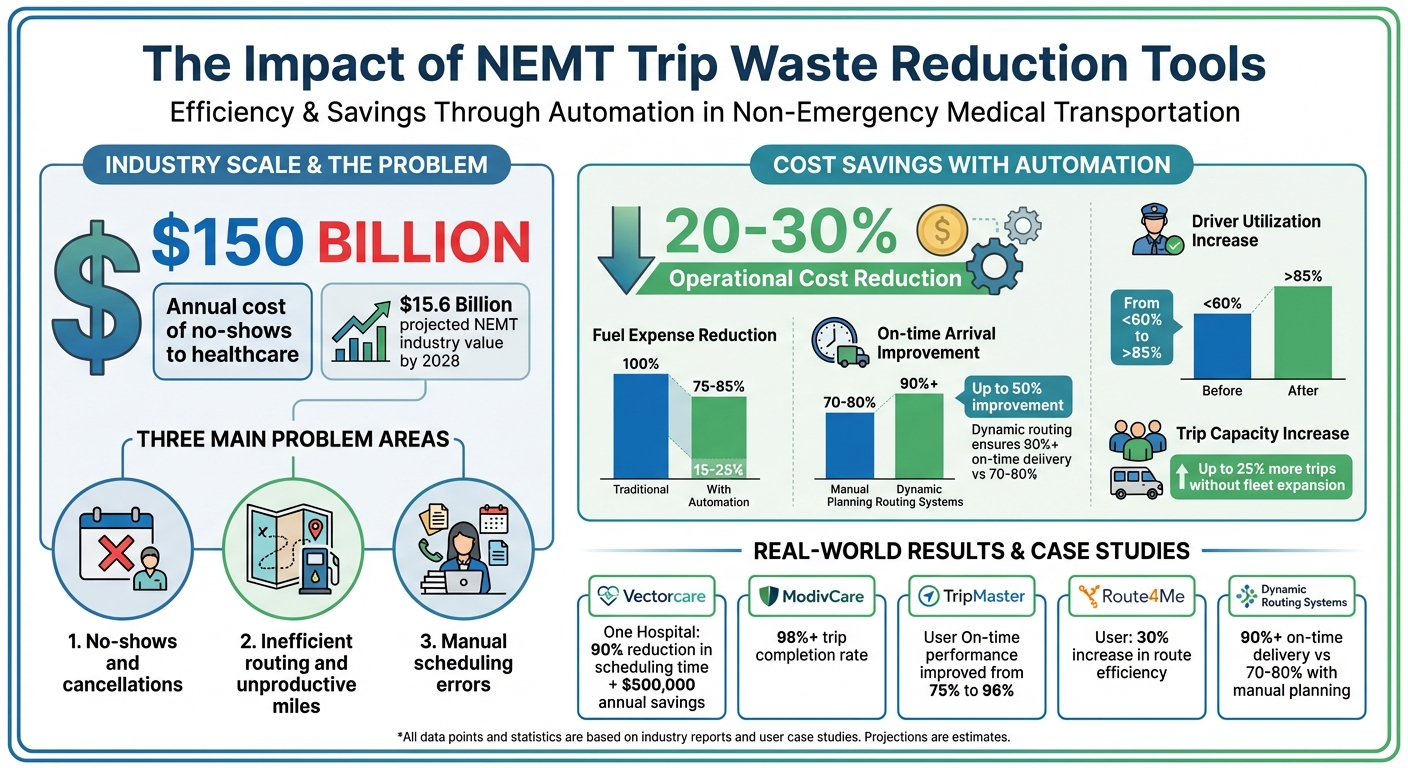
NEMT Trip Waste Reduction: Key Statistics and Cost Savings
Run Bambi Run All Day | Bambi NEMT Software: FULL DAY Real-Time Scheduling & Dynamic Dispatch Demo
What To Look For In NEMT Trip Waste Reduction Tools
When it comes to reducing wasted trips in Non-Emergency Medical Transportation (NEMT), the right tools can make all the difference. They tackle issues like manual errors, inefficient routing, and no-shows by automating key processes such as scheduling, route planning, and cancellation management. Let’s explore the features that help prevent waste and improve efficiency.
Automated Scheduling and Dispatch
Manual scheduling often leads to headaches - double bookings, mismatched vehicles, and underused resources. Tools that automate this process streamline the workflow by aligning schedules with optimized routes, factoring in real-time traffic, and making dispatch decisions automatically.
Take Bambi’s AI-powered software, for instance. It assigns trips in real time by considering vehicle constraints and current conditions. These platforms handle vehicle assignments intelligently, ensuring the right vehicle is matched to patient needs, whether it’s for wheelchair access, stretcher transport, or ambulatory services. They also optimize schedules by balancing driver availability with vehicle capacity, cutting down on inefficiencies.
On top of that, real-time route adjustments can eliminate unnecessary travel, saving both time and money.
Route Optimization and Real-Time Adjustments
Unproductive miles between pickups and drop-offs can drain resources fast. Advanced route optimization tools use algorithms to plan efficient sequences for pickups and drop-offs. They also adapt dynamically to live traffic updates, road closures, and unexpected delays.
For example, MediRoutes employs an algorithm to determine the most efficient routes and can reconfigure them instantly to account for last-minute cancellations or new appointments. Its driver app provides a real-time manifest that updates on the go, allowing dispatchers to make adjustments as needed. Similarly, Tobi imports bookings, plans routes in advance, and adapts to traffic or road changes in real time.
The impact of such tools is clear. One hospital using Vectorcare cut scheduling time by 90% and saved over $500,000 annually. ModivCare, another standout example, boasts a trip completion rate exceeding 98%. These results highlight how optimized routing and real-time adjustments can significantly reduce trip waste.
No-Show and Cancellation Management
No-shows are a major drain on resources, leaving drivers idle and increasing costs. In fact, no-shows cost the healthcare industry more than $150 billion annually. To combat this, effective tools include automated notification systems that send reminders via voice, email, or text, allowing passengers to confirm, reschedule, or cancel directly.
Platforms like TripMaster and Bambi leverage multiple notification methods, including automated calls, SMS, and push notifications, to cut down on no-shows while improving rider satisfaction. Additionally, online booking portals empower clients, family members, or caregivers to manage rides easily, reducing the workload on dispatchers and improving accuracy. When cancellations happen, these systems instantly adjust routes to fill gaps and make the most of available resources.
Best Tools To Reduce NEMT Trip Waste
Now that you know which features truly make a difference, let’s dive into specific tools that help NEMT providers achieve real efficiency. These platforms combine scheduling automation, route planning, and smart dispatching to cut down on unnecessary trips. They take the core features we discussed earlier and turn them into actionable solutions for smoother operations.
RouteGenie NEMT Software
RouteGenie stands out with its dynamic route optimization. It identifies the best routes by steering clear of traffic congestion and inefficient paths, which helps save on fuel costs, reduces wear on vehicles, and ensures passengers arrive on time.
The platform automates trip scheduling and driver assignments, automatically matching the best driver or vehicle for each trip. This reduces the chances of double bookings or scheduling mistakes that could lead to wasted trips. Plus, RouteGenie integrates seamlessly with NEMT brokers, importing trip details and passenger requirements directly into the system.
One of RouteGenie’s key features is its real-time dispatching. Dispatchers can track vehicles via GPS and make quick adjustments to routes if there’s an accident or road closure. The system also looks for opportunities to combine multiple passengers into a single trip, maximizing vehicle use and cutting down on empty miles.
"Route optimization software pinpoints the most efficient routes for every single trip to avoid bad traffic and indirect routes that prevent your passengers from arriving at their appointments on time. Additionally, software searches for multiload opportunities every time a trip is dispatched to cut down on the number of vehicles on the road at any given time." - RouteGenie
RouteGenie also includes fleet maintenance tracking. Using pre- and post-trip checklists, drivers can catch potential issues early, helping prevent unexpected breakdowns. This tool is especially effective for urban fleets handling recurring trips, where consistent scheduling and routing are critical for keeping operations efficient.
TripMaster Transit Management

TripMaster takes a proactive approach to scheduling and tracking, helping providers address common inefficiencies. One standout feature is its automated call and text reminders, which notify clients about upcoming pick-ups and ensure they’re prepared - even for additional stops like pharmacy visits. This feature alone has helped some operators significantly improve their service. For example, one company raised its On-Time Performance from 75% to over 96%.
The platform’s real-time GPS tracking system allows dispatchers to monitor vehicle locations and adjust routes as needed, keeping delays in check. Updated maps provide current road conditions, while drivers receive turn-by-turn directions with accurate drive time and mileage estimates.
Another highlight is the Rider Portal. This tool gives clients, family members, or caregivers the ability to book rides online 24/7. For passengers with recurring appointments, the subscription reservation feature ensures that no trip is forgotten, making it easier to manage standing schedules efficiently.
sbb-itb-cef70f4
More Tools for Route Optimization and Trip Verification
Expanding on automated scheduling and route optimization, these tools take operational efficiency to the next level with improved route verification and streamlined no-show management.
Route Optimization Engines
Standalone route optimization engines work alongside your NEMT platform to cut down on wasted miles and improve route planning. Take Route4Me, for example - a platform that creates multi-stop routes in seconds and adapts instantly to schedule changes. It integrates seamlessly with mobile apps for iOS, Android, and Zebra devices, offering drivers turn-by-turn navigation while allowing dispatchers to monitor progress in real time.
"The routing algorithm is phenomenal and allows for great flexibility in solving for numerous parameters, increasing route efficiency by 30% and reducing employee routing frustrations with the easy-to-use navigator function." - Operations Manager and Vice President, Logistics Companies
These engines also provide detailed mileage reports and fuel cost calculations, giving businesses a clear view of revenue and costs per stop for better financial planning. However, keep in mind that NEMT routing software typically starts at $50 per vehicle. These tools integrate effortlessly with scheduling systems, setting the stage for precise trip verification methods discussed below.
Trip Verification and No-Show Management Tools
No-shows and last-minute cancellations can be a major drain on resources. While earlier strategies focused on better routing and scheduling, these tools close the loop by confirming trip completion and minimizing manual processes.
Digital attestation, such as eSignatures, ensures trips are completed and simplifies billing while boosting accountability. Geofencing technology automatically checks drivers in when they enter specific zones, eliminating the need for manual updates and keeping dispatchers in the loop without extra effort. On top of that, these systems provide accurate ETAs to patients, reducing uncertainty and improving overall satisfaction. Companies using dynamic routing paired with real-time verification report on-time delivery rates exceeding 90%, compared to 70–80% with manual planning.
Using NEMT Entrepreneur for Expert Guidance

Beyond technical solutions, expert advice can make a big difference in refining your approach. Choosing the right tools to cut down on trip waste involves making well-informed decisions, and that's where NEMT Entrepreneur comes in. They offer valuable insights, strategies, and resources to help streamline your Non-Emergency Medical Transportation (NEMT) operations.
With their guidance, you can evaluate scheduling systems, route optimization software, and trip verification tools that fit seamlessly into your workflow. For businesses aiming to minimize trip waste, NEMT Entrepreneur serves as a reliable resource for staying updated on the best practices in the industry. By combining their expert advice with the tools you select, you can enhance efficiency and effectively reduce trip waste. Check out NEMT Entrepreneur for practical tips and support tailored to help you choose the best solutions for your business.
Conclusion
Minimizing trip waste is a game-changer for running a more efficient and reliable Non-Emergency Medical Transportation (NEMT) operation. With the industry projected to hit $15.6 billion by 2028, it’s clear that traditional, manual processes just can’t keep up with increasing trip volumes, tighter schedules, and the need for real-time adjustments.
Automation is the key. Automated route planning can slash operational costs by 20%–30% and cut fuel expenses by 15%–25%. Plus, smart technology can improve on-time arrivals by as much as 50%. When you consider the earlier estimate of $150 billion in lost revenue due to inefficiencies, the case for automation becomes even stronger.
Beyond cost savings, the right software can completely reshape your operations. Tools like automated scheduling, real-time route optimization, and no-show management can significantly boost efficiency. For example, driver utilization rates can climb from under 60% to over 85% with automation. Some providers have even managed to handle up to 25% more trips without expanding their fleets. These kinds of results can mean the difference between barely getting by and building a scalable, profitable business.
Choosing the right tools starts with understanding your specific operational challenges and long-term goals. That’s where NEMT Entrepreneur can help. They provide practical advice on evaluating software, implementing new systems, and keeping up with industry best practices. Their expertise ensures you’re making informed decisions tailored to your business.
To get started, focus on identifying the biggest sources of waste in your operations - like unnecessary deadhead miles, frequent no-shows, or inefficient routing. Then, invest in specialized NEMT software that tackles those issues directly. The payoff? Lower costs, better service, and the ability to grow your business sustainably. It’s an investment that truly delivers.
FAQs
How does automated scheduling help NEMT providers improve efficiency?
Automated scheduling takes the hassle out of assigning trips by instantly pairing ride requests with the best-suited driver, vehicle, and schedule. It factors in patient location, appointment times, medical requirements, and driver capacity to create efficient routes in just seconds. This not only eliminates manual effort but also minimizes errors and keeps operations running smoothly.
With this system, providers can easily manage recurring appointments, prioritize urgent trips, and adapt to last-minute changes without throwing off the entire schedule. Many providers have reported saving over 20 hours per week and cutting scheduling time by as much as 60%. The result? Better vehicle usage, lower fuel costs, and improved on-time performance. Plus, automated systems offer real-time updates, enabling dispatchers and drivers to quickly handle cancellations or changes, leading to greater patient satisfaction and smoother workflows.
For NEMT providers looking to improve their processes, NEMT Entrepreneur delivers expert guidance and resources to help you cut down on waste and boost efficiency in your business.
How does route optimization help reduce waste in NEMT trips?
Route optimization is a game-changer for non-emergency medical transportation (NEMT) providers looking to cut down on waste. With advanced software, providers can evaluate factors like traffic patterns, weather conditions, vehicle capacity, and passenger destinations to design the most efficient routes. This approach trims unnecessary mileage, slashes fuel costs, and reduces wear and tear on vehicles - saving money while also extending the life of the fleet.
Efficient routing doesn’t just save resources; it also improves scheduling. Providers can coordinate multiple pickups or drop-offs in a single trip, reducing the risk of missed appointments. Real-time tracking adds another layer of efficiency, keeping drivers on course and ensuring timely arrivals. For NEMT providers aiming to fine-tune their operations, NEMT Entrepreneur offers valuable guidance and strategies to integrate these tools seamlessly, helping to significantly reduce wasted trips.
What are the benefits of using no-show management tools for NEMT providers?
No-show management tools are a game-changer for NEMT providers, helping to cut down on missed trips that waste time and fuel. By reducing these inefficiencies, providers can save money while streamlining their operations for better scheduling and productivity.
When no-shows are managed effectively, providers not only avoid revenue losses but also enhance customer satisfaction. This, in turn, can lead to stronger financial performance. Adopting a dependable no-show management system is a practical move for running a smoother and more profitable NEMT business.