NEMT Fleet Maintenance & Management: The Complete Guide to Uptime, Cost Control & Utilization


NEMT Entrepreneur provides expert insights, strategies, and resources to help non-emergency medical transportation professionals grow their businesses. Get industry-leading advice to succeed in NEMT.
Featured articles
In NEMT, a vehicle in the shop is revenue on the floor. Your fleet is your single largest capital asset and your biggest operational risk at the same time — miss a preventive service and you trade a $300 repair for a $3,000 breakdown, a missed dialysis run, and a broker on-time score that costs you the contract. This guide covers the three disciplines that keep an NEMT fleet profitable: preventive maintenance, cost control, and utilization — plus the software that ties them together.
Build a preventive maintenance schedule
Reactive maintenance is the most expensive way to run a fleet. Preventive maintenance (PM) — servicing on a set mileage or time interval before something fails — is cheaper, safer, and keeps you compliant with DOT inspection requirements. Build a schedule around each vehicle's duty cycle:
- Routine intervals — oil, tires, brakes, fluids on manufacturer or mileage-based cadence.
- Specialized equipment — wheelchair lifts, ramps, and securement systems need their own inspection schedule; they fail differently than the drivetrain and they're a safety and ADA-compliance liability if neglected.
- Timing — schedule service around your demand pattern so a vehicle is never down during peak trip hours.
Track your maintenance data
You can't manage what you don't measure. Keep a record per vehicle: service history, costs, downtime, and recurring issues. That data does three things — it proves compliance in a broker audit, it flags the vehicle that's quietly becoming a money pit, and it tells you when a unit has crossed from 'maintain' to 'replace.' Real-time telematics and a simple maintenance log turn guesswork into decisions.
Control your fleet maintenance costs
Maintenance cost has predictable components — labor, parts, vendor markups, and the hidden one that dwarfs them all: vehicle downtime. Separate scheduled costs (planned PM you can budget) from unscheduled costs (breakdowns you can't), then attack the unscheduled bucket with better PM.
| Cost lever | How to control it |
|---|---|
| Preventive vs. reactive | Shift spend to scheduled PM to shrink expensive breakdowns |
| Parts & vendors | Standardize vehicles to simplify parts; negotiate vendor rates |
| Downtime | Schedule service off-peak; keep a spare-capacity plan |
| Vehicle lifecycle | Use cost-per-mile data to time replacement before repairs spike |
Manage utilization: the profit hiding in your fleet
Maintenance keeps vehicles running; utilization decides whether running them makes money. Fleet utilization analytics tell you how much of each vehicle's available time produces billable trips versus sits idle or runs empty (deadhead) miles. The levers: route optimization to pack more paid trips into fewer miles, real-time tracking and dispatch to fill gaps and adjust on the fly, and automated scheduling to cut the idle time manual dispatch leaves on the table. A well-utilized three-van fleet often out-earns a poorly-utilized five-van one.
Let software carry the load
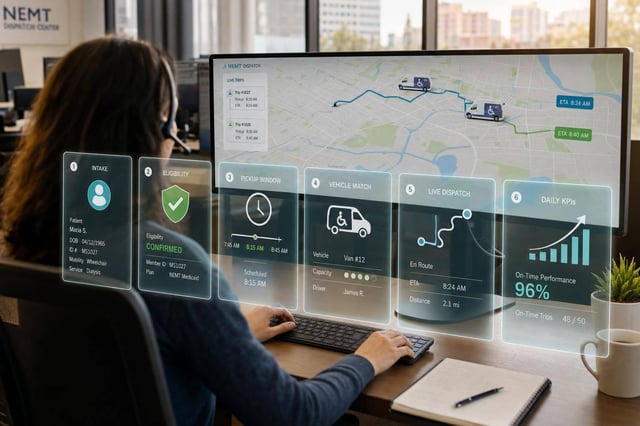
Purpose-built NEMT software turns all of this from spreadsheets into a system: automated PM reminders, per-vehicle cost and downtime tracking, route optimization to cut deadhead miles, and real-time GPS tracking that feeds both dispatch and utilization reporting. Manual tracking works for one van; it breaks down fast as you add vehicles, and the errors it introduces cost more than the software.
Your fleet management checklist
- Set a preventive maintenance schedule per vehicle, including lifts and securement gear
- Log service history, cost, and downtime for every unit
- Split scheduled vs. unscheduled costs and drive down the unscheduled bucket
- Track cost-per-mile to time vehicle replacement
- Measure utilization; cut idle and deadhead miles with routing and dispatch
- Run it on NEMT software once you're past a single vehicle
Treat your fleet as a system, not a collection of vans: maintain proactively, measure everything, and optimize utilization. That's how you keep vehicles on the road, costs predictable, and every unit earning its keep.