NEMT Entrepreneur provides expert insights, strategies, and resources to help non-emergency medical transportation professionals grow their businesses. Get industry-leading advice to succeed in NEMT.
Featured articles
Your NEMT business might be losing time and money without you realizing it. If your systems - like scheduling, billing, and GPS tracking - don’t work together, you’re stuck with inefficiencies that hurt your bottom line. That’s where API integration comes in. It connects your tools, eliminates manual data entry, and ensures real-time communication between brokers, providers, and healthcare systems.
Here’s why it matters:
- Save Time: Automating trip assignments and data entry can cut administrative work by 75%.
- Fewer Errors: Integrated systems reduce trip errors by 60% and improve claim acceptance rates from 78% to 94%.
- Faster Payments: Payment cycles shrink by 30–40%, meaning you get paid quicker.
- Better Compliance: APIs create audit-ready records automatically, reducing risks during Medicaid reviews.
- Scale Efficiently: Handle more trips without adding staff by automating workflows and optimizing vehicle usage.
With the NEMT market growing to $12.8 billion by 2027, API integration isn’t optional - it’s the key to staying competitive. If you’re running disconnected systems, now is the time to make the switch.
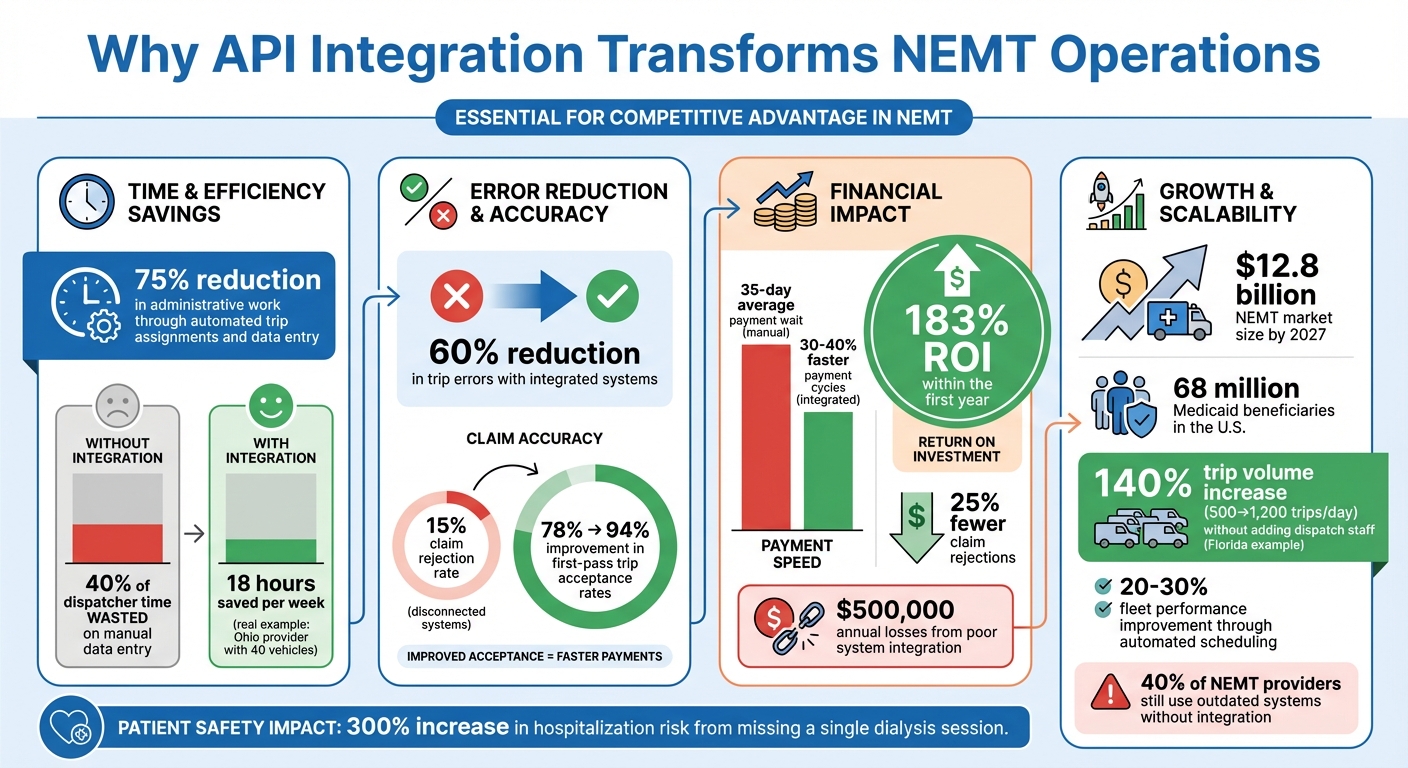
API Integration Impact on NEMT Operations: Key Statistics and ROI
NEMT & Patient Transportation Optimisation Software
sbb-itb-cef70f4
The Problem: Operational Inefficiencies in NEMT
Running a Non-Emergency Medical Transportation (NEMT) business without integrated systems is like trying to organize a relay race where no one can communicate. Departments operate in isolation, creating errors, inefficiencies, and unhappy patients.
Disconnected Systems Lead to Data Silos
When your scheduling, dispatch, and billing systems don’t work together, you’re left with data silos that waste time and create more work. Dispatchers often find themselves manually entering trip requests from phone calls or emails, copying patient details across multiple systems.
This tedious process eats up 40% of a dispatcher’s time when systems aren’t connected. Beyond the time drain, manual entry increases the risk of errors in addresses, patient details, medical needs, and billing codes. These mistakes can lead to missed appointments, denied claims, and a 15% rejection rate for medical transportation claims.
Disconnected systems also make it harder for brokers and providers to communicate effectively.
Communication Gaps Between Providers and Brokers
Poor integration between systems creates a communication void that API solutions could solve. Brokers assign trips but often have no way to monitor progress in real time. For example, if a driver gets stuck in traffic or a vehicle breaks down, brokers are often unaware until a patient or healthcare facility reports the issue.
"Trips are thrown 'over the fence' to the transportation providers, leaving the broker with little visibility into what happens as the day progresses." - Veyo
This lack of visibility creates delays and frustration for everyone involved. Patients worry about missing critical appointments, such as dialysis or chemotherapy - appointments they can’t afford to skip, as missing a single dialysis session increases hospitalization risk by 300%.
Without real-time updates, brokers can’t properly manage vehicle availability, leading to imbalances in supply and demand. Fleets may be overwhelmed during peak hours while sitting unused later in the day. The result? Longer wait times for patients and underutilized vehicles for providers.
Compliance Challenges from Fragmented Records
Disconnected systems don’t just slow down operations - they also make regulatory compliance a nightmare. State Medicaid agencies require detailed records, including pickup times, drop-off locations, mileage, and patient signatures. When data is scattered across multiple systems, compiling this information becomes a time-consuming and error-prone task.
"Traditional brokers must rely on self-reported trip data from the transportation providers, and assume that those transportation providers will report accurate data, even if they were late for a trip or didn't pick up a member." - Veyo
Fragmented data forces administrative teams to manually standardize records before submitting them for audits. A single missing signature or incorrect date format can result in rejected claims or compliance issues. Medicaid eligibility checks are often done after the trip, leading to unpaid services when patients turn out to be ineligible. With 40% of NEMT providers still using outdated systems that lack integration capabilities, these compliance headaches remain a persistent problem.
| Challenge | Manual/Disconnected Systems | Impact on Your Business |
|---|---|---|
| Data Entry | Repetitive manual transcription | 40% of dispatcher time wasted |
| Visibility | No real-time trip tracking | More patient complaints and higher call volumes |
| Billing | Manual claim coding | 15% rejection rate for claims |
| Payment Cycle | Delayed reimbursement | Average 35-day wait for payment |
| Compliance | Fragmented audit trails | Greater risk during regulatory reviews |
How API Integration Solves These Challenges
API integration transforms the chaos of disconnected systems into an automated workflow that eliminates inefficiencies in NEMT operations. Instead of dispatchers manually transferring data between platforms, APIs act as the "connective tissue" linking healthcare providers, brokers, and transportation services. This creates a seamless flow of information.
Real-Time Data Flow Across Systems
APIs enable instant data updates throughout your operation. When a patient schedules an appointment, the API automatically triggers a transportation request in your dispatch system, removing the need for manual input and delays. Integration with Electronic Health Records (EHR) ensures the system immediately identifies if a passenger requires specific accommodations like wheelchair access or oxygen support.
Billing processes also become automated, processing claims as soon as trips are completed. Trip details are logged and staff are notified via webhooks, cutting administrative delays. Providers using broker integrations often see 30-40% faster payment cycles and about 25% fewer claim rejections. These integrations streamline communication across departments, making operations more efficient.
"APIs are more than just a technological buzzword; they're the backbone of modern, efficient NEMT operations." - Aya Bazzi, Marketing Outreach Specialist, Momentm Technologies
Better Communication Between Brokers and Providers
APIs enhance connectivity between brokers and providers by enabling two-way data sharing. Brokers can track real-time vehicle locations and estimated arrival times directly from dispatch systems using GPS and telematics APIs. If a driver encounters traffic or a breakdown, automated notifications alert coordinators to address the issue immediately.
Specialized broker APIs allow trip assignments to flow directly into dispatch software, removing the need for manual data entry. Healthcare facilities benefit from booking portals where they can monitor patient ride statuses in real time without needing to call. This transparency reduces call volumes and improves coordination. By implementing broker integrations, administrative time can be cut by 75%, allowing teams to prioritize service quality over repetitive tasks.
Simplified Compliance and Reporting
APIs turn compliance into an automated process. Every system interaction, status change, and event is logged with precise timestamps and user attribution, creating audit-ready records without manual effort. Real-time eligibility verification through 270/271 API integrations instantly confirms insurance coverage and benefit limits, avoiding costly mistakes like servicing ineligible patients.
Geographic validation APIs flag address errors - such as incorrect zip codes or locations outside your service area - before they escalate into billing or compliance problems. Automated exception handling resolves common issues without human intervention. When it's time to report to Medicaid agencies, APIs format trip data into compliant reports automatically. These tools can reduce trip errors by 60%, while automation improves first-pass trip acceptance rates from 78% to 94%. Together, these features strengthen operations and ensure consistent performance.
"Healthcare regulations require detailed documentation, real-time reporting, and audit trails that are nearly impossible to maintain through manual processes." - NEMT Platform
Scaling Your NEMT Business with API Integration
Expanding a Non-Emergency Medical Transportation (NEMT) business isn't just about adding more vehicles or drivers. True growth requires robust systems that can handle higher demand without falling apart. API integration provides the backbone for scaling efficiently, whether you're managing a few hundred trips a day or over a thousand. The key difference between businesses that scale smoothly and those that struggle often lies in how well their systems communicate.
Managing Increased Service Demand
When trip volumes surge, manual processes can quickly become a bottleneck. For instance, a Florida-based NEMT provider managed to increase their daily trip volume by 140% - from 500 to 1,200 trips - over just 18 months without adding more dispatch staff. How? They leaned on automated trip assignments and real-time data synchronization, eliminating the need for manual intervention.
APIs play a crucial role in handling excess demand. They connect your dispatch system with Transportation Network Companies (TNCs) like Uber Health and Lyft. When your fleet is maxed out, the system can automatically assign less complex rides to TNC drivers. This not only ensures no trips are turned down but also optimizes fleet usage and reduces idle time through real-time GPS data sharing.
Efficiency gains from automated scheduling and route optimization are significant, often improving fleet performance by 20% to 30%. For example, a 40-vehicle provider in Ohio saved 18 hours of administrative work per week after implementing broker integrations. This allowed them to handle 300 daily trips with 95% automation. Features like self-service portals and automated notifications further reduced call volumes, enabling staff to focus on delivering quality service. By streamlining operations, these tools open doors to seamless collaborations with brokers.
Greater Flexibility with Multi-Broker Aggregation
Managing relationships with multiple brokers used to mean juggling different portals, data formats, and workflows. API integration simplifies this by offering a unified dashboard, allowing you to manage brokers like Modivcare, MTM, and Kaiser Permanente through a single system. With streamlined processes, your team only needs to learn one platform, while trip data flows efficiently regardless of the broker source.
This is especially important given the scale of the Medicaid market, which serves approximately 68 million beneficiaries across the U.S.. APIs also enable features like "Auto-Accept", where trips are automatically confirmed based on your fleet's capacity and geographic coverage.
The competitive edge here is undeniable. Brokers increasingly favor providers with real-time electronic integration and automated status updates. Additionally, open APIs eliminate the risk of vendor lock-in, giving you the freedom to work with a mix of brokers and billing platforms as your business grows. This flexibility becomes even more critical as the industry continues to digitize and new opportunities arise.
Practical Steps for Implementing API Integration
If you're ready to dive into API integration, here’s how to get started effectively. First, ensure the API aligns with your existing systems like scheduling, billing, and EHR platforms. Check that it supports essential data formats (e.g., JSON, XML, HL7, FHIR), uses RESTful (modern) or SOAP (legacy) protocols, and meets HIPAA requirements with strong authentication methods like OAuth and TLS encryption.
Before signing any agreements, ask for access to the vendor's API documentation. This should clearly outline endpoints, request and response formats, and error codes. Also, look for vendors that provide a sandbox environment - an isolated testing space where your team can try out features and confirm that everything works smoothly before going live.
"API management... strengthens and streamlines API documentation, API security and API discovery, helps organizations avoid infrastructure chaos and redundancy, and drives API efficiency."
– IBM
This quote highlights the importance of clear documentation and strong API management practices. Choose vendors who follow RESTful standards and offer multi-protocol support for both synchronous and asynchronous exchanges. If you're dealing with more complex integrations - like linking to Uber Health or hospital EHRs - prioritize partners with dedicated engineering support. For instance, Ambulnz, under CEO Stan Vashovsky, successfully integrated with hospital EHRs, using APIs to simplify everything from patient data collection to dispatching. This significantly improved care coordination. Having access to technical support can make all the difference in a seamless integration process.
To take it a step further, conduct an audit of your current workflows. Identify areas where manual data transfers occur - these are prime candidates for API integration. Whether it’s automating trip assignments, streamlining billing submissions, or updating statuses, removing manual steps will save time and allow your team to focus on delivering exceptional service to your passengers.
Conclusion: The Future of NEMT Depends on API Integration
The Non-Emergency Medical Transportation (NEMT) industry is reaching a crucial crossroads. Relying on manual workflows and disconnected systems just doesn’t cut it anymore. API integration offers a clear solution by automating data exchange, reducing human error, and providing real-time visibility across operations. The numbers back this up: integrated systems can reduce trip errors by 60%, speed up payment processing by 30-40%, and generate a 183% return on investment within the first year.
These efficiency gains aren’t just about saving time - they set the stage for sustainable growth. With API integration, you can scale your business without adding extra administrative staff, connect with Transportation Network Company (TNC) platforms to handle overflow demand, and meet brokers' growing expectations for real-time communication. The stakes are high - companies lose up to $500,000 annually due to poor system integration. In a competitive market, that’s a loss few can afford.
More than ever, brokers are prioritizing providers who offer seamless electronic integration. API capabilities are no longer optional - they’re a must-have for securing major contracts. Whether you’re managing 10 trips a day or 300, the real question isn’t if you should integrate, but how quickly you can make it happen to stay competitive.
To get started, assess your current systems, look for open APIs to avoid vendor lock-in, and test integrations in sandbox environments before going live. By adopting automation, reducing manual workflows, and delivering the real-time transparency that patients and healthcare partners demand, your business will be ready to lead the future of NEMT.
FAQs
How does API integration help ensure compliance in NEMT operations?
API integration is a key component in ensuring compliance for NEMT (Non-Emergency Medical Transportation) operations. By automating real-time data sharing between systems, it minimizes human errors and guarantees accurate record-keeping. For example, APIs seamlessly link scheduling, billing, and healthcare platforms, enabling instant updates on trip details, patient eligibility, and billing information. This level of automation not only simplifies processes but also ensures that regulatory requirements are met and proper documentation is always maintained.
Moreover, APIs play a vital role in adhering to healthcare privacy standards like HIPAA. They enable secure, encrypted data transfers, safeguarding sensitive patient information. Additionally, APIs automatically log all data exchanges, creating reliable audit trails that are invaluable during regulatory audits and reporting. By streamlining operations and reducing manual tasks, API integration helps NEMT providers maintain accuracy, efficiency, and full compliance with industry regulations.
How can I get started with API integration for my NEMT business?
To kick off API integration for your NEMT business, start by pinpointing the systems you want to connect. This could include scheduling software, billing platforms, or dispatch tools. Knowing what needs to be linked is the first step toward streamlining your operations.
Next, get your hands on the API documentation for these systems. This documentation outlines how to securely exchange data and access the features you’ll need. It’s essentially your roadmap for making the connection work.
From there, you can either build custom integration tools or rely on pre-existing ones to link the systems. Whichever route you take, make sure your solution follows security best practices to safeguard sensitive information.
Finally, don’t skip the testing phase. Run thorough tests to ensure data flows smoothly between systems and that automation works as intended. This step is crucial for ironing out any issues before applying the integration to your daily operations, setting the stage for improved efficiency across the board.
How does API integration help grow my NEMT business without hiring more staff?
API integration helps your NEMT business grow by streamlining tasks like scheduling, dispatching, and real-time tracking. These automated processes boost efficiency, allowing your team to manage more trips without the need to hire additional staff.
By linking systems - such as scheduling tools with billing platforms or dispatch software with healthcare providers - API integration cuts down on manual tasks, reduces errors, and keeps operations running smoothly. This kind of connectivity ensures your business can expand while delivering reliable, high-quality service.