

NEMT Entrepreneur provides expert insights, strategies, and resources to help non-emergency medical transportation professionals grow their businesses. Get industry-leading advice to succeed in NEMT.
Featured articles
Fuel costs are a major expense for Non-Emergency Medical Transportation (NEMT) fleets, but driver behavior can significantly impact fuel efficiency. Simple changes like smoother acceleration, steady speeds, and reduced idling can cut fuel consumption by 10% to 40%, saving businesses thousands annually.
Key takeaways:
- Aggressive driving increases fuel use by up to 40% in traffic.
- Training programs improve fuel efficiency by 10%–20%.
- Technologies like telematics provide real-time feedback to sustain savings.
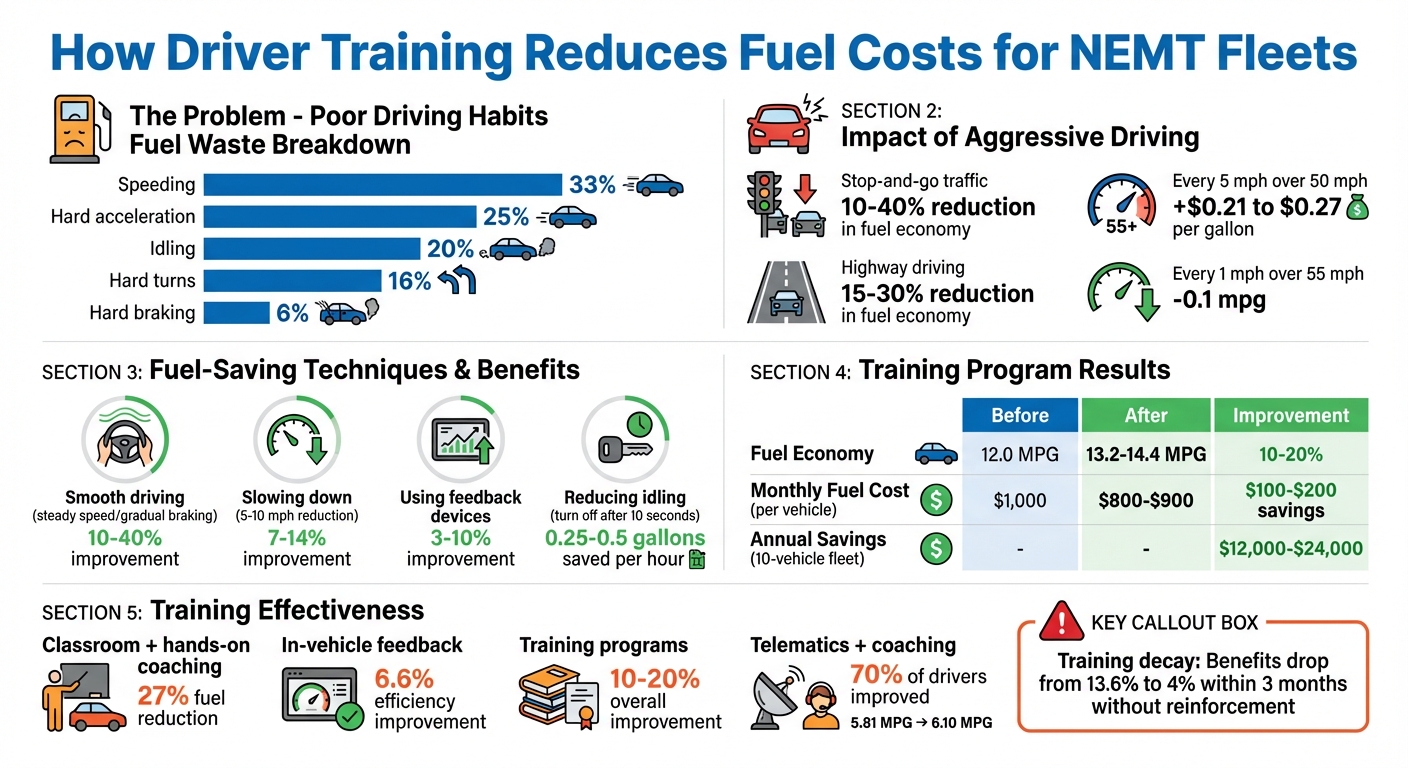
How Driver Training Reduces NEMT Fuel Costs: Key Statistics and Savings
Why NEMT Operations Face High Fuel Costs
How NEMT Fleets Use More Fuel
Non-emergency medical transportation (NEMT) services tend to burn through fuel at a faster rate due to the nature of their operations and the way their services are structured. For starters, about 75% of NEMT trips are less than 10 miles, and 90% fall under 20 miles. These short trips limit the time engines have to warm up to their most efficient operating temperature, which negatively impacts fuel efficiency.
Additionally, NEMT fleets rely on specialized vehicles like wheelchair-accessible minivans, full-size vans, and small buses equipped with ADA-compliant features such as lifts and gurneys. These modifications add weight to the vehicles, and for every extra 100 pounds, fuel efficiency drops by about 1%. When you combine this with frequent stops in urban areas, the losses add up quickly.
Another hidden fuel drain comes from extended idling. Larger vehicles can use up to 1 gallon of fuel per hour while idling, while smaller ones consume 0.25–0.5 gallons within the same timeframe. Frequent stops at intersections during urban routes can tack on an additional 1–2 gallons over a 70-mile trip. Since NEMT services often involve short, stop-heavy routes and vehicles with specialized configurations, these inefficiencies hit their fuel budgets especially hard.
How Poor Driving Habits Increase Costs
Driver behavior is another major factor driving up fuel expenses for NEMT operations. Studies reveal that speeding accounts for 33% of fuel waste, while hard acceleration contributes 25%, idling 20%, hard turns 16%, and hard braking 6%. Fuel efficiency also drops sharply at speeds above 50–55 mph. For every 1 mph driven over 55 mph, fuel economy decreases by 0.1 mpg, which translates to an extra $0.21 to $0.27 per gallon for every 5 mph over 50 mph. In stop-and-go city traffic, aggressive driving behaviors like rapid acceleration and hard braking can reduce fuel economy by as much as 10% to 40%.
"The skill with which a driver controls a vehicle, the frequency of idling and average vehicle speed all play a role in how efficiently a vehicle is operated." - American Transportation Research Institute
Operational inefficiencies, like last-minute pickup requests or emergency calls, often disrupt pre-planned routes. This leads to "deadhead" miles - miles driven without passengers - and unnecessary detours. Combined with poor driving habits, these factors significantly inflate fuel costs. For example, the average fuel cost for a wheelchair-accessible NEMT van is estimated at $0.20 per mile, but inefficient driving can push that figure even higher.
Eco Driving: Save 20-40% Fuel With PRO Hypermiling Tips & Myths Busted.
Driving Techniques That Save Fuel
How a Non-Emergency Medical Transportation (NEMT) driver maneuvers their vehicle directly impacts fuel consumption. Simple changes in driving habits can cut fuel usage by 10% to 40% in stop-and-go traffic and 15% to 30% on highways . These adjustments don’t require special tools - just awareness and consistent practice.
Gradual Acceleration and Braking
Quick bursts of acceleration burn more fuel than necessary. Instead, drivers should aim for smooth, gradual acceleration. Similarly, anticipating stops and braking gently can conserve fuel.
"Instead, accelerate smoothly and brake softer and earlier, as though a raw egg were taped to the sole of your boot. Cruise at steady, moderate speeds and stay in one lane maintaining as constant a speed as you can." – Tom Berg, Author and Truck Writer, Automotive Fleet
Looking ahead 10 to 12 seconds while driving helps anticipate traffic lights and other vehicles, minimizing sudden stops and starts. Coasting to slow down, rather than slamming on the brakes, is another way to save fuel. Additionally, keeping a steady speed wherever possible helps maximize efficiency.
Keeping Speed Steady
Frequent speed changes force your engine to work harder, leading to higher fuel consumption. This is especially true on highways, where aerodynamic drag becomes a bigger factor above 50 mph. For most vehicles, fuel efficiency drops significantly once speeds exceed this threshold .
A 2025 Consumer Reports test on a Nissan Altima and a Toyota RAV4 highlights this point: reducing speed from 65 mph to 55 mph boosted fuel efficiency by up to 8 mpg. On highways, using cruise control can help maintain a consistent speed, ensuring better fuel economy.
Here’s a key takeaway: every 5 mph driven over 50 mph adds an extra $0.21 to $0.27 per gallon of fuel . Pairing steady speeds with minimal idling can lead to noticeable savings.
Reducing Idle Time
Idling is a silent fuel drainer, consuming 0.25–0.5 gallons of fuel per hour . If you’re stopped for more than 10 seconds, it’s more efficient to turn off the engine . Restarting uses about the same amount of fuel as idling for 10 seconds, so shutting off the engine during patient pickups, drop-offs, or while waiting can make a difference .
Modern engines warm up more efficiently when driven gently, even in colder weather. After about 30 seconds of idling, it’s better to start driving to warm the engine and reduce emissions. For longer stops, auxiliary power systems can keep passengers comfortable without running the engine. To ensure the vehicle’s battery stays charged, aim to drive at least 5 miles between frequent engine restarts .
These small but impactful driving techniques form the cornerstone of fuel-saving strategies for NEMT drivers.
| Driving Habit Change | Estimated Fuel Economy Benefit |
|---|---|
| Smooth Driving (Steady Speed/Gradual Braking) | 10%–40% |
| Slowing Down (5–10 mph reduction) | 7%–14% |
| Using Feedback Devices | 3%–10% |
What to Include in Driver Training Programs
A well-designed training program tackles the unique challenges that NEMT drivers face daily. The primary goal? To make fuel-efficient driving second nature. Combining classroom instruction with hands-on coaching can significantly improve results - delivering a 27% reduction in fuel consumption compared to classroom-only training. Below, we’ll break down strategies for various driving conditions and how modern feedback tools can enhance driver performance.
Driving Efficiently on Different Road Types
NEMT drivers encounter a wide range of road conditions, so training needs to prepare them for everything from congested city streets to open highways and steep terrain. Each scenario demands specific fuel-saving techniques.
- Stop-and-go traffic: Teach "anticipatory driving", a method that involves reading the road ahead, keeping an eye on pedestrians, and maintaining safe following distances to avoid unnecessary braking. For example, drivers should aim to accelerate gradually, taking about 5 seconds to go from a stop to 12 mph, which conserves fuel in urban settings.
- Highways: Focus on speed control and the use of cruise control. Since fuel efficiency drops sharply above 50 mph, drivers should understand that every 5 mph over this limit can add $0.21 to $0.27 per gallon in fuel costs.
- Hilly terrain: Train drivers to let the vehicle's speed naturally decrease while climbing and regain momentum on the descent, rather than trying to maintain constant throttle pressure. Studies show that even taking an interstate route - though 5 miles longer - can save 1 to 2 gallons of fuel compared to state highways with stoplights, thanks to steadier speeds.
Using Momentum and Coasting
Modern vehicles with fuel injection systems shut off fuel flow when the accelerator is released, making coasting an effective way to save fuel. Drivers should learn to identify opportunities for coasting, such as approaching red lights, entering lower speed zones, or traveling downhill. This reduces the need for harsh braking followed by heavy acceleration.
Most vehicles achieve their best fuel efficiency between 31 and 50 mph, so drivers should aim to stay within this range whenever possible. When combined with smooth acceleration and braking, coasting becomes part of a broader strategy for conserving fuel.
Using Telematics for Driver Feedback
Telematics systems provide actionable, real-time data on driving habits, such as rapid acceleration, hard braking, and excessive idling. These in-cab alerts allow drivers to correct inefficient behaviors on the spot. For example, the Public Service Company of New Mexico used telematics to monitor fleet performance and driver behavior, achieving a 15% improvement in average fuel economy.
Fleet managers can also use telematics data to identify drivers who may need extra coaching. Since the benefits of eco-driving can drop from 13.6% to 4% within three months of training, regular follow-ups using telematics insights help sustain long-term improvements.
"The in-cab telematics provided both the driver and their supervisor with information on driving habits such as fuel efficiency or shifting patterns; in addition the system would alert the driver when they engaged in inefficient driving behaviors." – American Transportation Research Institute
sbb-itb-cef70f4
Measuring Fuel Cost Savings from Training
Expected Fuel Savings for NEMT Fleets
Driver training has the potential to reduce fuel costs by 10% to 20%, though the exact savings depend on how drivers operated before training and how well they stick to fuel-efficient practices afterward. A 2018 study from UC Davis found that providing in-vehicle feedback improved fuel efficiency by 6.6%. When paired with structured training and performance incentives, these gains can increase even further.
Since Non-Emergency Medical Transportation (NEMT) fleets often make frequent stops for patient pickups and drop-offs, addressing inefficient driving habits can significantly impact fuel expenses. Regular training, combined with consistent feedback, helps maintain these cost-saving benefits over the long term. The table below highlights how such efforts translate into tangible savings.
Before and After Training Results
Here’s a breakdown of fuel cost improvements for a single NEMT vehicle after implementing driver training and telematics-based feedback:
| Metric | Before Training | After Training | Improvement |
|---|---|---|---|
| Fuel Economy (MPG) | 12.0 MPG | 13.2–14.4 MPG | 10%–20% |
| Monthly Fuel Cost | $1,000 | $800–$900 | $100–$200 savings |
| Idling Time | Unrestricted | Under 30 seconds | Significant reduction |
| Speeding Incidents | Frequent | Minimal | Noticeable safety and fuel efficiency gains |
For a fleet of 10 vehicles, these improvements could lead to monthly savings of $1,000 to $2,000, adding up to $12,000 to $24,000 annually. Fleet managers can track and optimize these metrics using telematics systems that monitor fuel card usage, miles per gallon, idling times, and instances of aggressive driving.
Maintaining Fuel Savings Over Time
Regular Training Updates
Training isn’t a one-and-done deal. Studies show that the benefits of fuel-efficient driving can fade quickly without consistent reinforcement. For example, one study revealed that eco-driving training initially resulted in a 13.6% boost in fuel efficiency. However, within three months, this dropped to just 4% when no follow-up training occurred. This phenomenon, known as "training decay", highlights how easily drivers can slip back into less efficient habits.
"To sustain eco-driving behaviors long term, intermittent reinforcement through training is necessary to support lasting changes in driver behavior." - American Transportation Research Institute
To counteract this, scheduling quarterly refresher sessions can help drivers stay on track. These don’t have to be time-consuming - quick 30-minute reviews of essential techniques like smooth acceleration, speed control, and reducing idle time can go a long way. Pairing these sessions with technology can further solidify improvements, ensuring fuel-efficient habits stick.
Using Technology to Track Performance
Technology provides a powerful ally in maintaining fuel savings. Tools like telematics systems offer real-time insights into driving behaviors, helping fleets identify and address inefficiencies. These systems monitor critical metrics such as speed, hard braking, rapid acceleration, and idling - all of which impact fuel consumption. A great example comes from the Upstate Niagara Cooperative, which combined telematics coaching with classroom training. Within three months, 70% of their drivers improved, and their average fuel economy jumped from 5.81 MPG to 6.10 MPG.
Real-time alerts are another game-changer, allowing drivers to make immediate adjustments. Monitoring key metrics like pedal pressure and idle time (keeping it below 30 seconds) has been shown to boost fuel economy by an average of 6.6%. Fleet managers should prioritize tracking high-impact factors such as time spent at optimal speeds, idle duration, and gas pedal usage. Beyond fuel savings, telematics also contribute to safety, cutting speeding-related accidents by 30% while reducing overall fuel waste.
Conclusion
Driver training isn’t just about safety - it’s a smart investment with clear financial and operational rewards for NEMT operations. Teaching drivers to avoid aggressive acceleration, maintain steady speeds between 45–65 mph, and minimize idling can lead to fuel savings of 7.5% to 30%. For example, Artur Express implemented a driver reward program focused on fuel-efficient habits and saved around $2 million on fuel in 2022 alone.
The benefits extend far beyond fuel costs. Efficient driving also reduces wear on brakes and tires, cutting down on maintenance expenses. Considering that aggressive driving can decrease fuel economy by 10% to 40% in stop-and-go traffic - a daily reality for NEMT drivers - the importance of proper training becomes undeniable.
But the key to lasting success is ongoing training. Without regular reinforcement, those early gains can quickly disappear. That’s why top-performing fleets pair consistent refresher courses with telematics systems that provide real-time feedback. This combination keeps drivers accountable and ensures that fuel-efficient practices become second nature.
Saving even a single gallon of fuel can make a big difference to profit margins. Since fuel is one of the largest expenses for NEMT businesses, investing in driver training isn’t just a one-time fix - it’s a long-term strategy. The most successful companies are fostering a culture of efficiency, ensuring these practices deliver consistent results year after year.
For more tips and strategies to improve fuel efficiency in your NEMT operations, check out NEMT Entrepreneur.
FAQs
How does driver training help NEMT fleets save on fuel costs?
Effective driver training has the power to make a big difference in fuel efficiency for NEMT fleets. By focusing on smarter driving habits, drivers can cut down on fuel use significantly. Simple changes - like avoiding aggressive acceleration, hard braking, and speeding - can slash fuel consumption by as much as 30%. On top of that, encouraging drivers to coast to stops, use the gas pedal gently, and reduce idling during patient pickups can help eliminate even more fuel waste.
Keeping vehicles in good shape is another key factor. Regular maintenance, such as ensuring proper tire pressure and tuning up systems, helps keep fuel usage in check. Real-time feedback tools are also a game-changer. These tools let drivers see how their actions impact fuel economy instantly, often improving efficiency by up to 10%. When combined with incentive programs, these strategies not only lower operating costs and extend vehicle lifespan but also support more eco-friendly transportation services.
How does telematics help maintain fuel savings in NEMT operations?
Telematics plays a crucial role in promoting long-term fuel-efficient driving habits. By gathering real-time data on factors like speed, braking, idling, and fuel consumption, these systems allow fleet managers to pinpoint inefficient driving behaviors as they occur. This immediate insight makes it possible to provide timely feedback and focused coaching, helping drivers stick to fuel-saving practices.
Beyond just feedback, telematics supports continuous monitoring and improvement. Managers can analyze performance trends, detect issues such as excessive idling, and tweak routes to eliminate unnecessary mileage. With regular updates and clear benchmarks, telematics transforms initial driver training into lasting fuel cost reductions for NEMT fleets.
Why is regular training essential for fuel-efficient driving?
Regular training plays a key role in helping drivers stick to fuel-saving habits. It reinforces eco-driving techniques and minimizes the chances of slipping back into wasteful or aggressive driving patterns. Plus, it keeps drivers informed about the latest practices, which can translate into fuel savings ranging from 10% to 30%.
Committing to regular training sessions allows fleets to cut fuel expenses, enhance vehicle efficiency, and operate in a way that’s more environmentally conscious.


