NEMT Entrepreneur provides expert insights, strategies, and resources to help non-emergency medical transportation professionals grow their businesses. Get industry-leading advice to succeed in NEMT.
Featured articles
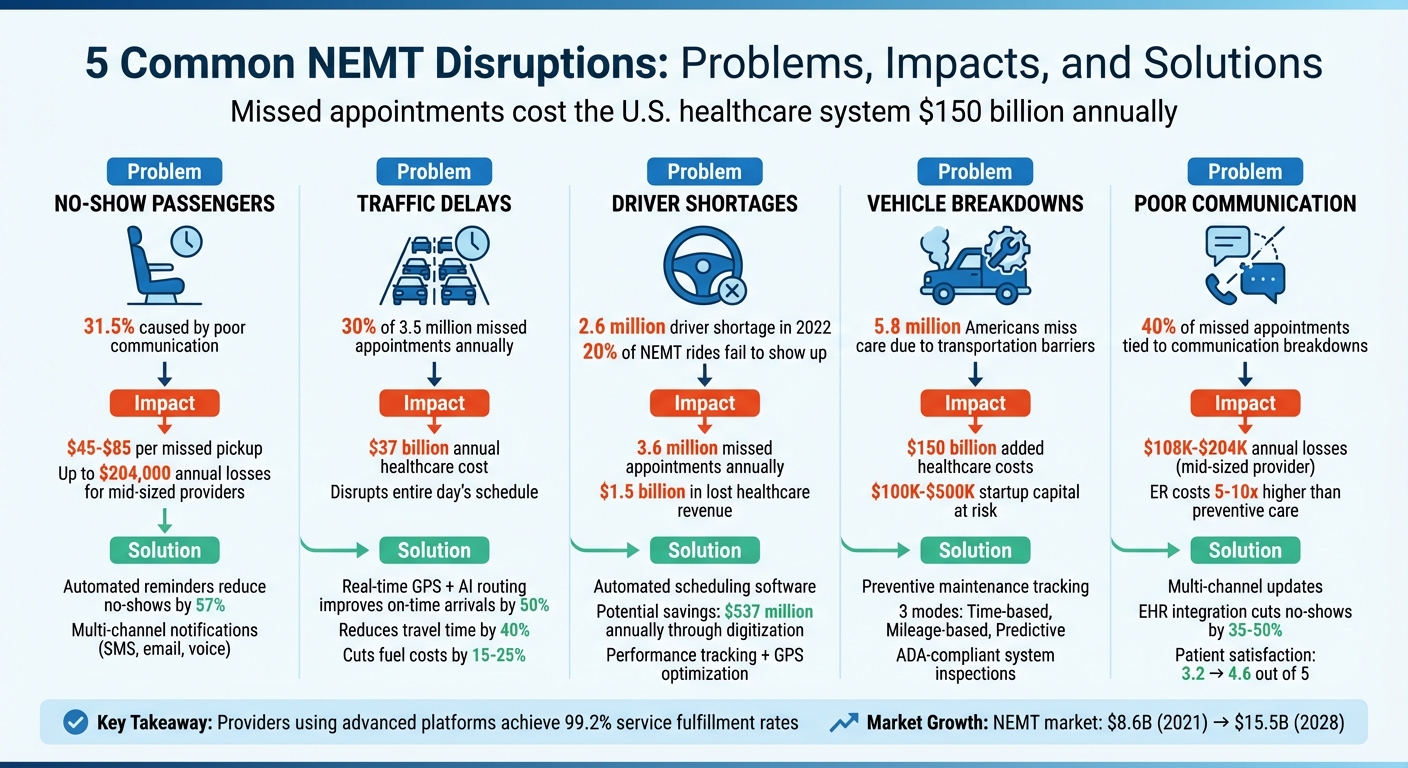
Non-Emergency Medical Transportation (NEMT) ensures access to healthcare for millions, but frequent disruptions can hinder its effectiveness. Missed appointments alone cost the U.S. healthcare system $150 billion annually, while issues like no-shows, traffic delays, driver shortages, vehicle breakdowns, and poor communication create widespread challenges. Here’s a quick summary of the main problems and actionable solutions:
- No-Show Passengers: Forgetfulness, unclear communication, and last-minute changes drive no-shows. Automated reminders and mobile apps reduce no-show rates by up to 57%.
- Traffic Delays: Congestion, accidents, and weather disrupt schedules. Real-time GPS tracking and AI route planning improve on-time arrivals by up to 50%.
- Driver Shortages: Strict qualifications and outdated systems limit workforce availability. Automated scheduling and performance tracking streamline operations.
- Vehicle Breakdowns: Aging fleets and skipped maintenance cause downtime. Preventive maintenance tracking and predictive analytics minimize disruptions.
- Poor Communication: Outdated systems lead to errors and missed updates. Multi-channel notifications and EHR integration cut no-show rates by 35–50%.
5 Common NEMT Disruptions: Problems, Impacts, and Solutions
No-Show Passengers
Why Passengers Don't Show Up
Forgetfulness is the top reason passengers miss their scheduled Non-Emergency Medical Transportation (NEMT) rides. Poor communication accounts for about 31.5% of no-shows, often due to missed reminders or unclear pickup details. Health emergencies, like sudden illnesses or mental health crises, can also prevent passengers from making their appointments. External conflicts, such as last-minute work schedule changes or childcare issues, add to the problem. For elderly or vulnerable passengers in remote areas, accessibility challenges further increase the chances of missed rides. On top of that, if medical appointments are rescheduled or canceled without notifying the NEMT provider, drivers may still be dispatched unnecessarily.
How No-Shows Affect Operations
Missed pickups are expensive, costing between $45 and $85 each. For a mid-sized provider handling around 1,000 trips per month with a 20% no-show rate, these missed appointments can result in monthly losses of $9,000 to $17,000 - or up to $204,000 annually. No-shows create idle driver time, require manual route changes, and leave fleets underutilized, leading to major financial and operational setbacks. For instance, in 2025, a regional healthcare network serving over 150,000 patients faced a 28% no-show rate, which significantly hindered its ability to expand services.
Solutions: Automated Reminders and Mobile Apps
Automated reminders have proven to reduce no-shows effectively. A regional healthcare network that implemented EHR-driven automated reminders saw its no-show rate drop from 28% to 12% in just six months. This led to 2,400 additional completed trips and $180,000 saved in fuel costs. Multi-channel notifications - sent via SMS, email, and voice calls - at critical times (such as the day before, the morning of, and when the driver is en route) ensure passengers are reminded in their preferred way.
Mobile apps also play a key role, allowing riders to confirm, cancel, or reschedule trips on their own. These apps ease the workload on dispatchers and keep passengers informed with real-time updates.
"A simple reminder is the difference between a no-show and a patient showing up for their appointment".
Another effective solution is syncing NEMT software with healthcare providers' EHR systems. This integration ensures transportation schedules automatically adjust when medical appointments are rescheduled or canceled, avoiding unnecessary pickups. These automated tools not only reduce no-shows but also help tackle other challenges, such as traffic delays, more efficiently.
Traffic Delays and Late Arrivals
What Causes Traffic Delays
Traffic delays are often caused by a mix of factors like rush-hour congestion, road construction, accidents, extreme weather, and vehicle breakdowns. Seasonal patterns - such as increased traffic to beaches in the summer, weekend shopping crowds, or large-scale events - can also create predictable bottlenecks. Understanding these trends allows transportation providers to anticipate and prepare for potential disruptions. These delays don’t just throw off schedules - they can directly impact patient care.
How Delays Affect Patients and Schedules
When traffic causes delays, the ripple effects can be significant. A single late arrival can derail the entire day’s schedule, delaying every subsequent pickup and drop-off for that vehicle. Transportation issues are a major factor behind missed medical appointments in the United States, contributing to about 30% of the 3.5 million missed appointments annually.
"In the fast-paced world of non-emergency medical transportation services, time is not just a metric - it's the backbone of enhanced medical services." – RouteGenie
Missed appointments don’t just inconvenience patients - they undermine trust in the transportation system and can lead to serious health consequences. On a larger scale, these missed visits cost the U.S. healthcare system approximately $37 billion each year. Addressing these challenges requires a combination of real-time tools and strategic planning.
Solutions: Real-Time Route Planning and GPS Tracking
Real-time GPS tracking and AI-powered route planning have become game-changers for non-emergency medical transportation (NEMT). These tools can alert dispatchers to traffic congestion in real time, allowing for quick rerouting. This approach has been shown to improve on-time arrivals by up to 50%, cut travel times by 40%, and reduce fuel costs by 15–25%. By analyzing both live and historical traffic data, AI systems can proactively warn drivers about potential delays caused by accidents, construction, or severe weather.
Adding buffer time between scheduled trips is another essential strategy. This extra time helps account for unexpected traffic and provides flexibility for assisting passengers who require mobility aids like wheelchairs or stretchers. Additionally, dispatchers should keep a close eye on performance metrics - such as on-time arrival rates - to identify recurring issues with specific routes or timeframes. Together, these measures help ensure that NEMT services remain dependable and efficient.
Non-emergency medical transportation: Route planning with Pickup Time Optimisation
Driver Shortages and Poor Scheduling
Beyond traffic delays, workforce challenges are another major hurdle for the transportation industry.
What Causes Driver Shortages
In 2022, the transportation sector faced a staggering shortage of 2.6 million drivers, creating immense pressure on Non-Emergency Medical Transportation (NEMT) providers. Becoming an NEMT driver requires more than just a valid driver’s license. These professionals need clean driving records, basic medical training, and excellent customer service skills to assist passengers who may be frail or irritable. These strict qualifications, combined with outdated, paper-based scheduling systems, make it even harder to attract and retain drivers.
The current broker-based model compounds the issue. It often prioritizes volume and profit over care quality, leading to poor driver vetting and minimal accountability for performance. This approach not only limits workforce availability but also undermines the reliability of services and the quality of patient care.
How Shortages Affect Service Reliability
The impact of driver shortages is severe. Around 20% of NEMT rides fail to show up, leaving patients stranded without notice. For example, one major NEMT provider faced widespread ride cancellations after its services were suspended, disrupting thousands of critical appointments.
Chuck Pecoraro, a dialysis patient with stage 5 kidney failure, shared his harrowing experience with missed rides from Modivcare in 2025. He reported missing several life-saving treatments in a single week. Investigations revealed that some drivers were hired without proper background checks, including individuals with felony records. Pecoraro summed up the stakes plainly:
"If I don't get the rides, I die".
These failures contribute to an estimated 3.6 million missed medical appointments annually in the U.S., resulting in $1.5 billion in lost healthcare revenue. The ripple effects of these disruptions compromise patient care and strain the entire NEMT system.
Solutions: Automated Scheduling Software and Performance Tracking
Switching to automated scheduling software could transform how NEMT providers manage their driver workforce. With predictive analytics, trips can be reassigned instantly when disruptions occur, eliminating the delays caused by outdated paper-based systems and manual phone calls.
"Modern NEMT could potentially save $537 million every year if every transportation provider in the U.S. digitized operations." – Erin Mayor, Senior Director of Digitization, Modivcare
Real-time GPS tracking and predictive analytics also allow for better route optimization and quicker trip adjustments, improving driver efficiency and service reliability. To maintain trust, GPS tracking should focus on specific trip exceptions, like delays or emergencies, rather than constant surveillance.
Performance tracking adds another layer of efficiency. It highlights which drivers consistently deliver dependable service and pinpoints problem areas in routes or schedules. Plus, designing schedules that consider drivers’ quality of life can boost retention and minimize the strain caused by workforce shortages.
sbb-itb-cef70f4
Vehicle Breakdowns and Maintenance Problems
Even the best-planned fleets can grind to a halt when mechanical issues arise. Understanding the causes of these problems and how to prevent them is critical for keeping operations running smoothly.
What Causes Vehicle Breakdowns
For NEMT (Non-Emergency Medical Transportation) providers, most vehicle failures can be traced back to a few key factors: skipped routine maintenance, aging vehicles, and unexpected issues like engine or tire failures. However, NEMT fleets face an additional hurdle - specialized accessibility equipment. Malfunctions in wheelchair lifts, ramps, or securement systems not only create safety risks but also put providers at risk of compliance violations. These systems must meet ADA standards, which require them to withstand 2,500 pounds of pressure per leg. When they fail, the vehicle is effectively out of service for passengers who rely on these features.
The ripple effects of a single breakdown can be enormous. Every year, approximately 5.8 million Americans miss or delay medical care due to transportation barriers, which adds an estimated $150 billion to healthcare costs. Mechanical failures don’t just disrupt vehicle reliability - they can lead to significant operational challenges that impact patients and providers alike.
How Breakdowns Affect Fleet Availability
Unplanned downtime and emergency repairs can wreak havoc on fleet availability. They drive up costs, disrupt schedules, and make it harder to ensure passengers get to critical appointments. Poorly maintained vehicles also burn more fuel and emit more pollutants, further increasing operational expenses and shortening the fleet's lifespan. For NEMT providers - who often invest between $100,000 and $500,000 in startup capital, much of it for vehicles - proper maintenance is a key part of protecting that investment.
Solutions: Preventive Maintenance Tracking and Data Analytics
To reduce breakdowns and keep fleets running efficiently, many providers are moving from reactive to proactive maintenance strategies. Instead of waiting for something to fail, they’re combining three types of maintenance:
- Time-Based Inspections: Routine checks scheduled at fixed intervals, such as weekly or monthly, are ideal for vehicles used daily.
- Mileage-Based Services: Maintenance triggered by distance traveled, like oil changes every 6,000 miles, helps manage wear and tear on engines and tires.
- Predictive Maintenance: Advanced sensors and software predict when specific parts are likely to fail, making this approach especially useful for large fleets.
| Mode | Basis | Best Use Case |
|---|---|---|
| Time-Based | Fixed intervals (e.g., weekly) | High-frequency, daily operations |
| Mileage-Based | Distance traveled (e.g., 6,000 miles) | Managing engine and tire wear |
| Predictive | Real-time sensor data | Large fleets needing efficiency |
(Source:)
Automated maintenance tracking tools are also replacing outdated manual spreadsheets. These systems ensure no vehicle misses its service window, allowing providers to budget for repairs in advance instead of scrambling to cover emergency costs. As NEMT Cloud Dispatch explains:
"A fleet with preventative maintenance can operate better by providing timely rides and scheduling rides faster. This increases customers' trust and interest." - NEMT Cloud Dispatch
Another crucial step is partnering with mechanics who are trained to work on ADA-compliant systems. Regular inspections of wheelchair lifts, ramps, and other accessibility features - not just standard vehicle components - help ensure compliance and protect passenger safety. By going beyond the minimum regulatory requirements, providers can avoid costly interruptions and maintain the trust of the patients who depend on them.
Poor Communication and Last-Minute Cancellations
Poor communication throws a wrench into the entire Non-Emergency Medical Transportation (NEMT) system. In fact, about 40% of missed NEMT appointments are tied to communication breakdowns. These issues stem from outdated practices like relying solely on phone calls, a lack of real-time driver updates, and miscommunication between dispatchers, drivers, and passengers. Manual coordination adds to the chaos, leading to errors like incorrect pickup times, addresses, or dates.
Language barriers and hearing impairments, especially among elderly patients, often result in misunderstood appointment details. For patients with cognitive challenges, such as dementia, or those dealing with medication side effects like drowsiness, remembering scheduled rides can become difficult. On top of that, when providers earn a reputation for being consistently late or canceling trips, patients lose faith and may make other plans without notifying anyone.
What Causes Communication Problems
At the heart of these issues are outdated communication systems. Many providers still rely on manual coordination with excessive phone calls and paper schedules, which leaves plenty of room for error. Without integrated systems connecting NEMT software to healthcare providers, critical details often get lost. For instance, a medical office might cancel an appointment at 2:00 PM, but the transportation provider may not find out until the driver shows up at the patient’s home the next day. This disconnect wastes time, fuel, and patience.
Patient-related factors add another layer of complexity. Sudden health changes may prevent a patient from keeping their scheduled trip, but without an easy way to notify the provider, the vehicle still arrives. Additionally, limiting communication to English can alienate diverse communities and lead to even more missed connections.
How Communication Problems Affect Customer Satisfaction
These communication gaps don’t just cause frustration - they hit providers where it hurts: their bottom line. For a mid-sized NEMT provider managing 1,000 trips per month with a 20% no-show rate, annual losses can range from $108,000 to $204,000. When patients aren’t kept informed about driver arrival times, anxiety builds, and they may leave the pickup area, resulting in a no-show.
The ripple effects can be severe. Missing NEMT rides for essential services like dialysis or chemotherapy often forces patients into emergency rooms, where costs can be 5 to 10 times higher than preventive care. Poor communication and a lack of transparency about service details or pricing also push patients to seek alternative transportation options. As highlighted by the American Journal of Public Health:
"Modern NEMT has the potential to yield greater cost savings than traditional NEMT while also improving patient experience."
Solutions: Multi-Channel Updates and Easy Rescheduling Tools
The best way to tackle these issues is by adopting automated reminders across multiple channels - SMS, email, phone calls, and app notifications - tailored to each patient’s preferred communication method. These reminders should allow patients to confirm, reschedule, or cancel trips directly, bypassing the need to call a dispatcher. For example, in June 2025, a regional healthcare network serving over 150,000 patients introduced smart scheduling tools integrated with electronic health records (EHR) and automated reminders. Within six months, their no-show rate dropped from 28% to 12% - a 57% improvement - resulting in 2,400 additional completed trips annually. Patient satisfaction also climbed, with scores increasing from 3.2 to 4.6 out of 5, and the network saved $180,000 in annual fuel costs.
Real-time GPS tracking further helps by showing patients exactly where their ride is and when it will arrive, easing anxiety and reducing premature departures from pickup spots. For rural providers dealing with limited cellular coverage, offline-capable mobile apps ensure communication remains intact even in dead zones. Smart scheduling tools have been shown to cut no-show rates by 35% to 50% through better communication and automated reminders. By syncing directly with healthcare facilities’ EHR systems, transportation providers receive instant updates on appointment changes, eliminating the manual coordination that often leads to errors. Walt Meffert, CIO of Modivcare, emphasizes the potential of these tools:
"We can use predictive analytics to help improve performance by reacting to business challenges in the same way other digital businesses react to theirs via predictive models and insights."
Conclusion
The issues outlined above call for a forward-thinking, technology-driven approach. Tackling no-shows, traffic delays, driver shortages, vehicle breakdowns, and communication gaps is crucial to ensuring patients receive the care they depend on. The numbers speak for themselves - missed appointments have a profound impact on patient health and outcomes.
Leveraging technology to digitize, automate, and monitor operations in real time is no longer optional. Providers using advanced platforms have reported service fulfillment rates as high as 99.2%, with grievance rates dropping below 0.25%. This is a sharp contrast to outdated manual processes. As SafeRide Health's CEO, Robbins Schrader, aptly states:
"By connecting the most vulnerable Medicare Advantage and Medicaid members with critical healthcare services through technology, SafeRide Health is at the epicenter of delivering reliable, individualized transportation, and more human-centered, value-based care solutions to improve the lives of individuals and the well-being of communities across the nation."
This highlights the importance of continuous improvement through data-driven strategies. Monitoring driver performance, staying on top of vehicle maintenance, and analyzing patterns in no-shows can drive better outcomes. With the NEMT market projected to grow from $8.6 billion in 2021 to $15.5 billion by 2028, demand is only going to increase. Providers who embrace automated scheduling, multi-channel communication, preventive maintenance systems, and real-time route optimization will set themselves apart.
Even small steps, like implementing automated reminders or GPS tracking, can make a big difference. These targeted improvements not only address operational challenges but also give providers a competitive edge - all while ensuring patients get the care they need, exactly when they need it.
FAQs
What are the best ways for NEMT providers to reduce no-show rates?
Reducing no-show rates hinges on effective communication and the use of smart scheduling tools. Automated reminders - whether through SMS, phone calls, or email - can help keep riders informed and on schedule. Pairing this with real-time GPS updates ensures riders know exactly when their ride will arrive. Additionally, offering an easy way for riders to reschedule or cancel can help avoid unnecessary trips and wasted resources.
Providers can take it a step further by leveraging AI-powered scheduling to pinpoint trips at higher risk for no-shows. This allows for adjustments like overbooking or scheduling backup rides to mitigate potential disruptions. Combining compatible trips into shared rides is another way to reduce wasted mileage when a rider doesn't show. Establishing clear cancellation policies and offering small perks, such as discounts for consistent attendance, can also motivate riders to stick to their appointments.
For more in-depth strategies and resources to tackle no-shows, NEMT Entrepreneur provides expert guidance to help providers turn challenges into growth opportunities.
How can technology improve the reliability of NEMT services?
Modern technology has become a game-changer in making non-emergency medical transportation (NEMT) services more reliable and efficient. Tools like NEMT dispatch software simplify trip scheduling, match riders with the right vehicles, and offer real-time tracking for both drivers and appointments. This helps ensure better coordination and fewer delays.
Features such as GPS tracking and mobile driver apps allow for route monitoring and quick adjustments when traffic or unexpected issues arise, cutting down on wait times. On top of that, AI-powered route optimization calculates the best routes by factoring in traffic, appointment schedules, and vehicle capacity, making operations run more smoothly.
Secure communication is another essential component. HIPAA-compliant communication platforms enable safe and seamless interaction between drivers, riders, and care coordinators. At the same time, data analytics can anticipate potential challenges, like driver shortages or maintenance needs, before they become problems. Integration with electronic health records (EHR) ensures accurate appointment information and better coordination with healthcare providers. Together, these technologies create a smoother, more dependable experience for everyone involved in NEMT services.
How does better communication improve NEMT operations?
Improving communication between drivers and dispatchers is a game-changer for non-emergency medical transportation (NEMT) services. Tools like live chat and instant messaging make it easy for dispatchers to share updates on route changes, traffic conditions, or specific patient requirements directly with drivers. This kind of real-time interaction helps cut down on delays, missed appointments, and wasted time, keeping operations running smoothly.
Technology also plays a big role here. Features like automatic status updates and driver tracking allow dispatchers to keep an eye on vehicle locations and make smarter decisions about routing. These tools not only help reduce fuel expenses but also boost on-time performance, leading to a better overall experience for both patients and providers. In the end, it means a more efficient and profitable NEMT service.