

NEMT Entrepreneur provides expert insights, strategies, and resources to help non-emergency medical transportation professionals grow their businesses. Get industry-leading advice to succeed in NEMT.
Featured articles
Non-Emergency Medical Transportation (NEMT) brokers use tier systems to rank transportation providers based on performance metrics like on-time rates, trip completion, and customer satisfaction. Your tier ranking directly impacts the volume of trips you receive and your business growth opportunities. To improve your score:
- Meet compliance standards: Ensure drivers and vehicles pass inspections, maintain proper insurance, and meet credentialing requirements.
- Focus on performance: Aim for high on-time rates (90–95%) and low trip cancellations or denials.
- Leverage technology: Use GPS tracking, automated scheduling, and digital trip verification to improve efficiency and transparency.
- Enhance customer satisfaction: Monitor feedback, address complaints, and provide quality service.
- Stay updated on regulations: Keep up with state-specific rules to avoid penalties or claim denials.
Performance Metrics That Determine Your Tier Ranking
On-Time Performance and Trip Completion Rates
Brokers evaluate your punctuality by comparing actual pick-up and drop-off times to the scheduled ones. For medical appointments, an on-time performance (OTP) rate of 90–95% is the benchmark for maintaining high service rankings. Hitting these targets consistently shows brokers that you’re dependable and respect both the member’s time and the healthcare system’s schedule. These metrics are a cornerstone for assessing overall operational effectiveness.
"Our top providers - those who go above and beyond by consistently delivering a high level of ride volume at an equally high level of member satisfaction - get promoted to the SafeRide Tier 1 Supplier Network." - SafeRide Health
Trip completion rates are just as critical. Brokers require verifiable proof of completed trips. Accurate trip logs, including driver and vehicle details, are essential. Low denial and cancellation rates further highlight your ability to manage fleet operations effectively and handle the volume of trips assigned. The stakes are high: transportation issues contribute significantly to the 30% of medical appointments missed annually in the U.S..
Customer Satisfaction and Feedback Scores
Brokers rely heavily on customer experience metrics - like complaint rates, response times, and ride quality - to evaluate your performance. Strong customer satisfaction scores indicate that you consistently exceed expectations, making you a preferred choice for higher trip volumes and long-term contracts. As brokers shift toward data-driven evaluations, customer metrics outweigh traditional relationship-based factors.
Real-time feedback systems are now standard. Many brokers use passenger-facing apps that sync directly with their headquarters, allowing for immediate post-ride feedback. These systems provide transparency, helping brokers assess individual driver and contractor performance. While they highlight your strengths when you deliver excellent service, they also quickly reveal any issues. Automated post-trip surveys and ratings offer a chance to capture immediate feedback and showcase your commitment to quality.
Trip Denials, Cancellations, and No-Shows
In addition to punctuality and customer feedback, brokers closely monitor cancellation metrics. High rates of trip denials or cancellations can significantly impact your tier ranking. These metrics are critical indicators of your ability to reliably handle assigned trips. For example, in Colorado, NEMT mileage claims are automatically flagged for review if they exceed 52 miles in non-rural areas or 125 miles in rural counties (as of September 30, 2025) unless proper documentation is provided. For trips over 25 miles, a signed medical necessity verification form from the treating provider or clinical staff is required before billing to avoid claim denials.
Compliance is non-negotiable. Drivers and vehicles must meet all credentialing requirements, as non-compliance leads to immediate disqualification from providing services. To stay ahead, use software to track driver licenses and vehicle inspections, ensuring you never miss an expiration date. Consistent credentialing reinforces your reliability and keeps you in good standing with brokers.
How to Boost Your NEMT Business with Broker Relationships
Licensing and Insurance Requirements
To get started, you'll need to secure some vital documentation. This includes a National Provider Identifier (NPI), a Federal Tax Identification Number (FTIN), and a state-specific business license. In many states, Medicaid enrollment is also required. For instance, in Colorado, NEMT providers are classified under Provider Type 73.
When it comes to insurance, there are several mandatory policies you’ll need to have in place:
- General liability
- Professional liability
- Commercial auto
- Workers' compensation
- Hired/non-owned auto insurance (if contractors are part of your operations)
"NEMT insurance is not optional: It is mandatory for all vehicles and drivers, to safeguard your business against liability claims and accidents." – Jaycee Morrill
Make sure to keep detailed records of your insurance policy numbers and their expiration dates. Any lapse in coverage could result in immediate penalties, such as tier demotion or even contract termination.
Licensing requirements for vehicles depend on the type of service you provide. For example, ground ambulances often need county-level permits, while air ambulances require state-level authorization. Additionally, many states require permits from agencies like the Public Utilities Commission or the Board of Transportation. Vehicles must also comply with ADA standards, which means having proper securement systems and ramps for wheelchair users.
Once your licensing and insurance are sorted, the next step is ensuring your drivers meet all the necessary credentialing standards.
Driver Training and Certification Standards
Driver credentialing is a critical component of compliance. Platforms like ProCredEx are commonly used by brokers for real-time credential management. For example, in Colorado, drivers cannot transport members without first passing credentialing through this system.
Federal guidelines under Section 209 of the Consolidated Appropriations Act set minimum requirements for drivers. These include:
- A valid driver’s license
- Verification that the driver is not on the OIG exclusion list
- Documented policies for handling drug law violations and disclosing driving history
In addition to federal regulations, most providers require drivers to complete health certifications, undergo criminal background checks, and participate in random drug screenings.
For those aiming to stand out in the industry, NEMTAC® accreditation offers national recognition. This accreditation involves a thorough review of driver credentialing and HR practices. The cost is $3,000 upfront or $3,600 if paid in monthly installments of $83.33 over three years. Some states even offer benefits tied to this accreditation. For instance, Mississippi allows it as an alternative to traditional state licensure, while Minnesota provides financial incentives for providers who achieve accreditation before January 31st each year. Meeting these standards not only ensures compliance but can also improve your tier score.
sbb-itb-cef70f4
Keeping Up with Regulatory Changes
Staying on top of regulatory updates is just as important as meeting initial requirements. Regulations frequently evolve, and missing key changes can impact your operations. For example, Colorado revised its rural mileage limits on September 30, 2025, increasing the daily threshold from 52 to 125 miles roundtrip for members in 40 rural counties. Failing to adapt to such changes could lead to claim denials, which might hurt your completion rates.
To avoid surprises during audits, use tools like the NEMTAC Accreditation Readiness Self-Check. This can help you identify gaps in areas like policies, vehicle maintenance, and driver records before brokers step in. Automating processes, such as eligibility verification, is another smart move. Systems like Batch 270 or Provider Web Portals can confirm member benefits before each trip, saving time and reducing errors. Additionally, keeping an eye on state memos - like Colorado HCPF OM-074 - can help you stay informed about billing codes, mileage updates, and documentation requirements.
"Accreditation is more than just a certificate - it proves your organization is committed to doing things the right way." – NEMTAC®
How to Improve Your Vendor Score
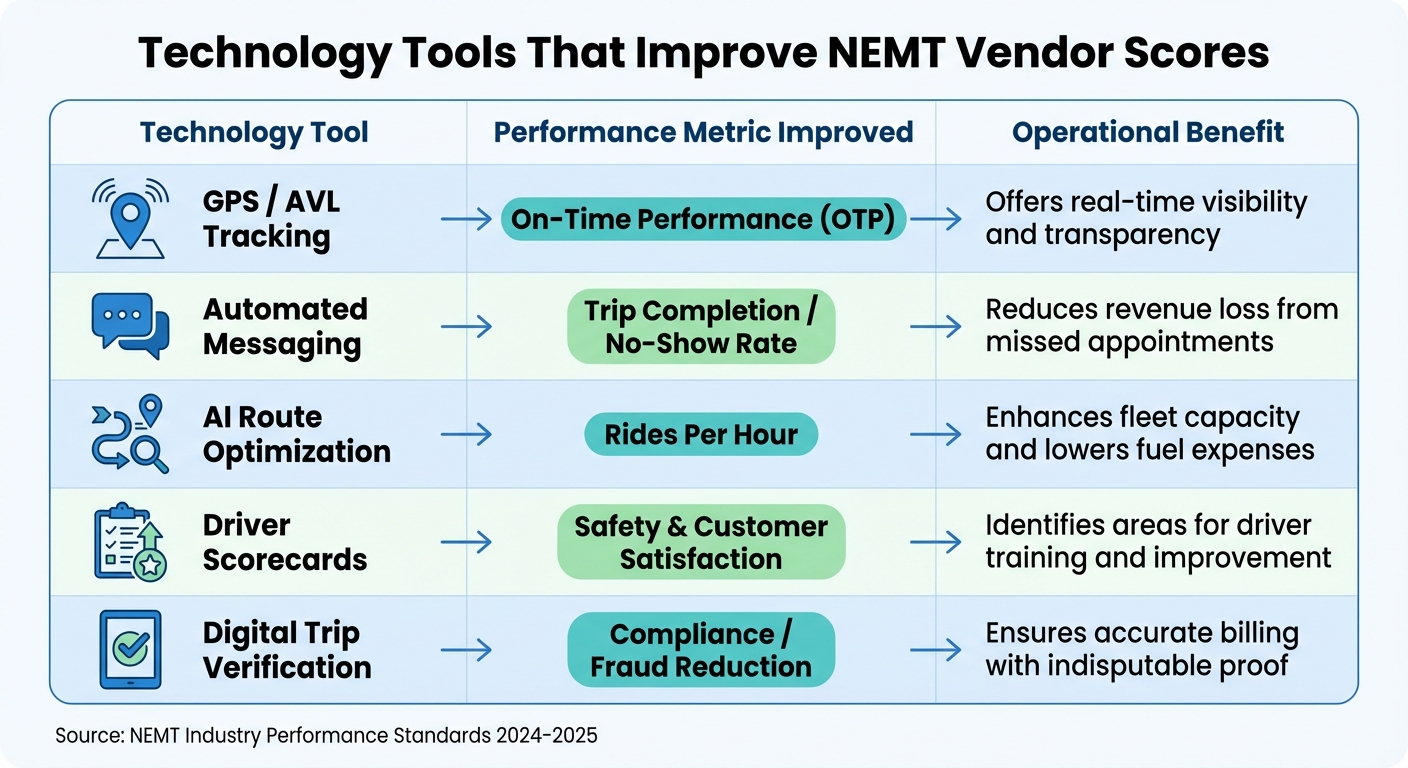
NEMT Technology Tools and Performance Metrics Impact Chart
Boost your tier ranking by refining operations, leveraging technology, and enhancing communication. These efforts can yield measurable results within months.
Improving Operational Efficiency
Fine-tuning your operations can significantly improve key broker metrics. For instance, automated scheduling tools help eliminate errors and optimize routes, leading to better on-time performance. With most NEMT providers completing 6 to 10 trips per vehicle daily, even small efficiency improvements can make a big impact.
Adopting route optimization software can cut fuel expenses, reduce driver hours, and minimize missed trips through automated reminders. Take Metro Medical Transport as an example: after struggling with a 23% claim denial rate and losing a major MCO contract in early 2024, they implemented an integrated NEMT software solution. This included GPS tracking and electronic documentation, which helped them achieve a 91% clean claim rate and reduce denials to just 6% within six months. The result? They regained their contract and added $200,000 in monthly revenue.
Investing in quality equipment, such as specialized wheelchairs and comfortable vehicles, can lower incident rates and improve customer satisfaction. Additionally, capturing real-time data - like GPS coordinates, digital signatures, and photos - provides undeniable proof of service, reducing the risk of billing disputes.
Using Technology to Track Performance in Real-Time
To improve, you need visibility. Real-time dashboards and GPS tracking enable you to monitor key metrics like on-time arrival rates, wait times, and trip completions as they happen. This instant insight allows you to address potential issues before they escalate and impact your vendor score.
| Technology Tool | Performance Metric Improved | Operational Benefit |
|---|---|---|
| GPS / AVL Tracking | On-Time Performance (OTP) | Offers real-time visibility and transparency |
| Automated Messaging | Trip Completion / No-Show Rate | Reduces revenue loss from missed appointments |
| AI Route Optimization | Rides Per Hour | Enhances fleet capacity and lowers fuel expenses |
| Driver Scorecards | Safety & Customer Satisfaction | Identifies areas for driver training and improvement |
| Digital Trip Verification | Compliance / Fraud Reduction | Ensures accurate billing with indisputable proof |
Mobile apps can guide drivers through proper documentation, ensuring consistent and accurate timestamps. Automated reminders - sent the night before trips or when drivers are en route - help curb no-shows, a problem that costs the healthcare industry an estimated $150 billion annually. For instance, Regional Transport Solutions implemented GPS tracking and automated mileage calculations, recovering $38,000 in corrected claims and cutting administrative processing time by 30%.
"If you can't measure it, you can't improve it." – Peter Drucker, Management Consultant
This level of real-time data allows for more proactive and transparent communication with brokers.
Improving Communication with Brokers
Once you've streamlined operations and implemented real-time tracking, the next step is fostering strong relationships with brokers. Transparency is key. Sharing detailed reports on trip efficiency, on-time performance, and customer satisfaction builds trust and shows your dedication to high-quality service. Use your NEMT software to generate automated compliance reports that brokers can access anytime.
Stay ahead of potential issues by addressing them proactively. Many brokers offer Corrective Action Plans (CAPs) and performance improvement plans as tools to help providers improve before penalties are imposed. Conducting monthly internal audits can help you spot claim denial trends, coding mistakes, or documentation gaps before brokers flag them. Cross-training your team - dispatchers, drivers, and billing staff - on regulatory updates ensures everyone is aligned with broker expectations.
"Modern healthcare organizations want NEMT providers who can demonstrate reliability, efficiency, and transparency." – Ryde Central
Clear communication with brokers from the start is essential to avoid costly mistakes. Regular check-ins with MCO or broker representatives can help you navigate complex billing and documentation rules, reducing claim denials that hurt your vendor score. By tracking improvements - like shorter wait times or faster trip completions - and sharing these metrics, you provide tangible evidence of your service quality.
Conclusion: Succeeding in NEMT Broker Tier Systems
Key Takeaways for NEMT Providers
Thriving within NEMT broker tier systems boils down to focusing on three essential elements: consistent performance, strict compliance, and clear communication. To stay competitive, aim for an On-Time Performance (OTP) rate between 95% and 99%, and ensure full compliance with driver background checks and insurance requirements. Falling short in these areas could lead to tier demotion or even contract termination.
Leveraging modern technology is no longer optional - it’s a necessity. Tools like GPS tracking, AI-driven scheduling, and digital trip verification offer brokers the transparency they need to assess vendors fairly. Credentialing is another non-negotiable factor. Every driver and vehicle must meet state-approved standards before they can start providing services. Additionally, maintaining precise trip documentation is critical for passing audits successfully.
If performance issues arise, act swiftly by implementing Corrective Action Plans (CAPs). This proactive approach shows brokers your commitment to improvement and helps protect those valuable relationships. By focusing on operational efficiency and open communication, you can not only address immediate challenges but also position your business for long-term success.
Long-Term Benefits of Higher Tier Placement
Reaching and maintaining a top-tier position comes with lasting rewards. For instance, in Connecticut, providers can earn performance bonuses of up to 5% of the contract value when they exceed service benchmarks. Beyond these bonuses, top-tier providers enjoy priority within broker networks, offering stability in competitive markets where brokers limit the number of providers based on network capacity.
Higher tier placement also opens doors to new opportunities. The NEMT industry is evolving to include services beyond traditional medical appointments, such as health-related social needs (HRSNs). These might involve trips to food banks, housing services, or other essential destinations. Providers with a proven track record and strong compliance are often the first to secure contracts for these emerging services. Moreover, the operational efficiencies gained through technology - like managing more trips with fewer dispatchers - can significantly boost profit margins and support sustainable growth.
"Providers and brokers who embrace technology, realistic performance standards, and creative network-building strategies will be best positioned to thrive in this changing landscape." – Mitch Cooper, Tobi
FAQs
How can I use technology to improve my NEMT vendor score?
Technology has the power to elevate your NEMT vendor score by improving critical areas such as punctuality, compliance, and customer satisfaction. With integrated, cloud-based platforms, you can seamlessly share trip details, patient data, and billing information. This real-time connectivity not only speeds up dispatch processes but also minimizes errors and ensures precise reporting to meet broker requirements.
Cutting-edge tools like AI-powered routing and analytics can fine-tune driver assignments, anticipate delays, and identify potential issues before they escalate. Additionally, mobile apps and electronic proof-of-service tools keep patients and brokers informed with instant trip updates, fostering trust and transparency. Embracing modern technology allows you to streamline your operations, enhance efficiency, and climb higher within broker tier rankings.
What are the main compliance requirements for NEMT providers?
NEMT providers have to navigate a maze of federal Medicaid laws, state-specific rules, and industry standards to stay compliant. At the federal level, Medicaid mandates that states ensure transportation access for eligible beneficiaries. However, each state has its own set of regulations and performance benchmarks, so providers must familiarize themselves with the specific requirements in every state where they operate.
Some of the key operational requirements include ensuring HIPAA-compliant privacy and security for patient data, submitting claims that are both accurate and timely, and maintaining thorough records of eligibility, prior authorizations, and trip details. Additionally, providers are expected to have solid fraud-prevention measures in place, such as verifying that their staff and contractors are not barred from participating in federal health programs.
Staying on top of these compliance standards isn’t just about following the rules - it’s also critical for maintaining strong relationships with brokers and boosting vendor scores within tier systems.
How does customer satisfaction affect my vendor tier ranking?
Customer satisfaction is a major factor in determining your vendor tier ranking. Brokers assess your performance using several key metrics, such as reliability, on-time performance, compliance, and rider feedback. Even if you score average on some metrics, a high satisfaction score can significantly boost your overall ranking.
Brokers prioritize providers who deliver a safe, courteous, and dependable experience for riders. Positive rider feedback, swift resolution of complaints, and consistently strong ratings show that you’re a trustworthy partner. This not only improves your chances of moving into higher tiers but also opens the door to more trip assignments and better contract opportunities.
To climb the rankings, focus on gathering rider feedback, addressing complaints promptly (ideally within 24 hours), and using that information to train drivers on key areas like punctuality, courtesy, and vehicle cleanliness. High customer satisfaction doesn’t just elevate your tier - it also builds a stronger reputation with brokers.


