

NEMT Entrepreneur provides expert insights, strategies, and resources to help non-emergency medical transportation professionals grow their businesses. Get industry-leading advice to succeed in NEMT.
Featured articles
Expanding an NEMT fleet from 5 to 50 vehicles is a major challenge. As operations grow, manual processes like spreadsheets and phone calls quickly become unmanageable. Key areas such as scheduling, dispatching, compliance, driver management, and vehicle maintenance face strain as demand increases. To scale effectively, automation and data-driven systems are essential. Here's what you need to know:
- Manual Systems Fail: Scheduling and dispatching break down beyond 10-15 vehicles, leading to inefficiencies, delays, and higher costs.
- Driver Turnover Rises: Managing a larger team requires automated scheduling, training programs, and retention strategies.
- Vehicle Maintenance Becomes Complex: Preventive maintenance systems reduce downtime and repair costs.
- Compliance Grows Harder: Automated tools ensure regulatory requirements are met and reduce claim errors.
- Service Quality Risks: Real-time tracking and route optimization keep on-time rates high and costs low.
Key Takeaway: Invest in automation early - before hitting 10 vehicles - to streamline operations, maintain quality, and avoid revenue loss. Tools like NEMT software for scheduling, GPS tracking, and compliance management are critical for scaling successfully.
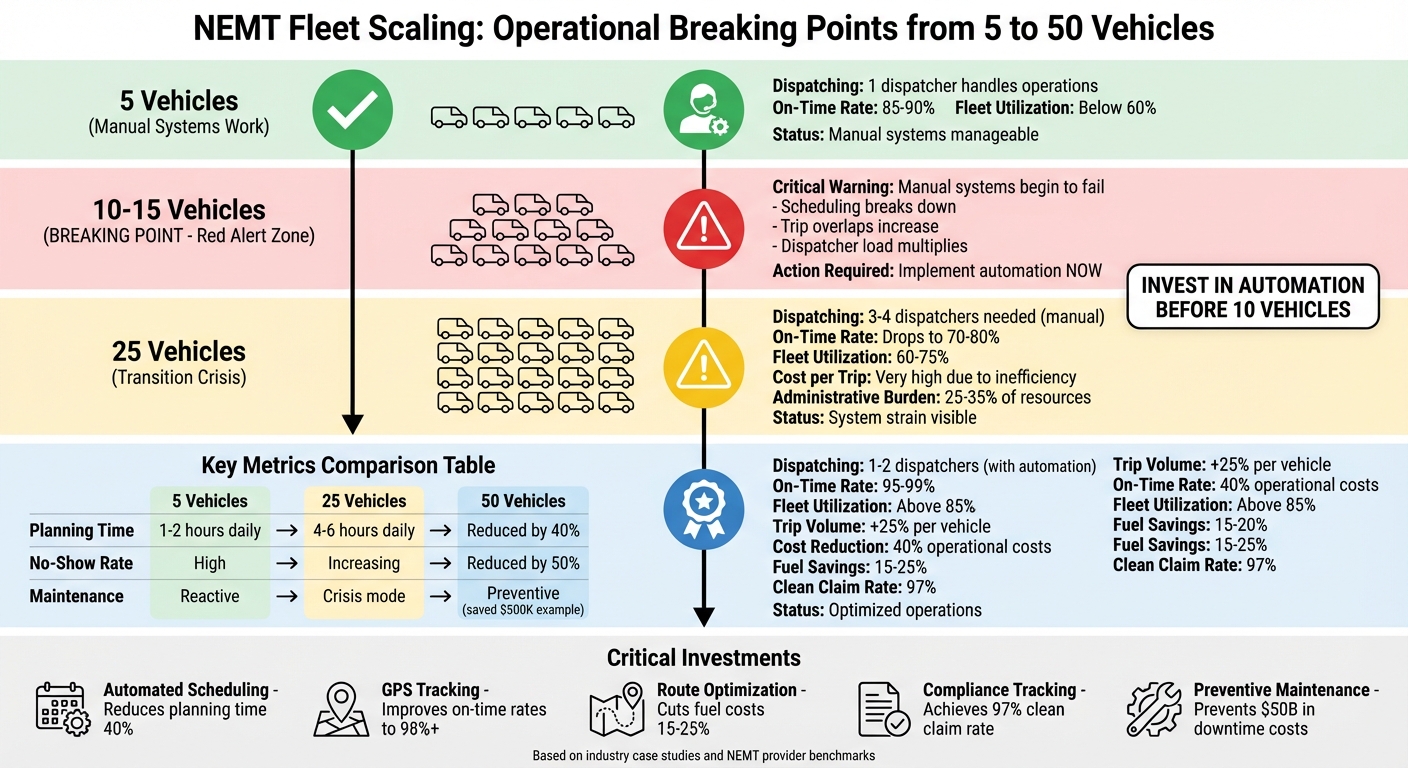
NEMT Fleet Scaling: Breaking Points from 5 to 50 Vehicles
Fleet Logistics: When Manual Systems Stop Working
The Problem: Manual Scheduling Breaks Down
When your fleet grows to 10 to 15 vehicles, relying on spreadsheets and phone calls for scheduling starts to fall apart. Trips overlap, drivers end up at the wrong locations, and passengers face longer wait times than necessary. The core issue? A lack of real-time visibility across your entire operation. For example, a dispatcher might mistakenly assign a sedan to a wheelchair-bound passenger, leading to delays and wasted fuel.
"An inefficient dispatching system has a domino effect that can lead to mismanagement or efficiency." - Yurii Martynov, Marketing Director, RouteGenie
Manual systems also miss opportunities to combine trips, leading to wasted fuel and unnecessary mileage. Drivers aren’t notified quickly about cancellations, so they take extra trips that could have been avoided. As your fleet expands to 25 vehicles, these inefficiencies snowball - on-time performance drops from around 95% to just 70–80%, which can seriously impact reliability and service quality at scale. Clearly, a better system is needed before these challenges become unmanageable.
The Solution: Automated Dispatching and Route Planning
Switching to NEMT software before your fleet reaches 15 vehicles can help you avoid operational headaches. Automation ensures patients are matched with the right vehicles, routes are planned efficiently, and adjustments are made in real time for traffic or cancellations. The results speak for themselves.
For instance, MedTransport Solutions adopted RouteOps and saw a 40% reduction in operational costs while increasing trips per vehicle by 25%. They also maintained a 95% on-time rate. Similarly, CareRide scaled from 10 to 30 vehicles - a 300% increase - without adding another dispatcher, achieving a patient satisfaction rate of 99%.
"Software can track routes in real-time and assign the most efficient route and most sensible driver and vehicle to the waiting patients... minimizing manual oversight." - RouteGenie
The financial benefits are undeniable. A midsize provider in Texas saved over $50,000 in fuel costs within six months of implementing route optimization. They also delivered 25% more trips each month. Fuel expenses typically drop by 15% to 25%, and overall operational costs can decrease by 20% to 30%. Driver productivity also jumps - from less than 60% with manual routing to over 85% with automated systems. This means you can handle more trips without increasing your team size.
Comparison Table: Manual vs. Automated Dispatching
| Metric | 5 Vehicles (Manual) | 25 Vehicles (Manual) | 50 Vehicles (Automated) |
|---|---|---|---|
| Trip Efficiency | High (Manageable) | Low (Overlapping/Gaps) | High (Optimized/Multi-load) |
| Cost Per Mile | Moderate | High (Inefficient Routing) | Low (Route Optimization) |
| On-Time Performance | 95%+ | 70–80% (Frequent Delays) | 98%+ (Real-time Adjustments) |
| Dispatcher Load | 1 Dispatcher | 3–4 Dispatchers | 1–2 Dispatchers |
| Billing Accuracy | High (Low Volume) | Low (Manual Errors) | 97% Clean Claim Rate |
Automated systems offer even more advantages, such as reducing deadhead miles by 30% and cutting dispatcher-related labor costs by 50%. They can also decrease no-shows by up to 50% by sending automated reminders, ensuring your schedule stays full and revenue keeps flowing. The key is making the switch before manual processes start eating away at your contracts and reputation.
Driver Management: Hiring, Training, and Retention at Scale
The Problem: High Turnover and Scheduling Conflicts
Once your fleet grows beyond 20 vehicles, the challenges of managing drivers increase significantly. You’ll likely need 25–30 drivers to cover shifts, sick days, and time off, which intensifies hiring, retention, and scheduling headaches. The NEMT industry already faces high turnover rates, and rapid expansion can make these problems worse. Drivers often leave for higher pay, more predictable schedules, or because they feel unprepared for the specific demands of medical transport. On top of that, manually tracking licenses, background checks, and CPR certifications can lead to missed expiration dates, putting your business at risk.
"Finding and training qualified professionals who possess the right skills, along with the compassion and empathy required, isn't always easy." - Jaycee Morrill, Contributor, Broda
As your team grows, scheduling conflicts also become more frequent. While quick calls or texts might work for a small team, they fall apart when managing a larger workforce. Last-minute call-outs can leave you scrambling to fill shifts, resulting in late pickups or even missed trips. Traditional NEMT operations often see administrative tasks consuming 25% to 35% of their resources, pulling focus away from delivering quality service. To combat these issues, automated tools are essential for streamlining scheduling and ensuring compliance.
The Solution: Driver Management Tools and Systems
Introducing NEMT software before your fleet exceeds 25 vehicles can save you from a lot of headaches. Automated shift scheduling tools help minimize conflicts by showing real-time driver availability and preventing double bookings. Compliance tracking features send alerts before licenses, certifications, or background checks expire, helping you avoid non-compliance risks.
Standardized training programs are another key to success. These ensure that every new driver meets your quality standards from the start. Beyond initial orientation, offering periodic refresher courses on topics like wheelchair securement, patient handling, and defensive driving keeps your team prepared. This is especially critical, given that traffic fatalities in the U.S. increased by 19% between 2019 and 2022.
"In the NEMT industry, brand identity reflects trust... top-notch drivers [are] an excellent marketing benefit and key selling point for your business." - Michelle McCullough, Marketing Manager, Broda
Driver incentives can also make a big difference. Performance-based bonuses tied to punctuality, safety, and customer feedback encourage drivers to perform their best. GPS data and customer ratings can help identify your top performers and those who may need extra coaching. Cross-training drivers in basic customer service and operational tasks not only improves service quality but also creates career growth opportunities, which can help retain experienced staff. For additional flexibility, consider partnering with independent contractor networks like HopSkipDrive or GoGoGrandparent to scale up without the fixed costs of full-time hires.
Vehicle Maintenance: Preventing Costly Downtime
The Problem: Unexpected Breakdowns and Rising Costs
After optimizing dispatching and managing drivers, keeping your vehicles in top shape becomes the next big challenge. Once your fleet grows to 30 or more vehicles, maintenance can quickly turn into a logistical nightmare. What worked when you had just a handful of vehicles - like jotting down oil changes on a whiteboard or relying on memory - simply doesn’t cut it anymore. Unscheduled repairs become a drain on your bottom line, with a single breakdown leading to canceled trips and lost revenue.
Expanding quickly with used vehicles might seem like a cost-effective move, but it often results in higher repair bills and worse fuel efficiency over time. Without a proper tracking system, critical inspections can slip through the cracks, leading to even bigger and more expensive problems. For Non-Emergency Medical Transportation (NEMT) fleets, maintenance costs are notoriously unpredictable, catching many providers off guard when expenses suddenly spike.
"Preventive maintenance is essential to your success. You need reliable vehicles to keep patients safe, maximize your uptime, and control operating costs." - Jaycee Morrill, Contributor, Broda
The stakes are high. Across industries, unexpected downtime is estimated to cost as much as $50 billion annually. For NEMT providers, every hour a vehicle is out of service means lost revenue. When you're managing a growing fleet, manually tracking service intervals, inspections, and compliance requirements creates unnecessary risks. Addressing these challenges means adopting scheduled, automated maintenance systems.
The Solution: Scheduled Maintenance with Fleet Management Systems
Scaling your fleet successfully requires a shift from reactive to preventive maintenance. Just as dispatch and staffing need optimization, so does your approach to vehicle maintenance. Fleet management software takes the guesswork out of the equation by scheduling maintenance based on mileage, engine hours, or specific calendar dates. These systems provide real-time alerts, helping you fix small issues before they escalate into costly repairs.
Take Certarus, for example. This low-carbon energy provider operates across Canada and the U.S. In 2024-2025, they integrated Samsara fleet software into their maintenance operations. By switching from time-based maintenance to usage-based thresholds and automating work orders through digital DVIRs (Driver Vehicle Inspection Reports), they saved $500,000 in maintenance costs in just one year. That’s a clear example of how the right system can make a massive difference.
Digital inspections, completed through mobile apps, allow for real-time reporting with photos and notes. This not only speeds up compliance checks but also helps identify cost trends.
To get started, build relationships with mechanics who understand NEMT-specific standards and can recommend reliable parts. Use automated calendar reminders to coordinate trips around scheduled maintenance, reducing the risk of last-minute cancellations. Look for software with open APIs and mobile app compatibility - entry-level options are available for around $20 per month. Aiming for a high Planned vs. Unplanned Work Ratio (PUWR) is a good indicator that your maintenance strategy is on the right track.
Compliance and Documentation: Managing Regulatory Requirements
The Problem: Manual Tracking Can't Keep Pace
Once your fleet grows to around 40 or 50 vehicles, manual tracking methods like paper logs, spreadsheets, or relying on memory simply can’t keep up with compliance demands. Overlooking something as small as a driver’s certification renewal or failing to properly document a trip can lead to serious consequences - claim denials, hefty fines, or even losing contracts.
The challenges only grow as your business scales. For private NEMT providers with more than 15 employees, compliance with ADA regulations becomes a legal requirement, not just a good practice. You’ll need to document vehicle accessibility features, keep driver certifications up to date (like CPR training, background checks, and drug screenings), and securely manage HIPAA-compliant patient data. On top of that, new billing requirements, such as the mandatory use of HCPCS code S0215 for ambulatory vehicle mileage starting July 1, 2025, highlight how regulations constantly evolve.
"Non-compliance with NEMT regulations carries severe consequences that can devastate businesses... resulting in substantial fines, operational restrictions, and criminal prosecutions." - NEMT Platform
Manual systems aren’t just inadequate for scheduling and maintenance - they also fall short when it comes to meeting these growing compliance needs. Take the example of Metro Medical Transport, a mid-sized provider operating across three states. In early 2024, they faced a claim denial rate of 23% and lost a major MCO contract due to documentation errors. These issues caused monthly revenue losses of over $150,000. When you’re managing dozens of vehicles, drivers, and trips daily, manual tracking simply can’t handle the volume. Seamless compliance management is just as important as efficient route planning or driver coordination when scaling your operations.
The Solution: Automated Compliance Tracking
Automated compliance tools take the uncertainty out of the equation and minimize costly mistakes. These systems collect data like GPS coordinates, digital signatures, and timestamps in real time, creating a detailed, audit-ready record for every trip. For instance, instead of manually logging mileage, GPS-based "breadcrumb" tracking automatically calculates distances and verifies pickup and drop-off locations, significantly reducing the risk of fraud.
Metro Medical Transport saw dramatic improvements after adopting NEMT software with GPS tracking and automated claim submission. Their claim denial rate dropped from 23% to just 6%, their clean claim rate soared to 91%, and they regained a lost contract - boosting monthly revenue by $200,000 within six months. Another example is Regional Transport Solutions, which uncovered $45,000 in fraudulent mileage claims across 200 trips. By switching to automated mileage tracking and digital signatures, they recovered $38,000 and put an end to further losses.
To set yourself up for success, consider appointing a dedicated compliance officer as your fleet nears 50 vehicles. This role can help monitor regulatory updates and ensure your standard operating procedures stay current. Use software that integrates with payer databases to verify patient insurance and pre-authorization before dispatching trips. Regularly conduct mock audits of trip logs and billing codes to catch issues before they escalate. Automated alerts for driver credential renewals, vehicle inspections, and maintenance schedules can also help ensure you’re always ahead of compliance requirements.
sbb-itb-cef70f4
Service Quality: Keeping Performance High During Growth
The Problem: Mismatched Capacity and Late Arrivals
As your fleet grows, keeping service quality consistent becomes a real challenge. Once you hit 25 to 30 vehicles, manual dispatching often leads to a chain reaction of issues that can erode client trust. Why? Because spreadsheets and manual systems just can’t juggle real-time traffic, driver availability, and equipment needs all at once. This can result in dispatchers mistakenly sending vehicles without essential features - like wheelchair lifts - to clients who depend on them. Fixing these errors at the last minute disrupts schedules for multiple drivers and clients.
This kind of mismanagement creates a ripple effect. A single late arrival or wrong assignment can throw off the entire day’s operations. At the same time, poor capacity planning leaves vehicles sitting idle while racking up unnecessary miles, leading to long wait times or canceled trips. In the U.S., transportation issues cause about 3.6 million people to miss medical appointments each year. To tackle these problems and maintain trust, fleets need to shift to smarter, data-driven solutions.
The Solution: Data-Driven Service Optimization
Automated systems can take the guesswork out of scheduling by matching trips to drivers and vehicles based on real-time factors like location, availability, and client needs. For example, MedTransport Solutions cut costs by 40% and increased trips per vehicle by 25% with automated scheduling. Similarly, CareRide achieved a 99% patient satisfaction rate while expanding its fleet by 300%.
Real-time GPS tracking further improves accuracy, providing precise ETAs and enabling quick adjustments when needed. Multi-load optimization groups compatible trips together, maximizing capacity without compromising on-time performance. Automated notifications via text or app can cut no-show rates by up to 50%, while route optimization reduces fuel costs by 15% to 25% and improves safety by avoiding risky maneuvers. By integrating these tools, fleets can minimize errors and disruptions, even during periods of rapid growth.
KPI Benchmark Table for Growing Fleets
| Metric | 5 Vehicles (Manual) | 25 Vehicles (Transition) | 50 Vehicles (Automated) |
|---|---|---|---|
| On-Time Rate | 85-90% | 75-80% (Breaking Point) | 95-99% |
| Fleet Utilization | Below 60% | 60-75% | Above 85% |
| Planning Time | 1-2 hours daily | 4-6 hours daily | Reduced by 40% |
| Trip Volume | Baseline performance | +15% efficiency gain | +25% trips per vehicle |
| No-Show Rate | High (manual reminders) | Increasing due to delays | Reduced by 50% |
| Cost per Trip | High (manual labor) | Very high (inefficiency) | Reduced by 40% |
To spot inefficiencies, keep a close eye on your capacity utilization rate. Look for signs like unused vehicles or scheduling gaps. Another critical metric is your clean claim rate - aim for 97% or higher to maintain steady cash flow and build strong relationships with brokers. High on-time performance and reliable service aren’t just about keeping clients happy; they’re essential for landing and retaining contracts with NEMT brokers and Medicaid payers.
Growing a $7M / Year Non Emergency Medical Transportation Business | NEMT Experts Podcast Episode 97
Conclusion: Planning for Continued Growth
Expanding from a small fleet of 5 vehicles to a robust operation with 50 is about much more than simply adding more vans to your lineup. It’s about creating systems that can handle the complexities of growth. The hurdles - like scheduling mishaps, driver turnover, unexpected breakdowns, compliance challenges, and dips in service quality - can all be addressed with one overarching solution: automation combined with data-driven decision-making.
To scale successfully, investing in the right technology is non-negotiable. Automated scheduling tools can slash planning time by as much as 40%, while intelligent routing systems have the potential to increase trip volume by 25% - all without adding a single vehicle to your fleet. As Mitch Cooper aptly put it, "Scaling a NEMT business isn't just about adding more vehicles. It's about building systems that can handle growth without adding stress."
The key is to act early. Shift away from manual processes before your fleet reaches 10 vehicles, implement preventive maintenance schedules to avoid disruptions, and get compliance tracking systems in place right from the start. Waiting too long to make these changes can lead to lost revenue and strained relationships with brokers.
Key Takeaways
Here’s a quick recap of the strategies that will set you up for sustainable growth:
- Automate core operations like scheduling, dispatching, and billing to save time and reduce errors.
- Use real-time GPS tracking for better visibility and to stay compliant with regulations.
- Set up preventive maintenance programs to minimize costly downtime.
- Closely monitor key performance indicators (KPIs), such as on-time rates, fleet utilization, and clean claim rates. Strive for a clean claim rate of 97% to keep your cash flow steady.
Scaling isn’t just about growing your fleet - it’s about building systems that grow with you. Providers who successfully reach the 50-vehicle mark are the ones who invested early in technology and processes, enabling them to expand without piling on administrative headaches or compromising the quality of their service.
FAQs
What are the best steps to automate an NEMT fleet with fewer than 10 vehicles?
To get ahead of the game and automate your NEMT fleet before hitting the 10-vehicle mark, start with a cloud-based NEMT software platform. This will take over time-consuming tasks like scheduling, dispatching, and billing, so you can focus on running a smoother operation right from the beginning.
From there, prioritize automated scheduling and dispatch. This lets you assign trips and notify drivers without lifting a finger. Pair it with real-time GPS tracking to keep an eye on vehicle locations and make quick route adjustments when necessary. Adding intelligent routing is another must - it helps cut down on unnecessary miles, keeps routes efficient, and boosts on-time arrivals.
Don’t stop there. Set up tools to track key performance metrics like fuel consumption and trip efficiency. And to make billing a breeze, integrate automated invoicing so you can generate invoices without the usual hassle. Make sure your team is well-trained on these tools to ensure everything runs smoothly as your fleet grows.
What are the best strategies for managing driver turnover and improving retention in NEMT operations?
Managing driver turnover and boosting retention in non-emergency medical transportation (NEMT) operations calls for a strong emphasis on training, support, and recognition. Start by building a thorough onboarding and training program that addresses compliance standards, safe driving techniques, and compassionate patient care. Offering ongoing training opportunities not only helps drivers feel more capable and appreciated but also opens up clear paths for career advancement.
Improving operational efficiency is just as crucial. Using modern software to automate scheduling and route planning can cut down on administrative tasks, reduce idle time, and provide drivers with real-time updates. This approach not only streamlines workflows but also increases job satisfaction by allowing drivers to focus on delivering excellent service.
Equally important is cultivating a workplace culture centered on appreciation and safety. Celebrate milestones, offer constructive feedback, and maintain open communication to provide scheduling flexibility. Combine this with proactive safety measures, like regular vehicle inspections and compliance checks, to ensure drivers feel secure and valued. By prioritizing these strategies, NEMT providers can create an environment where drivers are motivated to stay for the long term.
How can NEMT providers ensure compliance when scaling their fleet to 50 vehicles?
Expanding a fleet while staying compliant requires careful planning and consistent effort. Start by developing a detailed compliance checklist that covers all relevant federal, state, and local regulations. This should include HIPAA privacy rules, ADA accessibility requirements, driver qualifications (like background checks and drug testing), and Medicaid billing guidelines. Designate a compliance officer or team to keep this checklist up-to-date with any regulatory changes.
Next, establish a routine inspection and maintenance schedule to ensure vehicles meet safety and compliance standards. Perform daily safety checks, weekly assessments for tire pressure and brakes, and monthly preventive maintenance. Use digital fleet management tools to log these activities, schedule upcoming inspections, and generate reports that are ready for audits. This helps reduce the risk of non-compliance penalties.
Finally, focus on ongoing training and thorough documentation. Offer regular training sessions for drivers and staff on HIPAA, ADA, and specific state NEMT rules. Keep driver qualification files current, and use software to manage compliance data like trip logs and patient consent forms. Automating these tasks not only streamlines operations but also ensures a clear audit trail as your fleet grows.


