The operator's publication for non-emergency medical transportation. State licensing guides, broker intel, a 2,000+ provider directory and The Dispatch, our weekly newsletter.
Updated October 2026.
You can hold a valid Ohio ambulette license, a PUCO certificate, and an active Ohio Medicaid provider agreement and still be unable to bill a single trip. Ohio splits NEMT authorization across four gates: three run by different state agencies, the fourth by private companies that owe you nothing. Most operators who stall out here clear the first three, then find the fourth was the only one controlling their revenue. Here is what each costs, who runs it, and how long it takes.
Gate 1: The ambulette license (State Board of EMFTS)
Ohio does not use the phrase "NEMT certification." The operative license is an ambulette service license issued under ORC Chapter 4766 by the State Board of Emergency Medical, Fire, and Transportation Services, run day-to-day by the Ohio Department of Public Safety, Division of EMS, Medical Transportation Section. Applications go through the Medical Transportation Licensing System (MTLS).
The statutory definition matters more than operators expect. ORC 4766.01 defines an ambulette as a vehicle "specifically designed, constructed, or modified and equipped" to transport people who require a wheelchair or other mobility aid. Run ambulatory-only trips in an unmodified minivan and Chapter 4766 does not license you. That is not a loophole worth celebrating: Ohio Medicaid fee-for-service covers wheelchair van and ambulance only. Ambulatory work gets paid by managed care plans, their vendors, or county programs, never by a state FFS claim.
What the application actually requires
Per OAC 4766-3-02, the initial application needs your entity name and structure, EIN, trade name registrations, headquarters and every satellite address, service area by county, owners and officers, and for each vehicle: year, make, model, VIN, odometer, plate, unit number, and color photos showing your livery. Your liability certificate must name the board as certificate holder, list every permitted VIN, and carry a 30-day cancellation notice. You get 30 days to cure missing documents before the application is treated as incomplete.
Two details cost people weeks. Your base of operations gets inspected under OAC 4766-3-04, and you cannot operate from a headquarters or satellite until it passes; unannounced inspections, nights and weekends included, are authorized. And the clock only starts on a completed file: ORC 4766.04 gives the board 60 days after a completed license application to approve or deny it, and ORC 4766.07 gives it 45 days on a completed vehicle permit application. "Completed" is doing the heavy lifting there.
Fees under OAC 4766-3-03 are small: $100 annual license, $50 per ambulette annual permit, $50 per ambulette annual inspection, $50 per reinspection, $50 per temporary permit, $5 per decal reprint. Sites quoting $100 permits and $100 reinspections are using invented numbers.
Gate 2: The PUCO certificate, which almost everyone misses
On August 30, 2022 the Ohio Division of EMS published a notice stating that ambulette agencies must obtain a Certificate of Public Convenience and Necessity (a CPCN, or PUCO number) from the Public Utilities Commission of Ohio regardless of vehicle size or passenger capacity. Separate agency, separate application, separate annual renewal, and it carries the insurance requirement that drives your cost structure.
ORC 4766.06 sets the EMFTS floor at $500,000 per occurrence and aggregate general liability, plus $100,000/$300,000 bodily injury and $50,000 property damage per vehicle. Clearing that floor is not enough. OAC 4901:2-13-03 requires for-hire intrastate passenger carriers to carry $1.5 million at 15 seats or fewer including the driver, and $5 million at 16 or more. Your agent files proof electronically (Form E) once PUCO approves, and you need a USDOT number from FMCSA. PUCO's intrastate registration form lists a $30 annual fee per passenger vehicle, prorated by quarter; confirm the current fee, any application charge, and the renewal window at (800) 686-8277 or MCRegistration@puco.ohio.gov before you budget it.
Gate 3: Ohio Medicaid enrollment through PNM
Ohio retired MITS. Enrollment, revalidation, claims, prior authorization, and managed care affiliation all run through the Provider Network Management (PNM) module. Every person who touches it needs an individual OH|ID account from ohid.ohio.gov, not a shared company login. One person is the Administrator who signs the provider agreement and grants Agents scoped access.
You will need a Type 2 NPI, your ambulette license, and entity documents. OAC 5160-1-17.8 assigns every provider type a screening risk level: limited (database and license checks), moderate (adds an unannounced site visit), or high (adds fingerprint-based background checks for anyone with 5% or more ownership, within 30 days). The rule's appendix controls which level applies to wheelchair van providers and whether the application fee attaches; ask ODM provider enrollment rather than assuming. The CY2026 federal application fee is $750.
Ongoing obligations under Chapter 5160-15 are where revenue gets clawed back:
- Prior authorization is not required for fee-for-service wheelchair van claims (OAC 5160-15-26). Managed care plans set their own rules and most do require it.
- Medical necessity is certified on form ODM 03452 (OAC 5160-15-27), signed by a qualifying practitioner within 180 days of the first date of service or of learning of Medicaid eligibility. Certification runs 90 days temporary or one year ongoing.
- Mileage is capped at 50 miles unless you hold documentation justifying the distance (OAC 5160-15-26).
- No payment is made where you failed to obtain required documentation before submitting the claim (OAC 5160-15-27, as amended effective August 1, 2026).
- Provider agreements revalidate on the federal five-year cycle.
That standard drives most Ohio recoupments. Build the audit trail into intake and dispatch on day one; our guide to NEMT revenue auditing covers the mechanics.
Gate 4: The plan or broker contract, which no state agency controls
More than 90% of Ohio Medicaid's roughly 3 million members are in managed care. Seven plans serve the Next Generation program: AmeriHealth Caritas Ohio, Anthem, Buckeye Health Plan, CareSource, Humana Healthy Horizons, Molina Healthcare of Ohio, and UnitedHealthcare Community Plan of Ohio. Enrolling with ODM does not put you in any of their networks.
PNM has an MCP Affiliation page where you check "yes" to signal contracting interest. Per ODM's own PNM FAQ, plans then "receive information regarding all interested providers and can reach out directly if they intend to pursue contracts." Contracting is at the plan's discretion and separate from ODM credentialing. That sentence is what surprises new Ohio operators.
Underneath the plans sits a broker layer that keeps moving. MTM Health announced on October 8, 2024 that it had completed its acquisition of Access2Care, and Humana Healthy Horizons in Ohio told providers that Access2Care would begin migrating its NEMT program to MTM Health on January 29, 2026. AmeriHealth Caritas Ohio lists MTM as its transportation vendor. CareSource books through its own member services line and the Provide A Ride platform, with Lyft when no other option exists, per its 2026 network notice. Buckeye's transportation program is run by SafeRide Health. Assignments change on contract cycles, so verify the current vendor with each plan's provider relations desk before building a pipeline around it.
Broker onboarding is its own credentialing file, and acceptance is not merit-based the way operators expect. Provide A Ride states outright that applications are reviewed against "network needs, operational capabilities, experience, and location." You can be fully licensed, insured, and Medicaid-enrolled and still be told the network is closed in your county. Brokers also require more than the state does: excess liability, sexual abuse and molestation coverage, workers' comp regardless of headcount, a written drug and alcohol testing program, and portal-compatible trip data.
The county channel operators forget
Per ODM's managed care transportation guide, plans provide all necessary transportation when there is no provider within 30 miles. Shorter trips run under limits each plan sets on its own: CareSource cut its allowance from 30 round trips to 15 on April 15, 2026, and the Ohio Medicaid Consumer Hotline's 2026 plan comparison shows five of the seven plans at 15 round trips. For fee-for-service members, short-distance help comes from the county: each County Department of Job and Family Services administers non-emergency transportation under OAC 5160-15-10. Counties buy contracted livery service, fuel vouchers, fixed-route fares, or mileage reimbursement, and they contract locally; public transit agencies already hold many of those agreements. Building density in one or two counties? Call the CDJFS transportation coordinator early.
Driver and vehicle standards you are certifying to
OAC 4766-3-13 sets driver requirements: at least 18 with two years of driving experience, a valid license, and fewer than six points on an abstract dated within 14 days of the employment application and pulled annually thereafter. A BCI records check is required, plus an FBI check for anyone without five consecutive years of Ohio residency. Add medical clearance from a physician, NP, PA, or a DOT physical; hands-on CPR; basic first aid or EMR/EMT/paramedic certification; a lab drug and alcohol screen with repeat testing after any accident; a visible ID card; and a board-approved passenger assistance course every three years. The Division of EMS lists PASS and the Area Agency on Aging DRIVE course as approved; anything homegrown needs board sign-off. Our driver safety training guide covers what a defensible program looks like beyond the minimum.
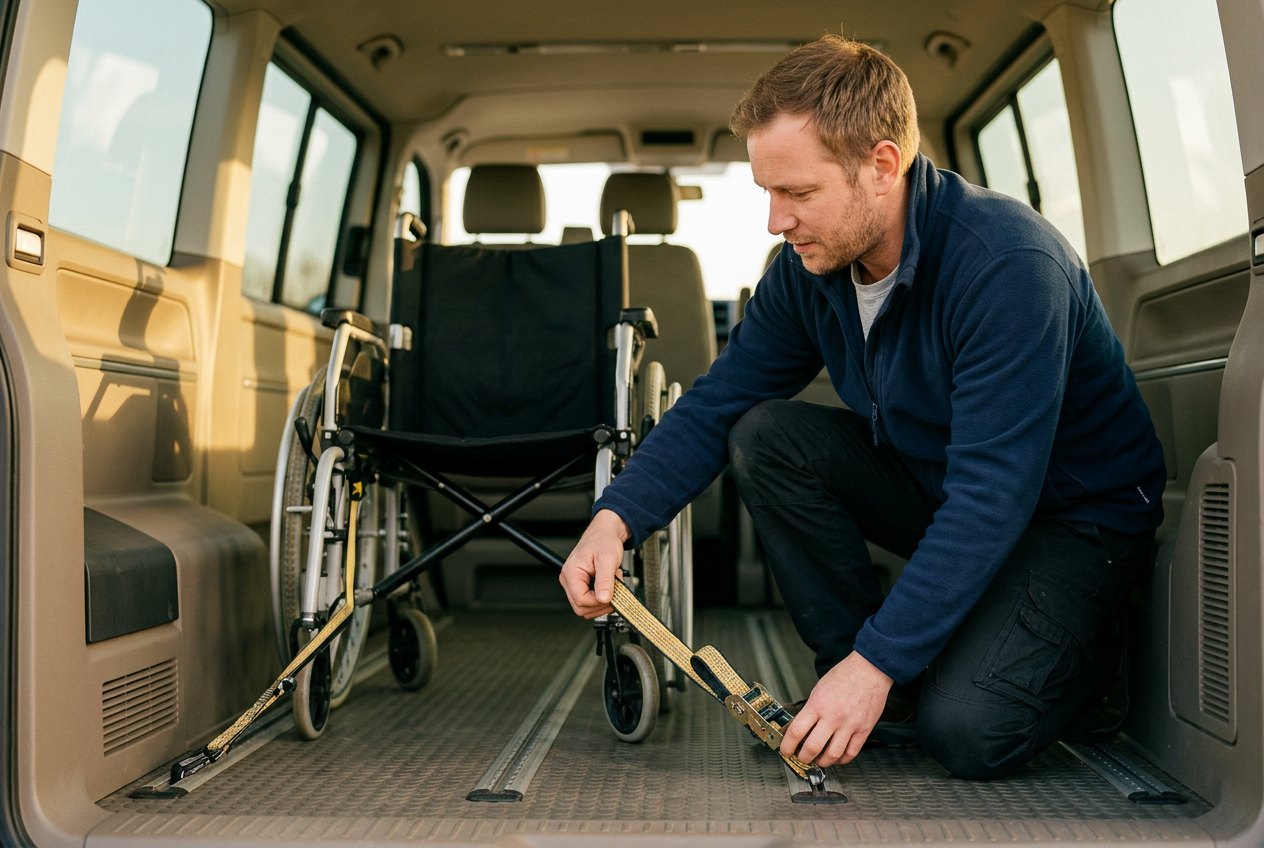
OAC 4766-3-08 governs vehicles: annual inspection, four-point permanent wheelchair fasteners, passenger restraints, a stable ramp or hydraulic lift, and onboard fire extinguisher, blanket, disinfectants, oxygen, isolation and first aid supplies. Storage must be in secured permanently mounted containers; bungee cords are prohibited outright. Service name lettering runs at least three inches on both sides, 1.5 inches on the rear. Overhead clearance is 56 inches at 22 feet or shorter, 68 inches above that. A cited vehicle comes out of service until it passes reinspection. Securement is the failure point auditors and plaintiffs both target; see our wheelchair securement guide. Vehicles need ambulette plates under ORC 4503.49 or compliant standard BMV registration.
The full sequence, with agency, timeline, and cost
| Step | Responsible agency | Typical timeline | Cost |
|---|---|---|---|
| Entity formation and EIN | Ohio Secretary of State / IRS | 1 to 3 business days | $99 (Ohio SOS); EIN free |
| Type 2 NPI | NPPES (CMS) | Same day to 1 week | $0 |
| USDOT number and PUCO CPCN | FMCSA and PUCO | 2 to 6 weeks | USDOT free; PUCO lists $30 per passenger vehicle per year; confirm any application fee |
| Bind auto, GL, excess; file Form E; workers' comp through Ohio BWC | Your agent, Ohio BWC | 1 to 3 weeks | Roughly $15,000 to $31,000 year one for a first vehicle, per one agency's 2026 cost guide |
| Ambulette license and vehicle permits (MTLS) | State Board of EMFTS / ODPS Division of EMS | Up to 60 days (license) and 45 days (permits) after a complete application | $100 + $50 permit and $50 inspection per vehicle |
| Facility and vehicle inspections | State Board of EMFTS | Scheduled after application | Included; $50 per reinspection |
| Driver files: BCI/FBI, abstract, physical, CPR, PASS, drug screen | Ohio BCI and your vendors | 2 to 5 weeks per driver | $22 BCI fee, plus vendor fees for the FBI check, physical, CPR, PASS and drug screen |
| Medicaid provider agreement | ODM, via PNM | 30+ days | $750 CY2026 fee if it applies to your type |
| MCP affiliation, plan and broker credentialing | Managed care plans and NEMT vendors | 30 to 120 days, not guaranteed | No direct fee |
| County NET contracting (optional) | Your CDJFS | Varies by county | No direct fee |
What this actually means for your P&L
Licensing fees are noise. An LLC, an ambulette license, one vehicle permit, one inspection, and the federal application fee total about $1,050, and about $300 if the application fee does not apply to your provider type. Ohio is not an expensive state to get permission in.
Insurance is the business. Southern States Insurance, a Georgia agency, puts a first vehicle's year-one coverage at roughly $15,000 to $31,000 across all lines in its June 2026 cost guide: $7,000 to $21,000 commercial auto, $2,500 to $3,500 general liability, $3,500 to $4,500 excess liability, and about $2,000 workers' comp on a $40,000 payroll. Treat those as one agency's quote ranges, not Ohio rates. Ohio is a monopolistic workers' comp state, so that line comes from the Ohio Bureau of Workers' Compensation, not a private carrier. Expect Ohio auto quotes to land toward the upper end, because PUCO's $1.5 million passenger floor sits above the $1 million limit many policies start at. Underwriters rate both where vehicles are garaged and how far they run, so ask how your service area is being rated. Specialist agencies such as SWAN Insurance, which says it has access to NEMT coverage in 46 states, quote this class; get three quotes at identical limits before comparing, and see our NEMT insurance guide for how the market works.
Time is the expensive resource. Sequenced properly, entity formation to first paid trip runs four to six months, and the last two are broker credentialing you cannot accelerate. Budget working capital for a vehicle, insurance, and a driver sitting idle 60 to 90 days after your state licenses land. For a broader cost model, see our breakdown of medical transportation startup costs and licenses.
Decide one more line item early: OAC 5160-15-27 assumes you can produce certification forms, crew credentials, times, mileage, and signatures on demand. Paper works until your third vehicle. NEMT dispatch platforms, Bambi, MediRoutes, Tobi Cloud, RouteGenie, TripMaster and others, differ mainly in broker portal integration and trip-level audit records, the feature that matters in Ohio.
Do these five things next
- Call PUCO at (800) 686-8277 for the current passenger CPCN fee, renewal window, and insurance filing requirements, before you buy a vehicle. This is the gate Ohio applicants find out about late.
- Email medicaltransportation@dps.ohio.gov or call (614) 466-9447 for the current MTLS application checklist and inspection lead time in your region.
- Call ODM's Provider Integrated Helpdesk (800-686-1516) and ask which screening risk level and application fee apply to your provider type, and whether a site visit is included.
- Call provider relations at all seven Next Generation plans with two questions: who is your current NEMT vendor, and is the network open in the counties I intend to serve. Do this before you sign a lease or a vehicle note.
- Call the CDJFS transportation coordinator in your two target counties and ask how they buy contracted trips and when agreements renew.
Rules under ORC 4766, OAC 4901:2-13, and OAC 5160-15 move on their own schedules, and plan-broker assignments move faster than either. Verify current requirements with the State Board of EMFTS, PUCO, and ODM before committing capital.
Operating in more than one state, or still choosing where to launch? Our NEMT licensing and certification by state guide compares each state's NEMT credential, licensing agency and broker setup in one table.