NEMT Entrepreneur provides expert insights, strategies, and resources to help non-emergency medical transportation professionals grow their businesses. Get industry-leading advice to succeed in NEMT.
Featured articles
When a NEMT incident happens, the first few minutes shape rider safety, claim outcomes, and company risk. This article comes down to five steps: care for the rider, secure the scene, document the facts, notify the right people on time, and keep the vehicle out of service until it passes inspection.
I’d use this checklist as a role-based guide for drivers, dispatchers, managers, and safety leads. That matters because process failures account for 71.4% of safety events in patient transport, and incomplete records drive about 35% of rejected Medicaid transportation claims. In plain terms: if your team misses steps, the problem often gets worse after the incident, not just during it.
Here’s the short version:
- Right away: stop safely, check the rider, call 911 if needed, alert dispatch, and confirm mobility or medical equipment is still secure.
- At the scene: record time, location, trip ID, names, witness details, police info, rider condition, and photos.
- The same day: notify managers, insurers, brokers, plans, and testing providers if post-accident testing rules apply.
- Before any vehicle goes back out: inspect damage, pull unsafe vehicles from service, and get written return-to-service clearance.
- Afterward: store all records in one secure file, keep them for the required time, and review the root cause so the same issue does not happen again.
A few points stand out. DOT alcohol testing may need to happen within 2 hours, controlled substance testing within 32 hours, and HIPAA-related records may need to stay on file for 6 years. For NEMT teams, that means the post-incident plan has to cover both people and paperwork.
If I were standardizing this for a team, I’d make sure every role knows what to do now, what to do today, and what to review later.
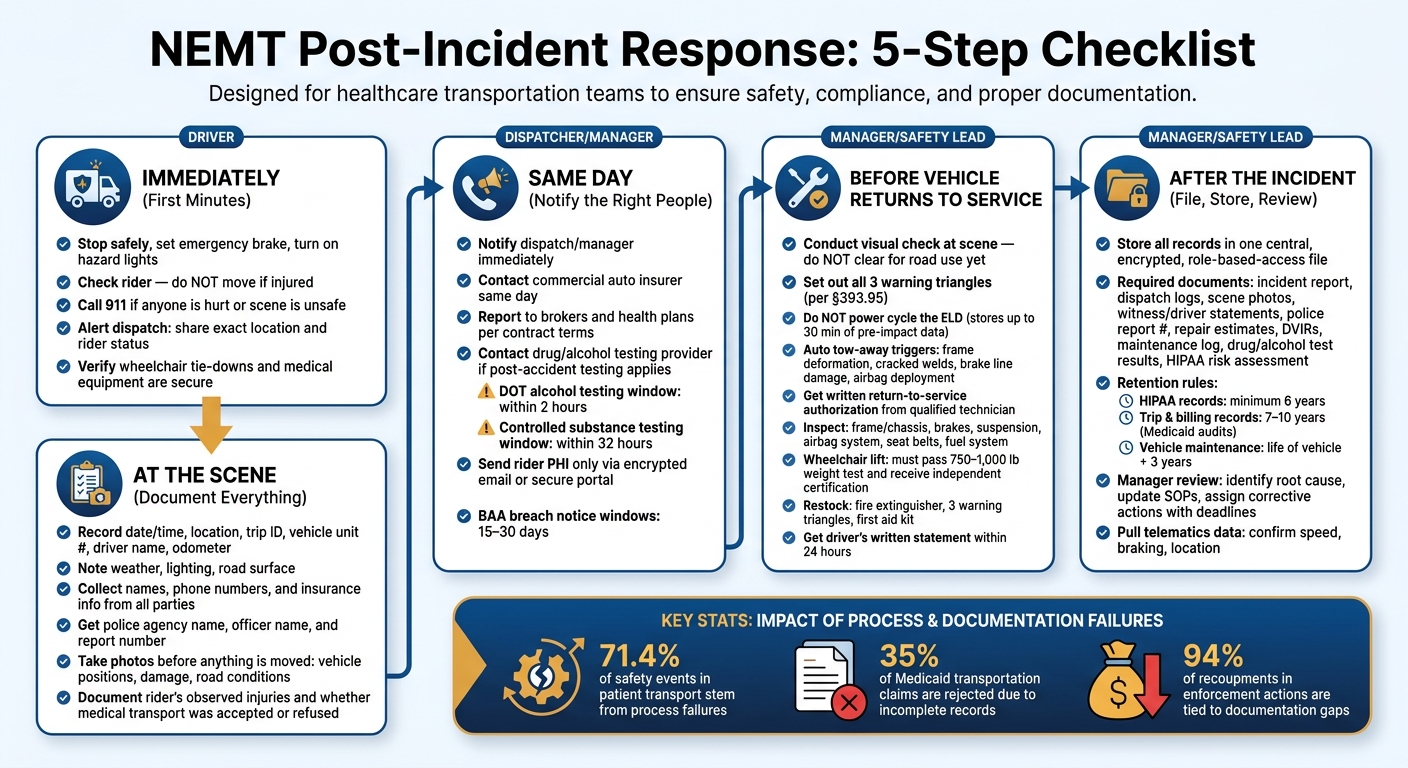
NEMT Post-Incident Response Checklist: 5 Steps Every Team Must Follow
1. Immediate Rider Care and Scene Safety Checklist
The first few minutes after an incident shape two things: the rider’s safety and the quality of the incident record.
Driver Checklist at the Scene
As soon as the vehicle is safely stopped, set the emergency brake and turn on the hazard lights. If the vehicle can be moved without added risk, pull it to a safe spot to lower the chance of a second crash.
Then check on the rider. Do not move an injured rider unless there’s an immediate danger, such as fire or the risk of another collision.
Call 911 if anyone is hurt, if the scene is unsafe, or if the vehicle can’t be moved safely. Stay with the rider until emergency personnel take over.
Next, contact dispatch by phone or radio. Share your exact location and the rider’s status. Keep it short and clear.
Once the scene is under control, dispatch can start documentation and plan for a replacement ride.
Dispatcher Checklist During the First Call
When the driver calls, confirm the GPS location and ask right away if 911 has already been called. Log the incident time, the first-report time, and each dispatch action.
If the trip can’t continue, line up a backup vehicle right away so the rider can still get to the destination. Record each step in the incident log as it happens.
Those timestamps become part of the incident record.
Special Care for Riders Using Mobility or Medical Equipment
If the rider uses a wheelchair, make sure the four-point tie-downs are still secure after the incident. If the rider uses oxygen or other medical equipment, check that the equipment is still secured and still working.
That quick equipment check matters, even when the incident looks minor.
| Immediate Action | Who Does It | Why It Matters |
|---|---|---|
| Hazard lights & emergency brake | Driver | Secures the scene and alerts other drivers |
| Injury check & 911 call if needed | Driver | Determines whether emergency response is required |
| Confirm location & log timestamps | Dispatcher | Directs responders and supports the audit trail |
| Verify wheelchair tie-downs & medical equipment | Driver | Prevents secondary injury |
| Arrange backup vehicle | Dispatcher | Maintains service continuity and helps the rider reach the destination |
After the scene is secure, the next step is to gather incident details and complete formal documentation.
sbb-itb-cef70f4
2. Incident Details and Scene Documentation Checklist
Document the incident as soon as the scene is stable. Memories start slipping fast, sometimes within hours. The goal is simple: create a factual, plain-language record that can stand up during an insurance review, compliance review, or legal proceeding.
Required Facts to Record
Start with the basic facts. Record the date and time in U.S. format, the location, trip ID, vehicle unit number, driver name, and odometer reading. Then add a short, factual summary of what happened in plain language.
The scene itself matters too. While you're still there, note the weather, lighting conditions, and road surface. Those details can end up mattering a lot later.
Names, Contacts, and Official Information
Collect the names and phone numbers of everyone involved, including the rider, any other drivers, and any witnesses. If another vehicle was part of the incident, get that driver's insurance provider and policy number before they leave.
If law enforcement responds, write down the police agency name, the responding officer's name, and the official report number. Small details like this are easy to miss in the moment, but they can save time later.
Photos, Damage Notes, and Rider Condition Records
Take photos before anything gets moved. That includes vehicle positions, visible damage to all vehicles or property, and the scene and road conditions. A photo can show things a written note may miss.
For the rider, record observed injuries and any complaints they state. Also note whether a medical evaluation or transport was offered, accepted, or refused. Before any handoff happens, document the rider's condition.
| Documentation Category | What to Record |
|---|---|
| Incident Basics | Date/time (MM/DD/YYYY, 12-hour format), location, trip ID, vehicle unit #, driver name, odometer |
| Environmental | Weather, lighting conditions, road surface |
| Parties Involved | Names and phone numbers for the rider, other drivers, and witnesses; insurance details for other drivers |
| Law Enforcement Details | Police agency, officer name, report number |
| Rider Condition | Observed injuries, stated complaints, medical evaluation or transport offered, accepted, or refused |
| Visual Evidence | Photos of vehicle positions, all visible damage, scene and road conditions |
Use this record to complete same-day notifications and claims.
3. Notifications and Same-Day Reporting Checklist
Once the scene is stable, the next job is notifications. This part matters more than many teams think. Getting the right people informed the same day helps protect the company, especially since documentation gaps account for 94% of recoupments in enforcement actions.
Internal Notifications for Drivers and Dispatch
The driver's first call should go to dispatch or the safety lead. That call needs to cover the basics, fast and clearly:
- vehicle ID
- rider status
- exact location
- whether a replacement vehicle is needed
Dispatch should move the issue up to a manager if there's an ambulance response, a rider injury, or major vehicle damage. Also, log the time of every contact. If someone can't reach the next person in the chain, write that down too. Those failed attempts matter.
External Reporting to Brokers, Plans, Insurers, and Authorities
Contact your commercial auto insurer the same day. Waiting can make a claim harder to process or even lead to a denial.
After that, review your contracts with brokers and health plans. Many of them require immediate or same-day reporting when a rider is involved in an incident. BAAs may also set incident or privacy-breach notice windows of 15–30 days.
| Party to Notify | Who Makes the Call | Key Details to Provide |
|---|---|---|
| Law Enforcement Records | Driver/Dispatch | Agency name, officer name, report number |
| Dispatch / Manager | Driver | Vehicle ID, rider status, exact location, and whether a replacement vehicle is needed |
| Commercial Auto Insurer | Manager/Owner | Policy number, date/time, location, and police report number |
| Brokers / Health Plans | Dispatch/Manager | Trip ID, incident description, and rider condition |
| Drug/alcohol testing provider | Safety Lead | Driver name and location for post-accident drug/alcohol screening |
For every contact, log:
- who was reached
- how the contact happened
- what time it happened
- any deadline tied to that notice
Drug Testing and Privacy-Sensitive Reporting
Decide right away whether the incident triggers post-accident drug or alcohol testing. Under DOT standards, alcohol testing must happen within 2 hours, and controlled substance testing within 32 hours. Your company policy may use tighter time limits. If testing is required but the window is missed, document the reason.
Rider details shared during notifications count as Protected Health Information (PHI). In NEMT, that includes names, pickup addresses, GPS data, and destinations that show a medical visit. Send that information to outside parties only through encrypted email or secure portals.
If a device is lost or a message goes to the wrong person, activate the Incident Response Plan right away to isolate the exposure and assess breach risk.
After the reporting is logged, move to vehicle checks and service recovery.
4. Vehicle Check, Service Recovery, and Return-to-Duty Checklist
Once notifications are logged, the next step is pretty simple: check whether the vehicle is safe, make sure the rider can still get to their destination, and confirm what must happen before normal service starts again.
At-Scene Vehicle Safety Check
Start with a quick visual check to decide whether the vehicle can move at all. But don't clear it for road use yet. A qualified technician still needs to inspect it first.
Set out all three warning triangles as required under §393.95.
For wheelchair-accessible vehicles, test the ramp or lift and make sure it deploys and retracts the way it should. If the lift fails, treat the vehicle as out of service.
Some damage is an automatic tow-away call. That includes:
- Frame deformation
- Cracked welds
- Brake line damage
- Airbag deployment
Also, do not power cycle the ELD. It may store up to 30 minutes of pre-impact speed and braking data.
Replacement Trip and Rider Completion Steps
If the vehicle can't continue, dispatch should send a replacement vehicle right away. The driver should stay with the rider until that replacement arrives.
Dispatch also needs to update the ETA and notify the receiving facility or destination contact immediately. If a wheelchair rider is being transferred to another vehicle, inspect the wheelchair securement equipment before departure. Any damaged securement equipment must be replaced before the trip continues.
Be sure to log the replacement trip time and the replacement vehicle ID in the incident record.
Post-Incident Inspection and Driver Release
After the scene is cleared, take the vehicle out of service until a formal inspection is done. A commercial vehicle cannot go back into operation until a qualified technician confirms that it is safe and roadworthy.
The post-incident inspection should cover the parts most likely to hide damage after a crash. That includes frame and chassis alignment, brake line integrity, suspension, the airbag system, seat belt load-limiters, and the fuel system. If the incident involved a wheelchair lift, the lift should also pass a 750–1,000 lb weight test and get independent certification before it goes back into service. The technician's written return-to-service authorization must be on file before the vehicle moves again.
Before the vehicle returns to service, check a few basic safety items too:
- Fire extinguishers are charged and sealed
- All three warning triangles are present
- First aid kits are restocked
Get the driver's written statement within 24 hours. If the DOT testing window is missed, it is treated the same as a refusal to test, which puts the driver immediately out of service.
Save the inspection results, tow decision, and return-to-service authorization in the incident file.
5. File Storage, Review, and Prevention Steps
What to Store in the Incident File
Once the vehicle is cleared and all notifications are done, put every record in one central file. That file should be complete enough to support an audit, an insurance claim, or a compliance review without anyone hunting through emails, texts, or paper folders.
At a minimum, include:
- Timestamped incident report
- Dispatch logs
- Scene photos (vehicle damage, road conditions, visible injuries)
- Witness and driver statements
- Contact and insurance information from all parties
- Police report number
- Repair estimates and insurer correspondence
- Driver Vehicle Inspection Reports (DVIRs) from the day of the incident
- Maintenance log
- Driver qualification file
- Drug/alcohol test results: confidential personnel file, access limited to HR and compliance officer only
- HIPAA risk assessment (if PHI was compromised)
Retention matters. HIPAA-related documentation must be kept for a minimum of 6 years, and trip and billing records should be retained for 7–10 years to satisfy Medicaid audits. Vehicle maintenance records should stay on file for the life of the vehicle plus 3 years.
Store everything in a central system with role-based access and multi-factor authentication. Encrypt data at rest and in transit. That may sound like IT housekeeping, but it can save a major headache later if a claim drags on or a regulator asks for proof.
| Document Type | Responsible Role | Storage Location | Access Level |
|---|---|---|---|
| Incident Report & Photos | Driver / Dispatcher | Secure Cloud (Encrypted) | Management / Compliance |
| Witness & Driver Statements | Dispatcher / Manager | Secure Cloud (Encrypted) | Management / Legal |
| Telematics & GPS Logs | Fleet Manager | Telematics Platform / Incident File | Management / Safety Officer |
| Maintenance & DVIR Logs | Maintenance Coordinator | Vehicle Life File (Digital) | Management / Maintenance |
| Drug/Alcohol Test Results | Compliance Officer | Confidential Personnel File | HR / Compliance Officer Only |
| HIPAA Risk Assessment | Privacy Officer | Compliance Folder | Privacy Officer / Legal |
| Insurance Correspondence | Manager | Claims Folder | Management / Finance |
Use the file to rebuild the timeline, back up the claim, and show what was fixed.
How Managers Should Review the Incident
After the file is complete, managers should review it with one goal in mind: figure out what went wrong and stop it from happening again.
That means finding the root cause, updating the SOP or procedure, assigning corrective actions, and setting deadlines. Telematics should also be part of the review to confirm speed, braking, and location. If the review turns up a compliance gap, such as an expired CPR certification, report it to regulators to show transparency and help reduce potential penalties.
This step matters because incidents rarely come from just one bad moment. Sometimes it's driver error. Sometimes it's a training gap, a missed maintenance item, or a process that looked fine on paper but fell apart in the field.
Conclusion: The Short List Every NEMT Team Should Standardize
Every NEMT team should have five steps built into daily practice: protect the rider, document the scene, notify the right parties on time, verify vehicle safety before putting it back in service, and keep a complete, secure incident file.
FAQs
Who should own each post-incident step?
Assign clear roles so people know who owns what and the work doesn’t stall.
- Incident Response Coordinator: Oversees the response process and keeps the team on track
- Communications Manager: Handles internal and external updates
- Data Security Specialist: Manages the protection and recovery of compromised information
- Immediate supervisor or safety officer: Reviews the formal incident report within 24 hours for accuracy and compliance
When does a vehicle need to stay out of service?
A vehicle must come out of service at once if it fails a pre-trip inspection or has a known safety defect. Don’t send it out until the problem has been fixed.
After an incident or breakdown, keep the vehicle out of service until the needed repairs are completed and signed off. The same goes for failed equipment. If a wheelchair securement system isn’t working, take it out of service and replace it.
How should NEMT teams securely store incident records?
Store incident records in secure digital systems whenever you can. If you use a cloud provider, make sure they offer a HIPAA-compliant Business Associate Agreement.
For paper files, guard them against damage, theft, and unauthorized access. Keep them organized so you can find and retrieve records within 30 days.
Use role-based access controls, maintain audit logs, and back up records on a regular basis. Keep records for 7 to 10 years, then dispose of them using documented secure-disposal procedures.