

NEMT Entrepreneur provides expert insights, strategies, and resources to help non-emergency medical transportation professionals grow their businesses. Get industry-leading advice to succeed in NEMT.
Featured articles
The FTA Section 5310 program supports Non-Emergency Medical Transportation (NEMT) providers by funding projects that improve transportation for seniors and individuals with disabilities. These grants can help organizations purchase accessible vehicles, cover operational costs, or implement services like door-to-door transport and mobility management programs.
Key Points:
- Who Can Apply: Private nonprofits, public transit operators, state/local government authorities, and tribal organizations.
- What It Funds: Up to 80% of capital costs (e.g., vehicles) and 50% of operational costs (e.g., driver salaries, fuel).
- Matching Funds: Applicants must provide 20% for capital expenses and 50% for operational costs.
- Required Documents: Tax ID, financial statements, operational plans, and proof of local match funding.
- Application Process: Work with your state or local grant administrator, ensure your project aligns with a coordinated public transit plan, and submit all required documents by the deadline.
To increase approval chances, focus on addressing transportation gaps for underserved populations and ensure your application is thorough, clear, and compliant with program requirements.
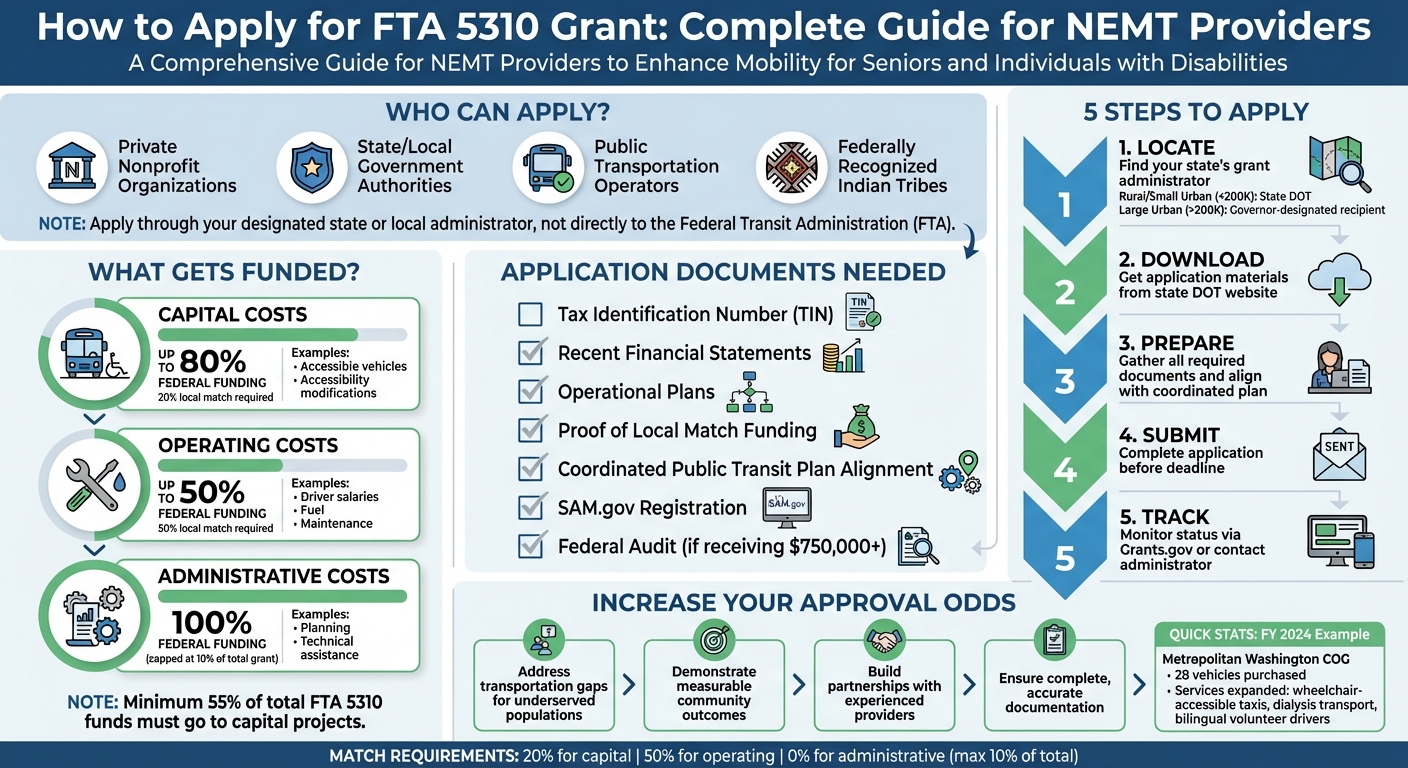
FTA 5310 Grant Application Process for NEMT Providers
Who Can Apply for FTA 5310 Grants
Eligible Organization Types
The FTA 5310 program operates through a two-tier system, where state and local agencies manage funds and distribute them to eligible subrecipients. Most Non-Emergency Medical Transportation (NEMT) providers typically apply through their state or local administrator rather than directly to the Federal Transit Administration (FTA).
Direct recipients of these funds include state departments of transportation, local government authorities, and, in large urban areas (with populations over 200,000), designated recipients chosen by the governor. For rural and small urban areas (populations under 200,000), only state agencies act as direct recipients.
Eligible subrecipients - where most NEMT providers fit - include private nonprofit organizations, state or local government authorities, public transportation operators, and federally recognized Indian tribes. Public transportation operators, offering shared-ride services open to the general public or targeted groups based on age, disability, or income, are particularly suited for nontraditional Section 5310 projects.
Take California as an example: Caltrans oversees FTA 5310 funding for rural, small urban, and some large urban areas, such as the San Francisco Bay Area, Riverside/San Bernardino, Sacramento, Stockton, Modesto, and Bakersfield. NEMT providers in these areas should connect with their local Caltrans office for guidance. Local administrators play a critical role in helping applicants align their proposals with regional priorities. Once the organizational requirements are clear, applicants must also meet specific qualifications to secure funding.
Required Qualifications
Meeting the organizational criteria is just the first step. Applicants must also fulfill specific qualifications to be eligible for FTA 5310 funding. The program focuses on organizations that serve older adults and individuals with disabilities, especially in cases where existing transportation options for these groups are unavailable, inadequate, or unsuitable.
To qualify, all projects must be part of a locally developed, coordinated public transit–human services transportation plan. Creating this plan requires input from key stakeholders, including older adults, people with disabilities, and representatives from public, private, and nonprofit transportation and human services providers. Additionally, the plan must align with transportation services supported by other federal agencies.
Applicants should highlight their community impact by demonstrating how their services improve healthcare access, enhance outcomes, and address transportation barriers. Essential documentation includes a Tax Identification Number (TIN), recent financial statements (such as balance sheets and profit/loss statements), and operational plans that clearly outline the organization’s mission, goals, and the intended use of funds.
What the FTA 5310 Grant Can Fund
Approved Project Types
The FTA 5310 program provides funding for both capital and operating expenses to support Non-Emergency Medical Transportation (NEMT) services. Capital expenses can include purchasing accessible vehicles or making modifications to improve accessibility. On the other hand, operating expenses might cover costs like driver salaries, fuel, vehicle maintenance, and travel training programs. A minimum of 55% of the funds must go toward capital projects, while the remaining 45% can be used for either additional capital needs or operating expenses. The federal share covers up to 80% of capital costs but only 50% of operating costs. For example, if your operating expenses amount to $100,000, you’ll need to provide $50,000 in local matching funds to qualify for the grant.
Other eligible uses of the grant include mobility management programs, volunteer driver initiatives, and contracted transportation services. Administrative costs, such as planning and technical assistance, are fully funded by federal dollars but are capped at 10% of your total allocation. In Fiscal Year 2024, the Metropolitan Washington Council of Governments utilized Section 5310 funds to purchase 28 vehicles and support projects that expanded wheelchair-accessible taxi services, improved transportation for dialysis patients, and offered mobility management services like travel training and bilingual volunteer driver programs.
Matching Your Project to Grant Priorities
Understanding which expenses are eligible is just the first step; you’ll need to align your project with the grant’s priorities to maximize your chances of approval. Focus on addressing specific transportation challenges faced by older adults and individuals with disabilities, particularly in areas where public transit is unavailable, inadequate, or unsuitable. Aim to demonstrate measurable outcomes, such as better access to healthcare or reduced mobility barriers.
For instance, the Bois Forte Band of Chippewa in northern Minnesota’s Arrowhead region used Section 5310 funding to purchase vehicles and offer dial-a-ride services, addressing the lack of traditional transit options in their area. Clearly outline how your project fills a transportation gap and ties into your region’s coordinated public transit–human services transportation plan.
Required Documents and Matching Funds
Application Documents You'll Need
Now that you’ve got a handle on eligibility and funding details, it’s time to focus on the paperwork and matching funds. To get started, gather the essentials: your tax identification number, up-to-date financial statements, and detailed operational plans for your NEMT (Non-Emergency Medical Transportation) services. If you’ve received funding in the past, include documentation of that as well - it helps strengthen your application.
Each state’s Department of Transportation provides its own set of application materials. For example, the New York State Department of Transportation (NYSDOT) offers resources like the "2025 Guidance & Application Instructions PDF" and the "2025 Grant Application Fillable PDF" for those applying for part of the $27.2 million allocated to the Section 5310 program. Be sure to download and review your state’s specific materials before diving into the application process.
To even be considered for funding, your application must meet the Minimum Application Responsiveness Requirements. Ishika Banerjee, a Content Writer at TobiCloud, emphasizes the importance of thoroughness:
Check to make sure your application is complete and includes all necessary documentation. Also, double-check all financial statements, tax identification numbers, and operational plans. Overlooking funding requirements and submitting generic applications can lead to rejection.
Missing just one required document could disqualify your application entirely. These documents not only establish your organization’s credibility but also demonstrate how well your project aligns with funding priorities. Once you’ve pulled everything together, confirm that your project meets the local match requirements.
Meeting the Local Match Requirement
For capital projects, you’ll need to provide a 20% local match, while operating expenses require a 50% local match . Administrative costs, however, are fully covered by federal funds, so no local match is needed .
If your organization doesn’t have the funds readily available, there are other ways to meet the local match requirement. Federal funds from other agencies can be used as a local match under the Section 5310 Program . For instance, funding from agencies like the U.S. Department of Veterans Affairs (VA) or the U.S. Department of Health and Human Services (HHS) through the Centers for Medicare and Medicaid Services (CMS) Medicaid Program can count toward your match . The Coordinating Council on Access and Mobility (CCAM) Federal Fund Braiding Guide provides detailed instructions on combining federal funds from different programs .
Additionally, projects tied to the Americans with Disabilities Act (ADA) or the Clean Air Act (CAA) may qualify for higher federal funding shares - 85% for accessible vehicles and 90% for vehicle-related equipment or facilities . These options can significantly lighten the financial burden while ensuring compliance with program requirements.
How to Apply for an FTA 5310 Grant
Locating Your State's Grant Administrator
The first step in applying for an FTA 5310 grant is identifying the organization responsible for managing these funds in your area. As an NEMT provider, you won’t apply directly to the FTA. Instead, you’ll work through a designated direct recipient responsible for handling applications and distributing funds.
For areas with populations under 200,000 (rural or small urban areas), the state's Department of Transportation (DOT) typically serves as the grant administrator. In larger urban areas with populations over 200,000, the governor designates a recipient organization. This could be a Metropolitan Planning Organization (MPO), a transportation provider, or another service agency.
To get started, visit your state's DOT website and search for terms like "FTA Section 5310", "Enhanced Mobility of Seniors and Individuals with Disabilities", or "public transportation grants." Many state administrators provide direct contact information for their Section 5310 programs. For instance:
- The New York State Department of Transportation can be contacted at 5310MobilityApplications@dot.ny.gov.
- The Oklahoma Department of Transportation uses ohook@odot.ok.gov for inquiries.
Additionally, the Coordinating Council on Access and Mobility Technical Assistance Center (CCAM-TAC) offers state-by-state profiles on their NEMT webpage, which can help you locate your grant administrator. Once you’ve identified the right contact, download the necessary application materials to begin.
Completing and Submitting Your Application
Next, download your state’s application materials. These typically include guidance documents and fillable application forms, which are available on your state’s DOT website.
Carefully review the requirements and ensure all necessary documentation is included. Your application must align with a locally developed, coordinated public transit-human services transportation plan. This plan should involve input from older adults, people with disabilities, and other community stakeholders. Be sure to include key documents like your tax ID, financial statements, and operational plans.
If your organization receives $750,000 or more in federal assistance, a federally compliant audit is required. Additionally, you’ll need to register on SAM.gov and keep your registration up to date throughout the grant period.
Submit your completed application before the deadline - late submissions will not be accepted. Once submitted, follow up with your grant administrator to confirm receipt and track the status of your application.
sbb-itb-cef70f4
After You Apply: Next Steps and Approval Tips
Tracking Your Application Status
After submitting your application, you can monitor its progress through Grants.gov if that’s the platform you used. Simply log in to your account, go to "Grant Applications", and click on "Check Application Status." Make sure to have your tracking number handy - it’s key to accessing updates.
When your application status updates to "Received by Agency" or "Agency Tracking Number Assigned", you can reach out for more detailed information. For instance, the Hawaii Department of Transportation (HDOT) provides contact details for their 5310 Program Manager, who can assist with inquiries. If updates seem delayed, don’t hesitate to follow up with your state DOT or the designated program administrator. Staying proactive helps ensure your application moves smoothly into the review process.
Improving Your Approval Odds
Tracking your application is important, but strengthening it is just as critical. A strong application clearly outlines operational plans and measurable benefits for the community. Make sure to highlight efficient strategies and demonstrate adherence to reporting requirements, such as submitting data to the National Transit Database. These details reflect good project management and a commitment to compliance, both of which are key factors evaluators look for.
Building partnerships can also elevate your application. Collaborating with experienced providers or agencies shows that you’ve taken a thoughtful and comprehensive approach to service delivery and operational efficiency.
If your application isn’t approved, use the feedback to refine future submissions. Common issues include failing to meet eligibility requirements, incomplete forms, unclear narratives, or budget inconsistencies. Addressing these areas and aligning your proposal with the funder’s priorities will improve your chances the next time around.
FY22 DRPT Pre Application Workshop FTA Section 5310
Conclusion
Securing an FTA 5310 grant requires meeting all eligibility requirements, submitting thorough documentation, and aligning your project with the grant’s goals. Once you’ve confirmed your eligibility, the next step is crafting a strong application package.
First, ensure your organization qualifies under the FTA Section 5310 criteria, which depend on your organizational type and inclusion in a coordinated public transit–human services transportation plan. It’s crucial that your project fits seamlessly within this coordinated plan.
Complete and accurate documentation is key. This not only proves your eligibility but also demonstrates your dedication to improving community mobility. Gather essential paperwork like your tax ID, financial records, proof of local match funding, vehicle insurance, and a Certificate of Good Standing. Double-check that all forms are properly completed and signed.
Your application should clearly align with the grant’s mission. Highlight how your NEMT services enhance mobility for seniors and individuals with disabilities. For instance, Mountain Rides Transportation Authority in Ketchum, Idaho, successfully launched a fixed-route NEMT service connecting rural areas to vital services. Avoid submitting generic applications, as they are more likely to be rejected.
FAQs
Who is eligible to apply for an FTA 5310 grant?
To be eligible for an FTA 5310 grant, your organization must fall into one of the following categories: a nonprofit organization, a local public entity that supports seniors and individuals with disabilities, or a designated recipient in larger urban areas. Typically, applicants serve rural or smaller urban communities and must clearly demonstrate how their services meet specific community needs.
Applicants are required to submit essential documents, including a Tax Identification Number, financial statements, and operational plans. Additionally, your proposal must clearly show how it aligns with the grant’s primary goal of enhancing mobility for seniors and individuals with disabilities.
How can I show the positive impact of my NEMT project on the community in my FTA 5310 grant application?
To showcase the impact of your project on the community, highlight the real, measurable benefits it delivers. For example, you could point to improved access to healthcare, reduced transportation hurdles, or enhanced independence for seniors and individuals with disabilities. Support these points with concrete data - like better service reliability or higher patient satisfaction rates - to make your case stronger.
Personal stories can also make a big difference. Share testimonials from riders or community partners that capture the human side of your work and illustrate its importance. Don’t forget to spotlight any collaborations with local organizations that help expand your project's reach and align it with the specific needs of the community. These partnerships can underline the broader value of your efforts.
What should I do if my FTA 5310 grant application is denied?
If your FTA 5310 grant application gets denied, don’t lose heart. Start by closely examining any feedback you received. Pinpoint the areas where your application might have missed the mark - this could include incomplete paperwork, failure to meet eligibility requirements, or project details that weren’t clearly explained.
Use this feedback to strengthen your proposal. Double-check that all documents are accurate and complete, and make sure your application aligns closely with the grant’s funding priorities. If you’re unsure how to proceed, reach out to your grant administrator or a technical assistance center for guidance on refining your approach.
After making the necessary improvements, think about submitting your revised application in the next funding cycle. With persistence and a well-polished proposal, you’ll boost your chances of securing the grant.


