

NEMT Entrepreneur provides expert insights, strategies, and resources to help non-emergency medical transportation professionals grow their businesses. Get industry-leading advice to succeed in NEMT.
Featured articles
Securely transmitting Protected Health Information (PHI) is a legal requirement for Non-Emergency Medical Transportation (NEMT) businesses under HIPAA regulations. Mishandling sensitive data - like patient names, medical details, and trip schedules - can lead to hefty fines, legal issues, and loss of trust. This article outlines four effective methods to protect PHI:
- Encrypted Email: Ideal for routine exchanges like trip manifests or insurance data. Tools like S/MIME or OpenPGP ensure end-to-end security.
- Secure Messaging Apps: Best for real-time communication between dispatchers and drivers. These apps meet HIPAA standards with strong encryption and access controls.
- HIPAA-Compliant NEMT Software: All-in-one platforms that handle dispatching, scheduling, billing, and PHI securely.
- Encrypted File Sharing Services: Useful for transferring large documents like medical records or billing files.
Each solution has its strengths and challenges. For smaller operators, starting with secure messaging or encrypted email is a practical step. Larger providers benefit from integrated NEMT platforms that streamline operations while maintaining compliance. Multi-Factor Authentication (MFA) is a must-have for all systems, as it blocks up to 99% of automated attacks.
1. Email with Encryption
Encrypted email is a reliable tool for Non-Emergency Medical Transportation (NEMT) businesses when set up correctly. Protocols like S/MIME and OpenPGP provide end-to-end encryption along with digital signatures. S/MIME, in particular, works smoothly with enterprise email platforms like Microsoft Outlook, making it easier for office staff to adopt. It supports essential daily tasks such as coordinating with healthcare facilities, sharing trip manifests with billing teams, and confirming appointments.
Encryption Strength
Both S/MIME and OpenPGP ensure that only the intended recipient can access the encrypted content, aligning with HIPAA's technical safeguards. The industry now relies on TLS 1.3 with S/MIME, replacing older SSL protocols. Digital signatures add another layer of security by verifying the sender's identity and ensuring the message remains unaltered during transmission - critical for protecting PHI when encryption is consistently applied.
Access Controls
Effective access controls enforce HIPAA's "minimum necessary" rule by implementing role-based permissions. Proper key management is crucial to prevent unauthorized access, and automated key rotation helps reduce the risk of compromised credentials.
Audit Trails
Audit trails play a key role by logging details such as message delivery, timestamps, and any forwarding attempts. Real-time monitoring can flag unencrypted transmissions, providing essential documentation for audits.
Integration Challenges in NEMT
While encrypted email integrates well with office-based systems, it can be tricky for drivers who rely on personal smartphones. S/MIME's compatibility with Outlook is a plus for office workflows, but setting it up on mobile devices often requires extra effort. To address this, targeted training is critical. Employees need to understand when encryption is necessary and how to confirm it’s active before sending PHI. This ensures sensitive information remains secure during daily operations. These challenges highlight the importance of balancing strong security measures with practical usability across NEMT activities.
This approach to email encryption provides a solid foundation for securely transmitting PHI as we examine other communication methods.
2. Secure Messaging Apps
Secure messaging apps are a vital tool for real-time communication in NEMT (Non-Emergency Medical Transportation) operations. However, to handle Protected Health Information (PHI) safely, these apps must meet strict HIPAA requirements. This means working with vendors who not only implement HIPAA safeguards but also sign a Business Associate Agreement (BAA). While popular consumer messaging apps may have strong encryption, they lack the HIPAA-specific settings and documentation required for compliance audits. Using these apps ensures both seamless communication and adherence to regulatory standards.
Encryption Strength
HIPAA-compliant messaging platforms rely on advanced encryption protocols like TLS 1.2+ for data in transit and AES-256 for data at rest. These measures ensure that sensitive details - such as trip schedules, patient names, and appointment times - are accessible only to authorized recipients. Unlike consumer apps, these platforms are specifically designed to meet HIPAA's stringent encryption requirements.
Access Controls
Encryption is only part of the equation. Role-based access control (RBAC) ensures that each team member - whether a dispatcher, driver, or billing specialist - sees only the information necessary for their specific role. Adding multi-factor authentication (MFA) strengthens security even further, reducing the risk of unauthorized access by blocking up to 99% of automated attacks.
Audit Trails
Audit logs are a cornerstone of HIPAA compliance. These detailed records track access times, devices used, and actions taken, making it easier to investigate potential breaches. This level of transparency is critical, especially since HIPAA mandates notifying affected individuals and regulators within 60 days of a breach. Reliable audit trails streamline both compliance efforts and incident response.
NEMT Integration Ease
Secure messaging works best when integrated into a broader HIPAA-compliant NEMT platform. Combining dispatch, driver communication, and billing into one secure system minimizes the risk of PHI exposure. It also eliminates the hassle of managing multiple, disconnected tools, creating a smoother workflow for the entire team.
Cost Considerations
Cost is an important factor when choosing a secure messaging solution. HIPAA-compliant platforms often require subscription fees, typically charged per user or device. These fees cover critical features like a signed BAA, compliance tools, and technical support. While free consumer apps might seem appealing, they lack the necessary safeguards for transmitting PHI, making the risks far outweigh any short-term savings.
For more detailed guidance on selecting secure messaging solutions tailored to NEMT needs, check out the industry-specific insights available at NEMT Entrepreneur.
3. HIPAA-Compliant NEMT Software Platforms
Specialized NEMT platforms provide an all-in-one solution for securely managing Protected Health Information (PHI). Unlike generic messaging apps or email systems, these platforms are designed specifically for transportation services while adhering to HIPAA requirements. They combine dispatch, scheduling, driver communication, and billing into a single, secure system, streamlining operations and ensuring compliance.
Encryption Strength
HIPAA-compliant NEMT platforms rely on AES-256 encryption for stored data and TLS 1.3 for data in transit. This dual-layer protection ensures patient information remains secure, whether it's stored in the cloud or shared between dispatchers and drivers. Encryption is automatic, so no technical expertise is needed to maintain security. This strong encryption foundation supports comprehensive access controls.
Access Controls
Role-based permissions and two-factor authentication ensure team members only access the information they need. For example, a driver can view trip details and pickup instructions, while billing staff access payment data without seeing sensitive medical information. These access controls are seamlessly integrated across all functions - dispatch, scheduling, and billing - creating a secure and unified system that standalone tools cannot replicate.
Audit Trails
Every action within the platform is automatically logged, including who accessed patient records, when they did so, and the device used. These detailed audit trails are crucial for HIPAA compliance and can help protect your business during breach investigations. Since HIPAA mandates notifying affected individuals within 60 days of a breach, having detailed logs ensures a quicker, more accurate response.
NEMT Integration Ease
One of the biggest advantages of these platforms is workflow automation. Unlike piecemeal tools, dedicated NEMT systems integrate all essential operations. Dispatching, driver notifications, route planning, and billing are all managed within a single system. This eliminates manual data entry and reduces the risk of errors caused by switching between separate tools. Cloud-based platforms also scale effortlessly, whether you’re running a small fleet or managing dozens of vehicles, without requiring extra IT resources.
Cost Considerations
Most HIPAA-compliant NEMT platforms use a subscription-based pricing model, typically charged monthly per user or vehicle. While costs vary by vendor, the investment can save money in the long run by automating compliance and preventing breaches. With HIPAA violation fines reaching up to $50,000 per violation, these platforms serve as a cost-effective safeguard. Additionally, they improve efficiency through optimized dispatching and reduced administrative tasks, helping offset the subscription fees with operational savings. Altogether, these features ensure secure and efficient PHI management for NEMT operations.
4. Encrypted File Sharing Services
Encrypted file sharing services provide a secure way for NEMT businesses to exchange large documents - like medical records, insurance authorizations, or billing files - with healthcare providers, brokers, and insurers. These platforms focus on safeguarding sensitive data through advanced encryption and controlled access, ensuring documents are shared securely.
Encryption Strength
These portals use strong encryption to protect uploaded documents and store them securely. To ensure maximum protection, check that the service provider’s data centers comply with standards like SOC 2.
Access Controls
Role-based access control (RBAC) is a key feature of these services, allowing permissions to be tailored to specific roles. For instance, drivers can access trip-related documents, while billing staff are restricted to insurance files. Many platforms also include multi-factor authentication (MFA), which can block up to 99% of automated attacks. Additionally, setting expiration dates on shared links ensures access is automatically revoked when files are no longer needed.
Audit Trails
Encrypted portals automatically track file activity, recording details like who accessed a document, when it was viewed, and from what device. These audit logs are crucial for meeting HIPAA requirements and can assist in investigating potential security breaches. While these logs enhance compliance, integrating them into daily workflows can pose challenges.
NEMT Integration Challenges
One drawback of many encrypted file sharing services is their lack of integration with core NEMT tools like dispatch, scheduling, or billing systems. This often means users have to manually upload files and switch between systems, increasing administrative workload and the chance of errors. For businesses primarily focused on sharing documents with external partners - such as healthcare facilities - this separation might be manageable. However, for those handling internal operations, the lack of integration can lead to inefficiencies in day-to-day workflows.
Cost Considerations
These services typically operate on a subscription model, with fees based on factors like storage limits, number of users, or file transfer volume. While generally more affordable than comprehensive NEMT platforms, it’s important to weigh the cost against the potential administrative burden and its impact on overall efficiency when calculating ROI.
sbb-itb-cef70f4
Pros and Cons
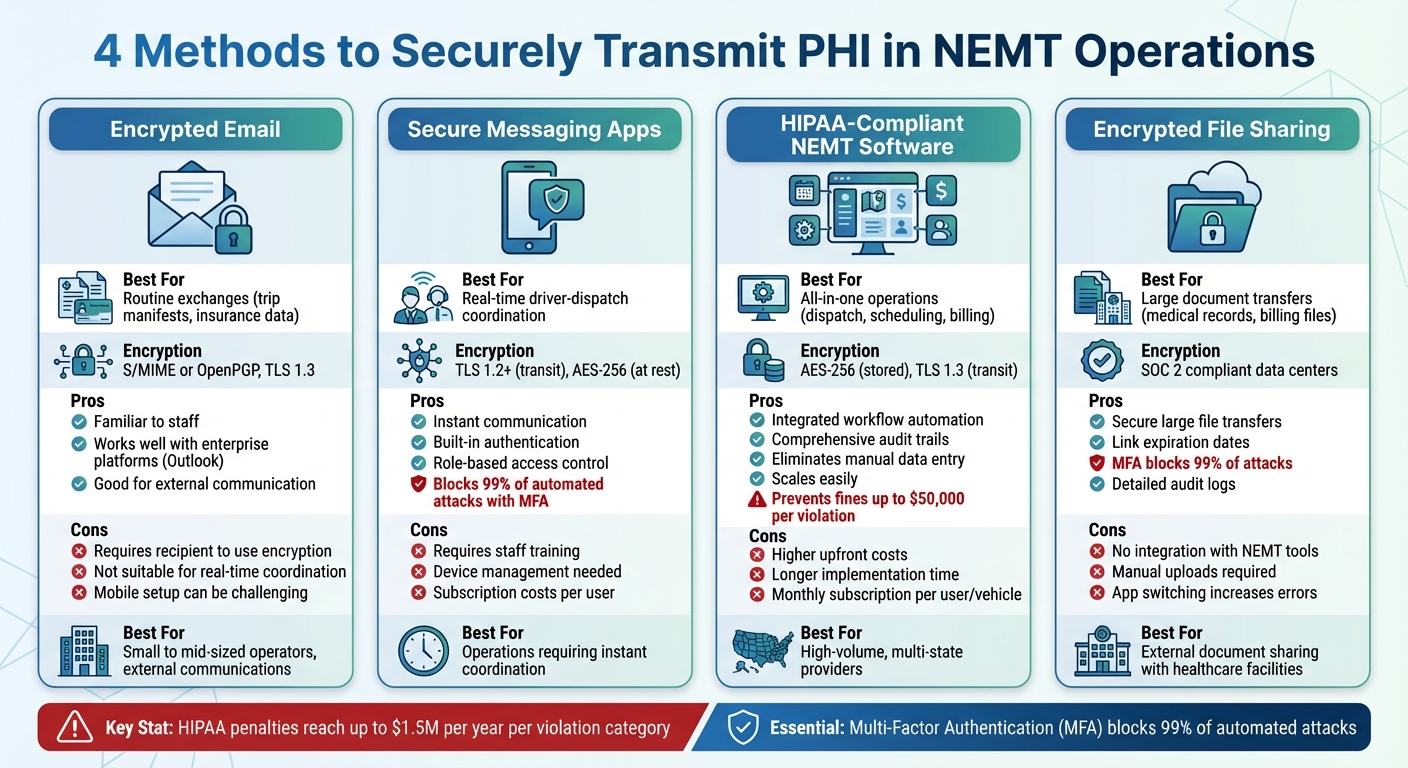
Comparison of 4 HIPAA-Compliant PHI Transmission Methods for NEMT Businesses
Each method of transmitting PHI comes with its own set of benefits and challenges for NEMT operations. Let’s take a closer look at how these options stack up.
Encrypted email works well for routine exchanges, like insurance authorizations or trip confirmations. It’s familiar to most staff, which makes it easy to adopt. However, its effectiveness depends on recipients also using encryption, and it’s not suitable for real-time trip coordination.
Secure messaging apps shine when instant communication is needed - think driver-dispatch coordination. They offer encrypted, real-time messaging with built-in authentication. That said, they require proper training and careful device management, which can be tricky for team members who aren’t as comfortable with technology.
HIPAA-compliant NEMT software platforms go a step further by integrating PHI transmission into dispatch, scheduling, and billing workflows. This eliminates the need to juggle multiple systems, reduces administrative errors, and provides detailed audit trails. The downside? Higher upfront costs and longer implementation times, which can be a hurdle for smaller operators. For high-volume, multi-state providers, though, the efficiency gains often make the investment worthwhile.
Encrypted file sharing services are great for securely transferring large documents. However, they operate outside your main systems, requiring manual uploads and app switching. This slows down workflows and increases the risk of errors when sharing files externally.
Choosing the best method depends on your operation’s size, resources, and specific workflow needs. Each option has its trade-offs, which play a key role in shaping practical strategies for NEMT operations.
How to Implement Secure PHI Transmission in NEMT Operations
To ensure the secure transmission of Protected Health Information (PHI) in Non-Emergency Medical Transportation (NEMT) operations, it’s essential to take a structured approach that includes mapping communication channels, using standardized tools, and ongoing monitoring.
Start by mapping out every channel PHI might travel through - whether it’s APIs, email, phone calls, text messages, portals, or file exports. This helps pinpoint areas where sensitive data may pass through public networks or personal devices, identifying encryption gaps that need attention.
Next, standardize secure tools and enforce encryption across all communication points. Transition PHI to HIPAA-compliant NEMT software that provides features like end-to-end encryption, audit trails, secure in-app messaging, and controlled document sharing. Ensure all web apps, APIs, portals, and mobile apps are secured with TLS 1.2 or higher (ideally TLS 1.3). Replace unencrypted FTP with SFTP or FTPS, use S/MIME or OpenPGP for email communication involving PHI, and require VPNs with AES-256 encryption for remote access.
Implement access controls to limit data exposure. Assign unique user credentials to every team member - avoiding shared logins entirely - and enforce role-based access. For example, drivers should only see their assigned trips, dispatchers should handle operational data, and billing staff should manage claims. Multi-factor authentication (MFA) should be mandatory for all systems handling PHI. According to Microsoft, MFA can prevent up to 99% of automated attacks. For mobile operations, equip staff with managed devices that include encryption, screen locks, and remote wipe capabilities. Personal SMS apps and email accounts should never be used to transmit patient information.
Establish clear policies and train staff on secure data handling. Develop written guidelines covering data access, transmission methods, password protocols, incident response, and breach notifications. Conduct annual HIPAA training for all team members - dispatchers, drivers, call center staff, and administrators - so they understand what constitutes PHI, which tools are authorized, and how to handle scenarios like misdirected emails or lost devices. Simulation exercises, such as testing responses to "wrong recipient" emails or practicing lost device protocols, can help reinforce training and reduce real-world mistakes.
Lastly, manage relationships with vendors and conduct regular audits to maintain compliance. Sign Business Associate Agreements with all vendors that store, process, or transmit PHI - this includes NEMT software providers, secure email services, cloud storage platforms, and call-recording tools. Confirm that each vendor meets encryption standards and document your due diligence. Regular compliance checks and system audit log reviews can help identify unauthorized access or unapproved transmission methods. These steps align with the broader PHI protection strategies discussed earlier, ensuring a comprehensive approach to safeguarding sensitive information.
Conclusion
Securely transmitting Protected Health Information (PHI) isn’t just about compliance - it’s about creating a streamlined and trustworthy operation. HIPAA-compliant NEMT software platforms should serve as the foundation of your communication system. These platforms can handle dispatching, trip assignments, patient information, and billing - all within an encrypted environment that includes audit trails. To complement this, use encrypted email (S/MIME or OpenPGP) for external communications with healthcare facilities and payers, and rely on secure messaging apps for quick, on-the-go coordination when your primary platform isn’t available. For large document transfers, encrypted file-sharing services are a solid option, though they should never replace your core system.
For growing NEMT companies, balancing cost, ease of use, and compliance is key. Smaller operators should prioritize moving away from personal SMS and unencrypted email, adopting a single HIPAA-compliant platform, and adding encrypted email as needed. Mid-sized providers managing hundreds of trips daily will benefit from a full suite of tools: integrated software, encrypted email, secure messaging for drivers, and controlled file-sharing solutions. Across the board, Multi-Factor Authentication (MFA) is essential - it can block up to 99% of automated attacks, making it a must-have layer of protection. With HIPAA penalties reaching $1.5 million per year per violation category, the financial risks of non-compliance are too high to ignore.
Take action in the next 30–90 days by auditing all channels that handle PHI, implementing a HIPAA-compliant NEMT platform, enforcing MFA across your systems, and training your team on approved communication tools. When staff understand how secure tools simplify their daily tasks - removing the need for personal devices, preventing sensitive email forwarding, and reducing compliance worries - they’re more likely to embrace these changes. These steps will strengthen your overall PHI security strategy.
Shifting from disorganized communication methods to secure PHI transmission not only protects your patients but also builds trust and positions your business for long-term success. For expert guidance, visit NEMT Entrepreneur (https://nemtrepreneur.com), where you’ll find resources to help you compare solutions, make informed decisions, and implement security measures that align with your operations. Start with one secure channel and expand systematically to turn PHI protection into a competitive edge.
FAQs
What are the advantages of using HIPAA-compliant software for securely transmitting PHI in NEMT operations?
Using HIPAA-compliant NEMT software helps safeguard Protected Health Information (PHI) by transmitting data through secure, encrypted channels, which lowers the risk of data breaches. These systems are built to align with HIPAA regulations, automating compliance processes to reduce human errors and steer clear of potential legal complications.
On top of that, they offer detailed audit trails, ensuring better accountability and transparency. By simplifying communication with healthcare providers, this software not only boosts operational efficiency but also strengthens patient confidence and ensures your NEMT business adheres to top-tier data security standards.
What steps can small NEMT businesses take to securely transmit PHI?
Small NEMT businesses can protect sensitive patient information by using HIPAA-compliant tools and ensuring all communication channels, like email and messaging platforms, are equipped with encryption. It's equally important to train staff on data privacy best practices to minimize the risk of breaches.
Investing in HIPAA-compliant software designed specifically for NEMT operations can also be a smart move. These solutions simplify secure data management, helping businesses stay compliant while safeguarding patient data.
Why is using Multi-Factor Authentication important for NEMT businesses managing PHI?
Multi-Factor Authentication (MFA) plays a crucial role for NEMT businesses handling Protected Health Information (PHI). By requiring more than one form of verification - like a password paired with a unique code sent to a mobile device - MFA adds an extra layer of security, making it much harder for unauthorized users to access sensitive patient data.
This extra protection doesn’t just keep PHI safe; it also helps businesses stay compliant with HIPAA regulations. For NEMT companies, this is vital for maintaining client trust and avoiding hefty fines. Adopting MFA is a practical move to safeguard both your clients' information and the integrity of your operations.


