The operator's publication for non-emergency medical transportation. State licensing guides, broker intel, a 2,000+ provider directory and The Dispatch, our weekly newsletter.
If I run an NEMT company, a weak value proposition costs me rides, referrals, and contracts. In a U.S. market expected to hit $12.5 billion to $12.8 billion in 2026, the providers that stand out are the ones that say, in plain words, who they serve, what problem they fix, and what proof backs it up.
Here’s the core idea in simple terms: I should not say “we offer reliable transportation.” I should say what that means with numbers and service details, like 95%+ on-time arrivals, EVV-verified trips, CPR-certified drivers, and support for wheelchair, stretcher, or bariatric riders. That matters because transportation barriers are tied to about $150 billion in avoidable healthcare costs each year, and about 3.6 million appointments are missed because patients cannot get to care.
If I want my message to work, I need to cover these points right away:
- Know the audience: riders, caregivers, facilities, brokers, and payers all want different things
- Name the problem: missed appointments, long wait times, poor communication, mobility needs, or weak documentation
- Promise a clear result: lower no-shows, short delays, safe handoffs, clean records
- Back it up with proof: on-time rates, delay data, complaint rates, trip completion, EVV accuracy
- Match words to service: my dispatch, drivers, fleet, and compliance records must support the promise
- Use the message everywhere: website, Google Business Profile, sales sheets, proposals, and MSAs
A simple way to think about it: riders care about safety and dignity, facilities care about fewer no-shows and smoother discharges, and payers care about compliance and accurate trip records. When I match each message to each group, my company sounds less generic and more like a fit for the job.
| Audience | What they want most | What I should show |
|---|---|---|
| Riders | Safe, respectful, on-time rides | Driver training, ETA updates, accessible vehicles |
| Caregivers | Clear pickup and drop-off communication | Real-time trip alerts, handoff updates |
| Facilities | Fewer delays and missed visits | On-time data, low no-show rates |
| Brokers | Clean service delivery | OTP, credential files, service coverage |
| Payers | Accurate records and verified trips | EVV, HIPAA-ready records, claim accuracy |
Bottom line: a strong NEMT value proposition is not a slogan. It is a short, specific promise tied to data, rider needs, and day-to-day service. The rest of the article shows how I can build that message, prove it, and use it to win more business.
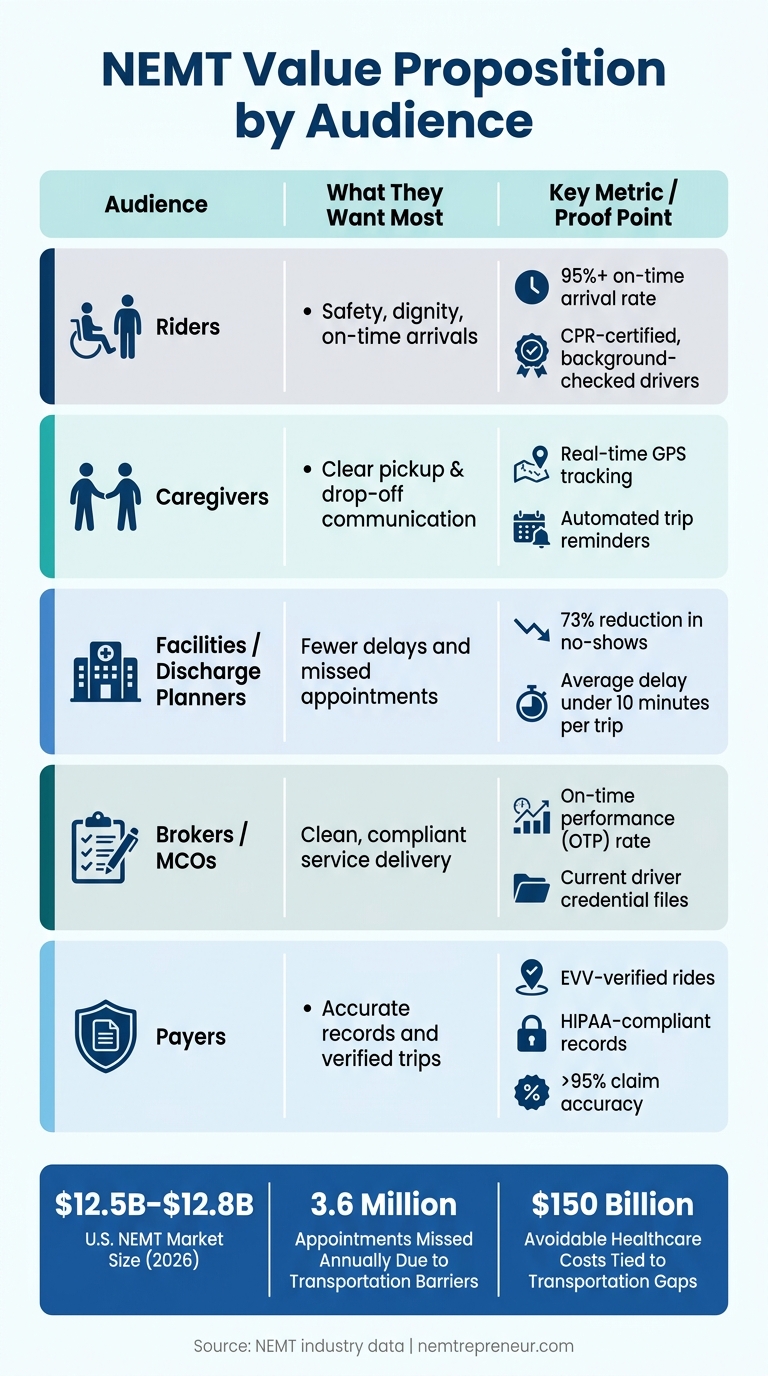
NEMT Value Proposition by Audience: What They Want & How to Prove It
NEMT Business Foundations: Ride to Success: Module 2: NEMT Business Planning & Strategy
sbb-itb-cef70f4
Who You Serve and What They Need
A strong NEMT value proposition shifts based on who you're talking to. Before you write a value statement, get specific about the audience and the result they care about most. NEMT providers serve riders, caregivers, facilities, and payers. Each group looks at the service through a different lens.
Riders, caregivers, and high-need patient groups
Most NEMT riders are people without dependable transportation: seniors, people with disabilities, and low-income patients who rely on outside help to get to care. Dialysis, oncology, bariatric, and behavioral health patients often need predictable scheduling, special equipment, and trained drivers.
For this group, the basics matter a lot. Safety matters. Dignity matters. Clear communication matters. If a rider doesn't know when the vehicle will arrive, or a caregiver can't trust the handoff, confidence drops fast. Those needs become the proof behind your message to riders and caregivers.
Facilities, case managers, and payer-side decision makers
Hospitals, clinics, discharge planners, brokers, and payers tend to judge NEMT by reliability and compliance. Modern NEMT programs can reduce no-shows by 73%, and that's the kind of result facilities pay attention to. Short response windows also help with hospital bottlenecks when a patient is ready for discharge but has no ride in place.
Brokers and MCOs look closely at a different set of signals: on-time performance, EVV compliance, and clean driver credentialing. For them, it's less about a nice experience and more about whether the operation runs cleanly, on time, and with the right records.
The table below shows what each group values and how to track it:
| Stakeholder | Primary Value | Key Metric |
|---|---|---|
| Riders | Dignity | Driver empathy and patience |
| Caregivers | Coordination | Real-time pickup updates |
| Facilities | Efficiency | Reduced no-show rates |
| Brokers | Compliance | On-time performance (OTP) |
| Payers | Accuracy | EVV data accuracy |
Those same metrics can shape your value statement for facilities and payers.
How to research service gaps and rider pain points
Start with the data you already have: ride complaints, on-time arrival rates, no-shows, and missed-appointment data. That information usually points to the cracks in service. Maybe wait windows are too long. Maybe driver assistance varies too much from trip to trip. Maybe pickup updates are vague or late.
Then talk to the people on the front lines. Dispatchers, drivers, and facility contacts like social workers and discharge planners often spot issues that dashboards miss. They hear the frustration in real time, and that can tell you where the service breaks down.
Geography matters too. Some underserved areas still don't have enough providers for wheelchair, stretcher, or bariatric transport. If local companies don't offer 1,000 lb-capacity lifts or stretcher-capable vehicles, that's not a small detail. It's a clear service gap your operation and messaging can speak to directly.
A couple of benchmark targets help keep the picture concrete:
- 95%+ on-time arrival rate
- Average delay under 10 minutes per trip
These gaps shouldn't stay buried in an internal report. They should turn into the exact outcomes your value proposition promises.
How to Build a Strong NEMT Value Proposition
Turn audience needs into specific promises you can prove. Use the gaps you found to shape promises buyers can check for themselves.
Match rider problems to specific service outcomes
Every common NEMT pain point has a measurable result on the other side of it. The aim is to close that gap with a clear service commitment, not a vague promise.
| Rider Problem | Service Outcome | Proof Point |
|---|---|---|
| Missed appointments | Fewer missed appointments | 73% reduction in no-shows |
| Long wait times | Reliable punctuality | 95% on-time arrival rate |
| Safety concerns | Trained, background-checked drivers | CPR-certified, background-checked drivers |
| Communication gaps | GPS updates and automated trip reminders | GPS tracking; automated trip reminders |
| Difficult mobility needs | Wheelchair-, stretcher-, and bariatric-ready transport | Wheelchair-, stretcher-, and bariatric-ready fleet |
This kind of mapping keeps your value proposition tied to facts. If a dialysis patient misses a ride, it’s not just a hassle. It can throw off treatment schedules and follow-through. So the promise shouldn’t be “we’ll try to be on time.” It should be a 95% on-time arrival rate backed by dispatch data.
Once the outcomes are clear, turn them into language each audience will care about.
Write clear value statements for each audience
Riders and families want to know they’ll be treated with dignity and that someone will show up when expected. Facilities and discharge planners want to know you won’t cause bottlenecks. Payers and brokers want clean records and cost-efficient trips.
Write a separate version for each group. Keep the wording plain and lead with the outcome they care about most.
For riders and families, that might sound like: "CPR-certified drivers, GPS tracking, and wheelchair-accessible vehicles - so you get to your appointment safely and on time." For facilities: "Average delays under 10 minutes per trip to reduce bottlenecks and missed appointments." For payers: "HIPAA-compliant trip records, EVV-verified rides, and strong trip completion rates."
Lead with the outcome each audience values most.
Weak value claims and how to fix them
Generic language is one of the most common mistakes in NEMT marketing. Phrases like "we care about your health" or "professional and reliable service" don’t tell anyone much. They don’t answer the question a discharge planner or broker is asking: Can I trust this provider to perform the same way every time?
If a claim can’t be measured, it doesn’t belong in your value proposition.
| Weak Claim | Stronger Rewrite |
|---|---|
| "Quality medical transport" | "Wheelchair and stretcher transport in [your city, state]" |
| "We are always on time" | "95% on-time arrival rate, tracked via real-time GPS" |
| "Professional, caring drivers" | "CPR-certified, background-checked drivers" |
| "Great customer service" | "Real-time family notifications and rapid issue resolution" |
Use real proof: trip volume, fleet types, certifications, and response times.
How to Prove and Deliver Your Value Proposition
Once the promise is written, you have to back it up in day-to-day work.
A value proposition is only as strong as the operation behind it. If your marketing says "95% on-time arrival" but dispatch is messy and vehicles aren't kept up, that claim falls apart the second a facility checks your performance data.
Day-to-day practices that support reliability, safety, and dignity
Reliability starts before a driver ever heads out. Maintenance logs, pre-trip inspections, and ADA-compliance checks help keep the fleet accessible and steady. Driver training also has to match the promise you're making. CPR, first aid, background checks, and patient communication training all support safety and dignity.
On the dispatch side, route optimization and smart dispatch can cut mileage and improve on-time performance. Automated trip reminders and real-time ETA updates help build trust and reduce no-shows.
Reliable communication and steady pickup performance can help you win contracts.
KPIs that back up your service claims
Use a small set of KPIs to support each claim: on-time arrival rate, average delay, no-show rate, trip completion rate, complaint rate, and rider satisfaction.
| Value Claim | Operational Requirement | KPI to Track |
|---|---|---|
| Reliability | Route optimization & real-time GPS tracking | On-time performance %; Average delay (mins) |
| Safety & dignity | Driver training, vehicle upkeep, and respectful communication | Incident rate; Complaint rate (<1%); Rider satisfaction score |
| Efficiency | Route optimization & automated dispatch | Cost per trip; Utilization rate % |
| Accountability | HIPAA & EVV integration | Claim accuracy (>95%); EVV data accuracy |
| Care coordination | Coordination with medical teams | No-show rate |
Track these numbers on a steady basis, then bring them into contract reviews.
But here's the catch: metrics only help if your records can back them up.
How compliance builds trust with healthcare partners
HIPAA-compliant trip data, EVV, and current driver credential files show healthcare partners that you run a disciplined operation. Vehicle maintenance logs, driver credentialing records, and incident documentation help keep the business audit-ready and support trust with payers over time.
NEMTAC accreditation gives you third-party proof. It shows that your standards go beyond the baseline and gives payers and MCOs one more reason to trust your claims.
When a broker sees HIPAA-compliant records, EVV verification, and current credentials, the promise feels concrete. Compliance isn't separate from the value proposition. It's part of it.
Use these proof points in proposals, renewals, and sales conversations.
Using Your Value Proposition in Marketing, Sales, and Contracts
Where to use your value proposition every day
Once your value proposition works in day-to-day operations, put it to work in the market too. This is where it starts helping you get seen, earn referrals, and land contracts.
Your value proposition should show up anywhere riders, families, facilities, and buyers come across your brand. Start with your Google Business Profile. Fill out every field, add geo-tagged photos of your actual vehicles, and ask for reviews so you can show up for searches like "wheelchair transport near me". On your website, spell out your vehicle types, safety record, and specialized services. For outreach to facilities, use a one-page capability sheet that lists vehicle types, coverage zones, insurance limits, and response times.
Then, when you meet with a facility, bring numbers from your dispatch software. Show average wait times, on-time arrival rates, and safety milestones. That says a lot more than telling people you're "reliable."
Your driver scripts and dispatch procedures should match the same promise. If your message is about safe, on-time transport, your team should sound and act that way on every trip. Use MSAs to lock in recurring work by setting rates, service levels, and billing terms. Written contracts help turn one-time trips into steady revenue, and they give both sides clear expectations from the start.
How to assess your position in the local market
Use this scan to spot the gap your message should own.
| Metric Category | What to Review |
|---|---|
| Service Area | Counties or zip codes covered; rural vs. urban focus |
| Vehicle Capability | Ambulatory, wheelchair, stretcher, or bariatric availability |
| Hours of Operation | Standard hours vs. 24/7 or after-hours/weekend coverage |
| Communication Tools | Real-time tracking, automated notifications, facility portals |
| Performance Claims | Stated on-time arrival rates, NEMTAC accreditation |
| Reporting | Ability to share wait times and trip outcome data with partners |
The gaps in this table are where opportunity lives. If no one nearby offers bariatric transport or nighttime coverage, that gives you a clear lane to own. An underserved dialysis center or SNF may bring steadier trip volume than scattered consumer bookings. Before you make any claim, know your numbers.
Conclusion: Key elements of a strong NEMT value proposition
After you map the market, turn that gap into a plain, direct promise.
A strong NEMT value proposition starts with knowing who you serve, naming the problem they deal with, and stating the outcome your service delivers. Then you back it up with operations and data. Riders need safety and dignity. Facilities need reliability and less admin work. Payers need compliance and clean documentation. The proof behind each promise is what makes your message believable across all three groups.
Providers who treat their value proposition as an active part of the business - not just a sentence on a website - tend to build lasting partnerships, earn referrals, and grow at a steady pace in a market where trust matters most.
For strategy and contract guidance, NEMT Entrepreneur offers practical resources for NEMT providers.
FAQs
How do I write a strong NEMT value proposition?
Focus on specific, data-backed benefits instead of generic claims.
Spell out the gap you fill. Maybe that means specialized vehicles, 24/7 availability, or a clear commitment to patient dignity. Then back it up with proof: performance metrics, testimonials, case studies, and real-time tracking.
The message should also fit the reader.
For facilities, lead with reliability and a clear process. Show on-time rates, response times, dispatch steps, and how updates are shared.
For patients and families, focus more on compassionate, professional care. Talk about how the ride feels, how staff communicate, and what you do to help people feel safe and respected.
Above all, use clear trust signals, not vague phrases.
Which KPIs should I track to prove my NEMT value?
Track KPIs that show both efficiency and patient-centered results.
Key operational metrics include on-time arrival rate - often 95% or higher - along with trip completion rate, vehicle utilization, cost per trip, no-show percentage, and average trip delay.
It also helps to watch the human side of the service. That means customer feedback, complaint resolution time, coordination with medical teams, and any drop in readmissions and emergency room visits.
NEMT Entrepreneur also points to software that supports real-time tracking, reporting, and benchmarking.
How should I tailor my NEMT message for riders, facilities, and payers?
Tailor your message to what each audience cares about most.
For riders and families, lead with empathy, trust, dignity, safe transportation, and driver professionalism. They want to feel cared for, not processed.
For facilities, put the focus on reliability, scheduling, compliance, visibility, and solving discharge bottlenecks. Time matters, and so does knowing what’s happening at every step.
For payers, speak to cost-effectiveness, consistent service, risk management, and transparent documentation. They need clear proof that the service works and that records are easy to track.
Across all three groups, keep your brand voice steady. The message can shift, but the tone should still sound like you.