The operator's publication for non-emergency medical transportation. State licensing guides, broker intel, a 2,000+ provider directory and The Dispatch, our weekly newsletter.
Search for "NEMT certification" and you would think there is one license to apply for. In most states there is not. What you need to run your first Medicaid trip is a stack of credentials from four or five different places: a business entity and local license, state transportation authority where your state has it, Medicaid provider enrollment, broker or health plan credentialing, vehicle inspections, insurance filings and a driver file for every person behind the wheel. Miss one layer and the others do not pay.
This guide lays out that stack, shows where the federal rules actually apply, and gives you a 20-state table of what each state requires and who runs its Medicaid NEMT program as of fall 2026. It is written for startup operators working out what paperwork comes before the first trip, and for owners adding a second state.
There is no single NEMT license: here is the stack
A handful of states do issue a credential aimed at NEMT or wheelchair van service: Minnesota's Special Transportation Service certificate, Ohio's ambulette license, New Jersey's Mobility Assistance Vehicle license and Virginia's NEMT carrier authority are examples. Even in those states, the state credential is one layer. Everywhere, the full stack looks like this:
- Business entity and local license. An LLC or corporation with your secretary of state, an EIN, and whatever city or county business license applies. Some counties license for-hire medical transport directly. Miami-Dade, for example, issues a Non-Emergency Transportation Certificate.
- State transportation authority, where it exists. A DOT, PUC, DMV or health department certificate. Many states have none for NEMT.
- Medicaid provider enrollment. An NPI, then enrollment with the state Medicaid agency. Depending on the state and the risk level it assigns NEMT, that can include an application fee, a site visit and fingerprint-based background checks for owners.
- Broker or health plan credentialing. Most Medicaid trips are assigned by a broker or a managed care plan, and each one credentials you separately.
- Vehicle inspection. By the state, the Medicaid agency, the broker or all three.
- Insurance filings. Proof of coverage at the limit your state or broker sets, sometimes filed directly with the regulator.
- Driver requirements. Background checks, license and driving record review, drug testing where it applies, CPR and first aid, and passenger assistance and securement training.
The order you work through those layers matters as much as the list. We cover the sequence after the state table. For the cost side of each layer, the startup guide to licensing, costs and launch walks through the full budget.
The federal layer: when FMCSA applies to you
Federal motor carrier rules come up in every NEMT forum, and they are often overstated. The Federal Motor Carrier Safety Administration requires a USDOT number when a vehicle is used in interstate commerce and meets one of its thresholds. The ones that matter for NEMT: a gross vehicle weight rating (or actual gross weight, whichever is greater) of 10,001 pounds or more, or a vehicle designed or used to transport more than 8 passengers, including the driver, for compensation.
Interstate commerce is broader than it sounds. It covers trips from one state to another, trips between two points in the same state that pass through another state, and trips that are part of a journey starting or ending out of state. If you run near a state line, check your routes.
Three more federal points:
- Operating authority (an MC number) is required for for-hire carriers transporting passengers in interstate commerce, unless you operate only within a federally designated commercial zone.
- Insurance. For-hire interstate passenger carriers must carry at least $1.5 million in liability for vehicles seating 15 or fewer passengers, including the driver, and $5 million for 16 or more.
- Driver and vehicle rules. Interstate operators of 9 to 15 passenger vehicles for direct compensation must follow FMCSA driver qualification, medical exam, hours of service and inspection and maintenance rules. Our summary of FMCSA Part 396 inspection and maintenance rules covers the vehicle side.
A sedan or ramp minivan running trips inside one state usually falls below every federal threshold. Full-size vans are where it gets close. A 2026 Ford Transit 350 high roof is rated at 9,500 pounds, while some heavy-duty dual-rear-wheel Transit 350 HD versions are rated at 11,000. Read the weight rating label on the driver's door pillar before you assume. Separately, many states require a USDOT number from intrastate carriers. FMCSA lists them, and Minnesota's MnDOT, for one, asks for a USDOT number before it will start your state application. For passenger vans, a commercial driver's license enters the picture at vehicles designed to carry 16 or more passengers, including the driver, or rated over 26,000 pounds.
NEMT licensing by state: 20-state table
The table shows whether each state has its own license or certificate that covers NEMT or wheelchair van service, who issues it, how the state delivers Medicaid NEMT, and the official source we used. Where we could not confirm a state credential from a primary source, the cell says to check with the agency. We name a broker only where a state or plan document from 2026 confirms it. Broker contracts moved a lot in 2025 and 2026, so confirm with the state before you plan around one.
| State | State NEMT-specific license or certificate? | Who issues it | Medicaid NEMT model | Official source |
|---|---|---|---|---|
| California (guide) | No NEMT-specific license. Medi-Cal NEMT vehicles need a Vehicle Safety Systems Inspection certificate (since March 27, 2025). Vehicles used exclusively for medical transportation are exempt from the CPUC charter-party permit (Public Utilities Code 5353(i)). The exemption is per vehicle: the CPUC warns that a van also used for non-medical for-hire trips can lose it. | DHCS (Medi-Cal enrollment); Bureau of Automotive Repair (inspection) | Managed care plans cover NEMT and must use Medi-Cal-enrolled providers; a plan can use a provider for up to 120 days while enrollment is pending. Fee-for-service providers enroll with DHCS. | DHCS; CPUC |
| Texas (guide) | No NEMT-specific license. For passenger carriers, a TxDMV number is triggered by vehicles designed to carry more than 15 passengers, including the driver, or rated or weighing over 26,000 pounds, so a typical wheelchair van or minivan does not need one. | TxDMV (motor carrier); HHSC through TMHP (Medicaid enrollment) | Medicaid managed care organizations approve NEMT for their members. The Medical Transportation Program (MTP) covers fee-for-service. | TMHP MTP; TxDMV |
| Florida | No state NEMT license. Medicaid requires a local license or business tax receipt; some counties license for-hire medical transport. | AHCA (Medicaid enrollment); your city or county | Statewide Medicaid Managed Care plans (2025 to 2030 contracts), each with its own transportation vendor. Fee-for-service rides go through two AHCA-contracted vendors, Modivcare and MTM, under a 1915(b) NEMT waiver running July 1, 2025 to June 30, 2027. | AHCA 59G-1.060; AHCA NEMT waiver |
| New York | No license covering all NEMT, but ambulettes (wheelchair vans) must meet NYSDOT licensure, inspection and operating requirements (17 NYCRR 720.3), and ambulette drivers must qualify under Article 19-A of the Vehicle and Traffic Law. Livery and taxi service needs local licensure, including the NYC Taxi and Limousine Commission in the city. | NYSDOT (ambulettes); NYS Department of Health (Medicaid); local licensing authority | One statewide broker: Medical Answering Services (MAS), covering upstate and downstate, per a DOH page revised February 2026. | NYS DOH; eMedNY manual |
| Pennsylvania | Not NEMT-specific, but for-hire wheelchair and stretcher van service falls under a Certificate of Public Convenience for paratransit service. | Pennsylvania Public Utility Commission | County-run Medical Assistance Transportation Program (MATP). | PA PUC; PA DHS MATP |
| Ohio (guide) | Yes: ambulette service license for wheelchair vans (Ohio Revised Code 4766.04). | State Board of Emergency Medical, Fire, and Transportation Services (Ohio EMS) | Managed care plans arrange rides for their members; county job and family services agencies run the NET program (OAC 5160-15-10). | ORC 4766.04; OAC 5160-15 |
| Georgia | Check with Georgia DCH | Check with Georgia DCH | One statewide broker: Verida, covering all five regions (North, Atlanta, Central, East and Southwest) since April 1, 2026, when Modivcare stopped serving the Central, East and Southwest regions. | Georgia DCH |
| Illinois | Not NEMT-specific. HFS requires medicars to be licensed by the Secretary of State, plus IDPH licensure if you bill for stretcher service. Service cars need livery or public transportation licensing. | Illinois Secretary of State; IDPH; HFS (Medicaid enrollment) | HealthChoice Illinois managed care plans and fee-for-service. HFS reported that Transdev administered non-emergency transportation prior approvals in 2025. | HFS handbook; HFS 2025 report |
| Michigan | Check with MDHHS | Check with MDHHS | A contracted broker (ModivCare), Medicaid Health Plans and MDHHS local offices. An October 2026 Auditor General follow-up found MDHHS had only partly fixed its checks on transportation provider eligibility, such as drivers' CHAMPS enrollment. | Michigan OAG |
| North Carolina | Check with NC Medicaid | Check with NC Medicaid | Standard Plans, Tailored Plans and the EBCI Tribal Option arrange rides; county DSS offices handle NC Medicaid Direct. | NC Medicaid |
| New Jersey | Yes: Mobility Assistance Vehicle (MAV) service license (N.J.A.C. 8:40). | NJ Department of Health, Office of EMS | One statewide broker: Modivcare, per a DMAHS page updated February 2026. | N.J.A.C. 8:40; NJ DMAHS |
| Virginia | Yes: Non-Emergency Medical Transportation Carrier operating authority. It covers only Medicaid trips arranged through DMAS or its broker; ask DMV which authority covers private-pay work. | Virginia DMV | Fee-for-service trips go through a DMAS-contracted broker; managed care plans arrange their own. Providers contract through the broker, not DMAS. | Virginia DMV; DMAS |
| Minnesota (guide) | Yes: Special Transportation Service (STS) Certificate of Compliance. | MnDOT; MHCP enrollment through DHS | Managed care plans (about 80% of NEMT spending), counties and tribes, and state-administered NEMT. New NEMT enrollment is frozen in the seven-county metro through January 27, 2027. | MnDOT STS; DHS, July 2026 |
| Indiana | Not NEMT-specific. For-profit ambulatory and wheelchair carriers need an Indiana Department of Revenue Motor Carrier Services certificate or USDOT authority to enroll with IHCP, plus a surety bond. Taxi providers need a local taxi license. | Indiana Department of Revenue, Motor Carrier Services; local government (taxi); FSSA through IHCP (Medicaid enrollment) | Verida brokers most fee-for-service NEMT; managed care programs use their own contractors. Providers enroll with IHCP and contract with Verida. | Indiana Medicaid; IHCP enrollment module, Sept. 2026 |
| Arizona | Not NEMT-specific. AHCCCS registration (provider type 28) requires an ADOT Vehicle for Hire permit and completion of the AHCCCS NEMT owner training. | ADOT; AHCCCS | Health plans (AHCCCS Complete Care and ALTCS) cover NEMT for their members. For fee-for-service members, including the American Indian Health Program, AHCCCS covers NEMT directly, with prior authorization for trips over 100 miles. AHCCCS screens new NEMT providers at high risk: fee, site visit and fingerprint background check. | AHCCCS PT-28; AHCCCS FFS manual, ch. 14 |
| Missouri | Check with MO HealthNet | Check with MO HealthNet | One statewide fee-for-service broker, MTM; managed care health plans arrange rides for their own members. Transportation providers subcontract with the broker and are not enrolled as MO HealthNet providers. | MO HealthNet; MO HealthNet NEMT manual |
| Washington | Check with Washington HCA | Check with Washington HCA | Regional transportation brokers, assigned by county, schedule Apple Health rides. | Washington HCA |
| Massachusetts | Check with MassHealth | Check with MassHealth | The EOHHS Human Service Transportation (HST) Office manages rides through regional brokers; members need a PT-1 form from their provider. | MassHealth |
| Tennessee | Check with TennCare | Check with TennCare | Health plan vendors: Verida for BlueCare and TennCare Select; Tennessee Carriers for UnitedHealthcare and Wellpoint (TennCare, revised June 2026). | TennCare |
| Maryland | Check with the Maryland Department of Health | Check with the Maryland Department of Health | Grant model: local health departments and the Montgomery County Department of Transportation run NEMT. | Maryland Medicaid notice, 2026 |
Notes on the table:
- Minnesota: the Minnesota Department of Human Services stopped enrolling new NEMT providers located in Anoka, Carver, Dakota, Hennepin, Ramsey, Scott and Washington counties effective January 27, 2026, and extended that moratorium to January 27, 2027. Providers outside the metro can enroll. See our full Minnesota guide.
- Florida: a full Florida guide is coming later in October.
- "Check with" cells mean we could not confirm from a primary source whether the state issues its own NEMT credential. That is not the same as "none required." Call the Medicaid agency's provider enrollment line and ask what state and local credentials it will want to see.
Before your first trip: the order of operations
Most expensive mistakes in NEMT licensing are sequencing mistakes: a van bought before the insurance quote, or a broker application filed before Medicaid enrollment clears. Work in this order.
- Pick your state and service lines. Ambulatory, wheelchair and stretcher service can fall under different rules. In Illinois, for example, stretcher service adds a licensing layer. Decide what you will run before you apply for anything.
- Form the entity and get an EIN. Register with the secretary of state, then get your EIN from the IRS. Open a business bank account the same week.
- Get the local business license. City or county, plus any local for-hire or medical transport permit.
- Get insurance quotes before you buy a vehicle. Quote the exact limit your state and your target broker require. Minnesota requires $500,000 combined single limit per vehicle, filed with MnDOT. Virginia's DMV sets minimums from $350,000 to $5 million by passenger capacity, plus a $25,000 bond. Some brokers ask for more than the state minimum. The premium on those limits often decides whether the business model works, so get the number first. Our NEMT insurance guide covers what drives that premium. The cost per trip calculator shows what that premium does to each trip.
- Apply for state transportation authority, if your state has it. An STS certificate, ambulette license, MAV license, PUC certificate or DMV authority, with the vehicle inspection that goes with it.
- Get your NPI and apply for Medicaid enrollment. Expect background checks on owners, and in some states a fee, a site visit and fingerprints.
- Apply to brokers and health plans. Each one credentials you separately, with its own vehicle, insurance and driver standards. In Virginia you do not enroll with DMAS at all; you enroll through the broker. Missouri works the same way for fee-for-service trips: providers subcontract with MTM and are not enrolled as MO HealthNet providers.
- Build driver qualification files. Background checks, license and driving record, drug test where required, training certificates. Nobody drives until the file is complete.
Some states put a step in a different place. MnDOT, for one, lists Medicaid enrollment as part of its own certification checklist. Read the state's checklist before you file, and follow its order where it differs from this one.
How long licensing and credentialing take
Few agencies publish timelines, and brokers rarely publish theirs. The ranges we can source:
- Minnesota: DHS says to allow 30 days to process a medical transportation enrollment, plus 60 more days if a site visit is needed. New STS certificate holders then have 90 days to finish MnDOT's initial provider education.
- California: a Medi-Cal managed care plan can use a transportation provider for up to 120 days while its Medi-Cal enrollment is pending, and must end the contract if DHCS denies the enrollment.
- Arizona: AHCCCS does not backdate NEMT registrations. Your effective date comes after screening, fee, site visit and fingerprints are done, so trips before that date are not billable.
Stack those waits and the path from entity formation to first paid Medicaid trip runs in months, not weeks. Our startup guide puts it at 60 to 120 days for most new operators. Private-pay and facility work do not wait on Medicaid enrollment, which is why many operators start there.
Company-level credentials
NPI
Your organization needs a Type 2 NPI from the NPPES registry. It is free. NEMT van providers typically register under taxonomy 343900000X, Non-emergency Medical Transport (VAN). The NPI does not license you to do anything; it is the identifier every Medicaid agency, plan and broker uses to find you. More in what an NPI number is.
Medicaid provider enrollment
Each state sets the screening level for NEMT, and they differ. Florida's enrollment policy screens non-emergency transportation as limited risk. Arizona screens it as high risk, which means an application fee, a site visit and fingerprint-based background checks. Minnesota requires a screening fee, a site visit and fingerprint-based studies for owners, managers, drivers and staff. See the glossary entry on Medicaid provider enrollment for the basics.
Broker and plan credentialing
Credentialing is where most operators actually get their volume, and it is a separate application from state enrollment. Indiana spells out the two-step model: NEMT providers must enroll with the state Medicaid program and also contract with Verida to join its fee-for-service network. Plans and brokers set their own vehicle, insurance, driver and technology standards on top of the state's. For how the major brokers treat providers, see the NEMT broker report card.
Accreditation
Accreditation is voluntary. We did not find it required for enrollment in any of the state sources above. The Commission on Accreditation of Ambulance Services (CAAS) accredits ambulance and mobile healthcare organizations; if you run stretcher service alongside NEMT, ask your plans whether it counts for anything in contracting before you spend on it.
Driver certification: what is required and what is worth having
There is no national NEMT driver certification. Driver requirements come from the state, the Medicaid agency and the broker, and they stack the same way company credentials do. For building the program, see our driver safety and training guide.
Commonly required
- Valid license and driving record review. Every state and broker checks this.
- Background checks. Scope varies. Minnesota runs fingerprint-based studies on drivers and on staff who assist passengers or handle scheduling, dispatch or billing. Florida requires fingerprint screening for everyone disclosed on the enrollment.
- CPR and first aid. Arizona requires current CPR and first aid certification for each driver as part of AHCCCS registration. Minnesota requires four hours of first aid within 45 days of hire.
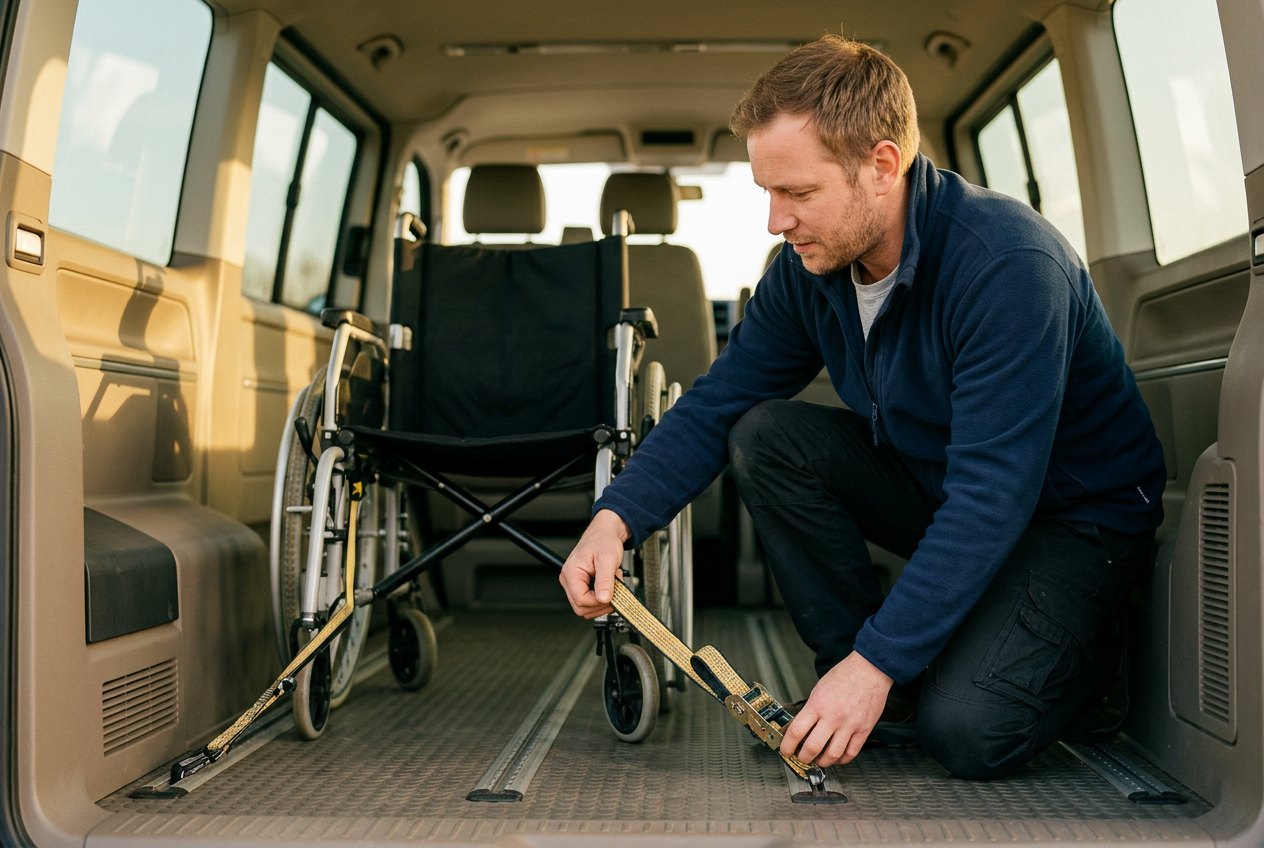
- Passenger assistance and wheelchair securement training. Minnesota sets hour minimums: at least 8 hours of passenger assistance training for wheelchair and transfer service. Our wheelchair securement guide covers the technique.
- Defensive driving. Minnesota requires four classroom hours for STS drivers, with refreshers every three years. Brokers may require one as well.
- HIPAA training. Arizona requires current HIPAA training certificates for drivers. Your drivers see protected health information on every manifest, so train them regardless. See HIPAA compliance in NEMT.
- A state-approved safety program in some states. Illinois requires drivers and attendants to complete a safety program approved by HFS before transporting participants, renewed every three years.
Drug and alcohol testing: when it is required
Federal testing rules apply in specific cases. FMCSA's Part 382 program covers drivers who need a CDL. FTA's Part 655 program covers recipients of certain federal transit grants and their contractors, which can include NEMT operators who contract with a transit agency. States can add their own: Florida's transportation disadvantaged rule requires drug and alcohol testing for drivers in that program. Brokers can require testing even where no rule does. Ask each contract what it requires.
Worth having
- PASS certification. The Community Transportation Association of America's Passenger Assistance Safety and Sensitivity program certifies drivers in passenger assistance and sensitivity for riders with disabilities. Certification lasts three years, and you can train drivers directly or send a staff member through CTAA's train-the-trainer course. Where a broker or plan asks for proof of passenger assistance training, a PASS certificate is one way to show it.
- Manufacturer securement training for the specific tie-down and lift systems in your vehicles.
Keep every certificate, with its expiration date, in the driver qualification file. State inspectors, Medicaid auditors and brokers all ask for it.
Revalidation, renewals and audits
Getting licensed is not the end of the paperwork. Federal rules require every state Medicaid agency to revalidate every provider's enrollment at least every five years, and states can revalidate sooner. Minnesota made existing high-risk providers, NEMT included, complete an off-cycle revalidation by May 31, 2026.
State credentials renew on their own cycles, and vehicle inspections recur. MnDOT inspects STS vehicles before service and at least annually, and can inspect unannounced. Broker contracts renew, and brokers audit driver files, trip logs and vehicle records. Rules also move under you: Ohio's updated transportation documentation and payment rules took effect August 1, 2026, and Minnesota will require NEMT to use electronic visit verification from January 1, 2027 or on federal approval, whichever is later.
Put every expiration date on one calendar: state certificate, insurance, each vehicle inspection, each driver's license, CPR, training refreshers and background check renewals. A lapsed item can stop your billing for a single vehicle or driver, or for the whole company.
Adding a second state
If you are expanding, most of the stack starts over. Your existing Medicaid enrollment, state authority and broker contracts do not transfer. Expect to:
- Register your entity to do business in the new state, or form a new one there.
- Get that state's transportation authority and vehicle inspections.
- Enroll with that state's Medicaid program. Some states skip a site visit or fee if another state's Medicaid program or Medicare already completed one, so keep your prior screening records handy.
- Credential separately with that state's brokers and plans.
- Recheck the federal layer. Once trips cross the state line, the interstate thresholds above apply.
Requirements change, sometimes mid-year, so confirm each one with the issuing agency before you file.
If you are already running, add your company to the NEMTrepreneur Directory. It is free, and it helps facilities, plans and riders find you. For state rule changes as they happen, subscribe to The NEMTrepreneur Dispatch.
Frequently asked questions
Is there a national NEMT certification?
No. There is no federal or national NEMT license or certification. Requirements come from your state, your Medicaid program and the brokers and plans you contract with. Driver programs like CTAA's PASS are training certifications, not licenses to operate.
What license do I need to start an NEMT business?
You need a registered business entity, any local business license, and state transportation authority if your state has one, such as Minnesota's STS certificate or Virginia's DMV NEMT carrier authority. To bill Medicaid you also need an NPI, state Medicaid enrollment and credentialing with the broker or plans in your area. Check the state table above for where your state stands.
Do NEMT companies need a USDOT number?
Only in specific cases. Federally, you need one for interstate commerce in a vehicle rated at (or weighing) 10,001 pounds or more or designed or used to carry more than 8 passengers, including the driver, for compensation. Many states also require a USDOT number from intrastate carriers, so check your state even if you never cross a state line.
How do I get NEMT certified as a driver?
Meet the requirements of your state and your broker: a valid license, a clean driving record, background checks, CPR and first aid, and passenger assistance and securement training. Some states set hour minimums or require a state-approved safety course. PASS certification from CTAA is one common way to document the passenger assistance piece.
How long does it take to get licensed and credentialed?
Plan on months. Minnesota's DHS says to allow 30 days for enrollment processing plus 60 days if a site visit is needed, and broker or plan credentialing runs on top of that. Our startup guide estimates 60 to 120 days from forming the company to the first billable Medicaid trip for most new operators.
Can I run private-pay NEMT without Medicaid enrollment?
Yes. Medicaid enrollment is what lets you bill Medicaid, not what lets you drive. You still need the business license, any state transportation authority, insurance and qualified drivers. Check that your authority covers private-pay riders: Virginia's DMV NEMT carrier authority, for example, covers only Medicaid trips. Many operators run private-pay and facility contracts while their Medicaid enrollment is pending.
Do I need a CDL to drive a wheelchair van?
Usually not. A commercial driver's license is required for vehicles designed to carry 16 or more passengers, including the driver, among other thresholds. Standard wheelchair vans and ramp minivans fall below that, though your state or broker may still set its own driver standards.