The operator's publication for non-emergency medical transportation. State licensing guides, broker intel, a 2,000+ provider directory and The Dispatch, our weekly newsletter.
Bad driver communication in NEMT usually comes from broken systems, not bad staff. If you want fewer missed pickups, fewer check-in calls, and cleaner billing records, put dispatch, driver updates, GPS, routing, rider alerts, and trip logs into one system.
Here’s the short version: NEMT software helps drivers and dispatch stay in sync at every trip stage. It does that by using fixed trip statuses, app alerts, live GPS, in-app messages, route updates, and automatic trip records. That means drivers see changes fast, dispatch sees trip progress in real time, and each update leaves a time-stamped record for EVV, audits, and billing.
What matters most:
- Fixed trip statuses like Scheduled → En Route → Arrived → Picked Up → Dropped Off → Completed
- Required driver acknowledgment for reassignments, edits, and cancellations
- In-app trip messaging instead of scattered calls and texts
- Live GPS and ETAs to spot delays and reroute drivers
- Automatic rider and facility alerts when pickup times change
- Trip logs with timestamps to support EVV and billing
A few numbers stand out:
- Route optimization can cut empty miles by 10% to 25%
- Some platforms report up to 25% more daily trips with the same fleet
| Area | What the software does | Why it helps |
|---|---|---|
| Dispatch updates | Sends trip changes to the driver app | Cuts missed messages |
| Driver status | Logs each trip step with timestamps | Keeps records clean |
| Routing | Updates ETAs and directions with GPS data | Helps avoid late pickups |
| Messaging | Keeps trip notes in one place | Cuts phone-tag |
| Rider alerts | Sends SMS or email updates | Cuts check-in calls |
| Billing/EVV | Stores trip history automatically | Helps with claims and audits |
If I had to sum it up in one line: better NEMT communication happens when every trip update moves through one shared workflow instead of calls, texts, and paper.
sbb-itb-cef70f4
Set up dispatch and driver apps for clear status updates
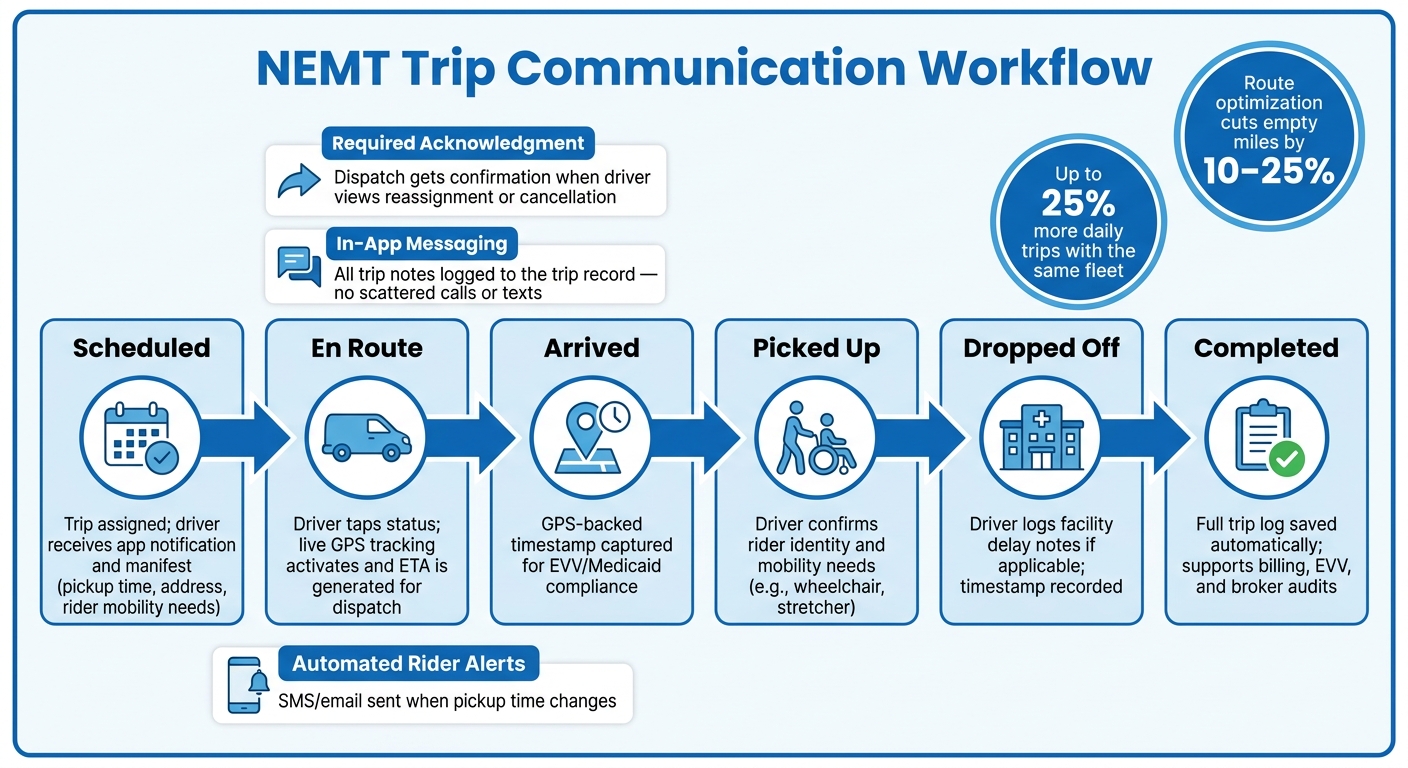
NEMT Trip Communication Workflow: From Dispatch to Completion
Standardized status updates give dispatch and drivers the same, accurate view of every trip in progress. When each trip stage follows a fixed sequence with required prompts, drivers see dispatch changes right away, and the current trip status stays correct throughout the shift.
Once those status updates are in place, routing and GPS can help deal with delays before they become missed pickups.
Build standard trip statuses and required driver prompts
The standard trip lifecycle should follow a fixed sequence: Scheduled → En Route → Arrived → Picked Up → Dropped Off → Completed. Require a prompt before the driver can move to the next status. Each stage should capture a GPS-backed timestamp to support Electronic Visit Verification (EVV) rules for Medicaid trips and keep service records accurate.
When the driver taps En Route, the system should turn on live tracking and generate an ETA. When the driver taps Arrived, it should capture the timestamp for EVV compliance. When the driver taps Picked Up, the driver should confirm the member's identity and mobility needs, such as wheelchair or stretcher transport. When the driver taps Dropped Off, a prompt can capture facility delay notes. That way, the trip record stays complete, and it becomes easier to document exceptions for broker audits.
Set up acknowledgment rules so dispatch gets a confirmation the moment a driver views a reassigned trip or a cancellation. Without that loop, a changed pickup can sit unseen while the driver keeps heading to the wrong location.
Replace scattered calls with in-app trip messaging
Phone-only workflows create a basic problem: there is no reliable trip-level record.
In-app messaging keeps each update attached to the trip record, so dispatchers and drivers see the same context. For urgent updates, push-to-talk lets a dispatcher send a short voice message right away without dialing or typing. It also keeps each update tied to the trip record and logged automatically.
Those trip-linked messages also feed live route changes and rider alerts.
Use routing and GPS to prevent delays before they grow
Routing tools keep dispatch and drivers on the same page. Everyone sees the same route, ETA, and location data.
Trips can enter the system through integrations or manual entry. From there, NEMT software builds each route based on driver location, vehicle type, rider mobility needs, appointment times, and live traffic. It then sends the manifest - pickup times, addresses, mileage, and special instructions - to the driver app.
But here’s the part that matters most: route data only helps if dispatch can change it instantly in the driver app. If updates lag, small issues can turn into missed pickups fast.
Send live routes, ETAs, and navigation to drivers
Turn-by-turn navigation in the driver app cuts confusion and helps keep everyone aligned. Dispatch can spot delays early and update the rider or facility right away. Automated ETAs also reduce check-in calls, since the GPS dashboard shows trip status at a glance.
Providers using advanced platforms have reported a 25% increase in daily trip capacity without adding vehicles. That’s a big shift, especially for teams trying to fit more rides into the same day without stretching staff too thin.
For rural routes or hospital basements where cell service can get spotty, offline GPS keeps route data available so navigation can continue without interruption. And when a route changes, that same live data supports trip edits and rider updates.
Handle traffic, facility delays, and route changes in real time
Routing delays often start the same way: traffic backs up, a facility runs late, or a driver goes off course without live traffic data. When that happens, dispatch can reroute the driver and update the ETA in one step.
Live routing cuts manual dispatch work by sending updated directions, ETAs, and reroutes straight to the driver app. Those same updates also power cancellations, reassignments, and rider notifications.
Manage trip changes and rider updates through one system
Once routing is live, trip changes often become the next weak spot. Same-day updates can throw communication off fast: pickup times shift, facilities run late, and drivers get moved around mid-shift.
NEMT software keeps those changes inside one workflow. Dispatch updates the trip, the driver gets an app alert, and the trip record updates on its own. No side texts. No phone-tag. No missing details.
Push cancellations, reassignments, and trip changes to the driver app
The biggest problem starts when updates happen outside the system. A text message or quick call may seem harmless, but it leaves no trip history behind.
That’s where required acknowledgment helps. When dispatch edits a trip, the driver has to acknowledge the alert before moving on. The system adds a timestamp to that acknowledgment, so dispatch can see that the update was received and confirmed.
Keep riders and facilities informed with automated notifications
The same trip change should also alert the rider and facility right away. Automated SMS or email notices handle that without giving dispatch extra admin work.
For example, a rider might receive: "Your pickup time has moved to 2:30 PM. Your driver will arrive by 2:40 PM."
That single message can cut down on check-in calls and give riders and facilities time to get ready. It also leaves a clean record if someone needs to review what happened later. Timestamps and GPS-backed updates add a clear audit trail for EVV and reviews.
Review the full communication workflow and fix bottlenecks
After dispatch, routing, and trip updates are live, the next move is to spot where communication still falls apart.
When that chain breaks, delays usually pile up in the same places. Check trip logs for late assignments, skipped status updates, and repeat facility waits. Those patterns usually tell you exactly what needs attention.
Map delay sources to the software features that solve them
Use the table below to match each delay to the feature that addresses it.
| Delay Source | Software Feature That Helps Most |
|---|---|
| Late assignments | Automated scheduling + instant push notifications |
| Missing status updates | Driver app prompts with required GPS timestamps |
| Traffic/route inefficiency | Live route optimization and live rerouting |
| Rider not ready | Automated SMS alerts with ETA updates |
| Facility delays | Integrated chat and real-time dashboards |
| Missing EVV timestamps | EVV integration with digital sign-off and timestamp logging |
Route optimization can cut empty miles by 10% to 25%, and better scheduling can help providers complete up to 25% more trips with the same fleet size. That kind of improvement usually comes from fixing the gaps in the table above, not from ripping out your whole process and starting over.
Conclusion: Faster updates, fewer missed trips, better service records
Fixing these weak points tightens the communication loop from dispatch to billing. When routing, messaging, status updates, and rider notifications all run through one system, fewer updates slip through the cracks. Drivers spend less time waiting for instructions. Dispatch spends less time chasing confirmations. Riders get accurate information without extra phone calls.
Cleaner communication also leads to cleaner records. Automated timestamps, required driver acknowledgments, and EVV-ready logs create an audit trail that supports broker audits and makes billing easier. Centralized communication means faster updates, fewer missed trips, and cleaner records.
FAQs
How does NEMT software reduce missed pickups?
NEMT software cuts missed pickups by replacing manual, disconnected work with one centralized, automated platform. Dispatchers can see drivers in real time and make fast changes for traffic or delays before a pickup slips through the cracks.
Drivers get clear trip assignments and updates through mobile apps. At the same time, automated rider notifications send accurate ETAs, so passengers are ready when their ride arrives.
What driver updates should be required in the app?
To keep operations in sync and cut down on delays, drivers should send key status updates in the app at each stage of the workflow:
- available at shift start
- vehicle ready after inspection
- arrived at pickup
- departed
- trip completed
Paired with live GPS tracking and automated notifications, these updates give dispatch an immediate view of what’s happening and help them stay ahead of schedule changes.
How do GPS and ETAs improve rider communication?
GPS tracking and real-time ETAs make rider communication a lot smoother. Instead of relying on manual status checks, teams can send automated updates that keep riders in the loop.
With live location data, NEMT software can estimate arrival times with more accuracy and send those ETAs by text, email, or app alerts. That means riders don’t have to wonder when their driver will show up.
If traffic or other delays hit, the ETA updates right away. Dispatchers can then adjust schedules and let patients know early, instead of scrambling at the last minute.
The result is simple: fewer “where’s my ride?” calls and a better rider experience.